

illustrated in Figure 19.6 (d). The optimizer boxes of all the modules are connected in
series to each other and to the central inverter. The inverter can accept input voltages
within a certain range – if the voltage is outside this range, the current is altered such that
the voltage falls within the acceptable range again. As a consequence, the output voltage
of the optimizers is determined by the input power from the PV module and the current
that is enforced by the inverter.
The main advantage of this architecture is that every module can operate at its MPP.
This is not only important for the shading of single modules, but also because of the fact
that no two modules are the same. Another advantage of this architecture is that all the
optimizers can operate at voltages close to the voltage of the PV module. Therefore, the
DC-DC conversion is very efficient. Further, the optimizers consume very little power, so
there are no problems with heating up, in contrast to what we have seen with micro
inverters.
Team concept
Aside from the four system architectures already described, many other concepts are also
discussed in the literature. However, these concepts are less widely utilized than the ones
already presented. One of the alternative concepts is the so-called team concept, which
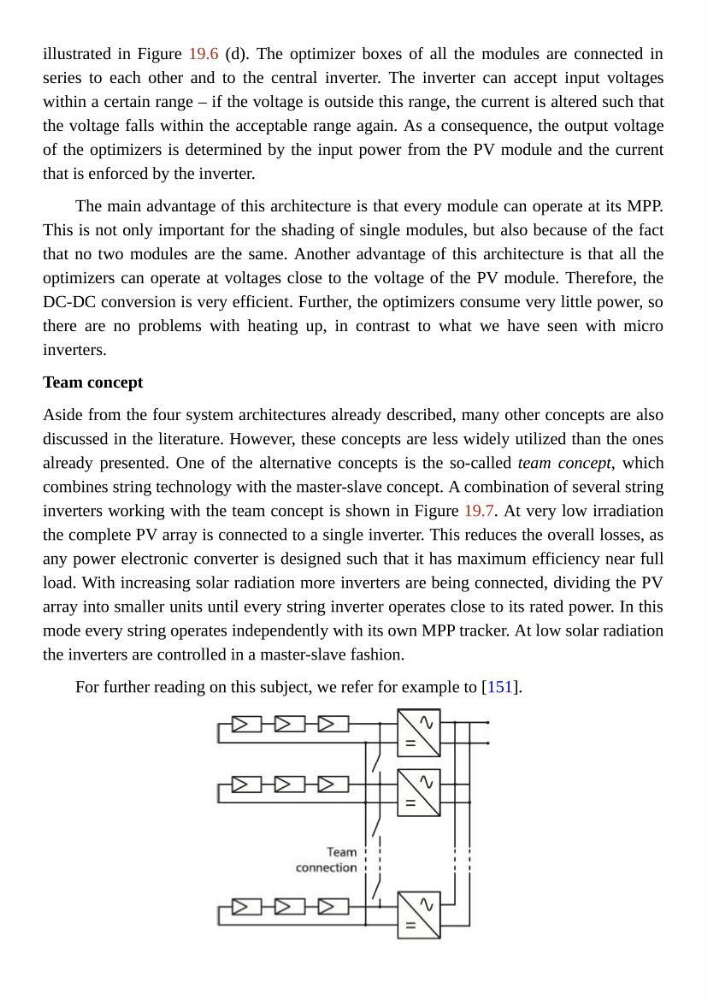
combines string technology with the master-slave concept. A combination of several string
inverters working with the team concept is shown in Figure 19.7. At very low irradiation
the complete PV array is connected to a single inverter. This reduces the overall losses, as
any power electronic converter is designed such that it has maximum efficiency near full
load. With increasing solar radiation more inverters are being connected, dividing the PV
array into smaller units until every string inverter operates close to its rated power. In this
mode every string operates independently with its own MPP tracker. At low solar radiation
the inverters are controlled in a master-slave fashion.
For further reading on this subject, we refer for example to [151].
series to each other and to the central inverter. The inverter can accept input voltages
within a certain range – if the voltage is outside this range, the current is altered such that
the voltage falls within the acceptable range again. As a consequence, the output voltage
of the optimizers is determined by the input power from the PV module and the current
that is enforced by the inverter.
The main advantage of this architecture is that every module can operate at its MPP.
This is not only important for the shading of single modules, but also because of the fact
that no two modules are the same. Another advantage of this architecture is that all the
optimizers can operate at voltages close to the voltage of the PV module. Therefore, the
DC-DC conversion is very efficient. Further, the optimizers consume very little power, so
there are no problems with heating up, in contrast to what we have seen with micro
inverters.
Team concept
Aside from the four system architectures already described, many other concepts are also
discussed in the literature. However, these concepts are less widely utilized than the ones
already presented. One of the alternative concepts is the so-called team concept, which
combines string technology with the master-slave concept. A combination of several string
inverters working with the team concept is shown in Figure 19.7. At very low irradiation
the complete PV array is connected to a single inverter. This reduces the overall losses, as
any power electronic converter is designed such that it has maximum efficiency near full
load. With increasing solar radiation more inverters are being connected, dividing the PV
array into smaller units until every string inverter operates close to its rated power. In this
mode every string operates independently with its own MPP tracker. At low solar radiation
the inverters are controlled in a master-slave fashion.
For further reading on this subject, we refer for example to [151].