

•
•
•
•
•
the maximally allowed field strength emitted from the inverter is regulated in
many countries.
In many instances the solar system is to be installed outdoors and inverters
should adhere to certain specifications regarding temperature and humidity
conditions, e.g. IP 54.
Design for high ambient temperatures.
Design for 10-25 years operation under harsh environmental conditions.
Silent operation (no audible noise).
Often, the possibility to monitor the PV system is required by the user.
We have to distinguish between single-phase and three-phase inverters. For low
powers, as they are common in small residential PV systems, single-phase inverters are
used. They are connected to one phase of the grid. For higher powers, three-phase
inverters are used that are connected to all phases of the grid. If a high power were to be
delivered to one phase, the currents flowing across the three phases would become very
asymmetric leading to multiple problems in the electricity grid.
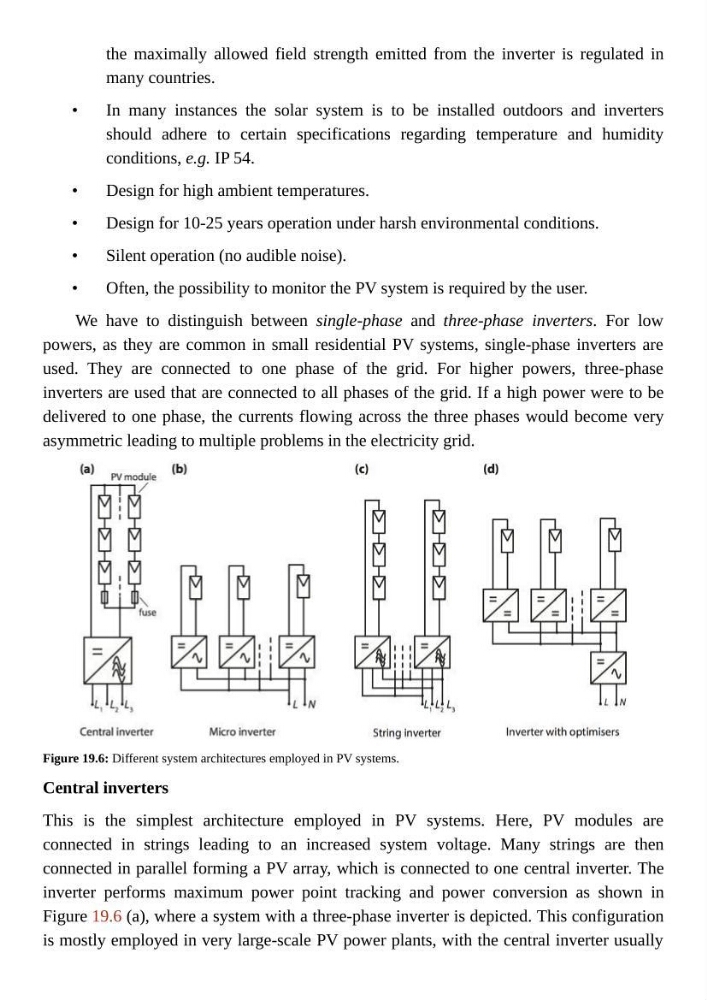
Figure 19.6: Different system architectures employed in PV systems.
Central inverters
This is the simplest architecture employed in PV systems. Here, PV modules are
connected in strings leading to an increased system voltage. Many strings are then
connected in parallel forming a PV array, which is connected to one central inverter. The
inverter performs maximum power point tracking and power conversion as shown in
Figure 19.6 (a), where a system with a three-phase inverter is depicted. This configuration
is mostly employed in very large-scale PV power plants, with the central inverter usually
•
•
•
•
the maximally allowed field strength emitted from the inverter is regulated in
many countries.
In many instances the solar system is to be installed outdoors and inverters
should adhere to certain specifications regarding temperature and humidity
conditions, e.g. IP 54.
Design for high ambient temperatures.
Design for 10-25 years operation under harsh environmental conditions.
Silent operation (no audible noise).
Often, the possibility to monitor the PV system is required by the user.
We have to distinguish between single-phase and three-phase inverters. For low
powers, as they are common in small residential PV systems, single-phase inverters are
used. They are connected to one phase of the grid. For higher powers, three-phase
inverters are used that are connected to all phases of the grid. If a high power were to be
delivered to one phase, the currents flowing across the three phases would become very
asymmetric leading to multiple problems in the electricity grid.
Figure 19.6: Different system architectures employed in PV systems.
Central inverters
This is the simplest architecture employed in PV systems. Here, PV modules are
connected in strings leading to an increased system voltage. Many strings are then
connected in parallel forming a PV array, which is connected to one central inverter. The
inverter performs maximum power point tracking and power conversion as shown in
Figure 19.6 (a), where a system with a three-phase inverter is depicted. This configuration
is mostly employed in very large-scale PV power plants, with the central inverter usually