

19.1.2
However, there are also certain drawbacks.
First, using a constant factor k only allows a rough estimate of the position of the
MPP. Therefore, the operating point will not usually be exactly on the MPP but in its
proximity. Secondly, every time the system needs to respond to a change in illumination
conditions, the V OC must be measured. For this measurement, the PV module needs to be
disconnected from the load for a short while, which will lead to a reduced total output of
the PV system.
The more often the V OC is determined, the larger the loss in output will be. This drawback
can be overcome by slightly modifying the method. For this modification a pilot PV cell is
required, which is highly matched with the rest of the cells in the module. The pilot cell
receives the same irradiance as the rest of the PV module, and a measurement of the pilot
PV cell’s V OC also gives an accurate representation of that of the PV module, hence it can
be used for estimating V MPP . Therefore, the operating point of the module can be adjusted
without needing to disconnect the PV module.
Direct MPPT
Now we discuss direct MPPT, which is more involved than indirect MPPT, because
current, voltage or power measurements are required. Further, the system must respond
more accurately and faster than in indirect MPPT. We shall look at a couple of the most
popular kinds of algorithms.
Perturb and observe (P&O) algorithm
The first algorithm that we discuss is the perturb and observe (P&O) algorithm, which is
also known as the ‘hill climbing’ algorithm. In this algorithm, a perturbation is provided to
the voltage at which the module is currently driven. This perturbation in voltage will lead
to a change in the power output. If an increasing voltage leads to an increasing power, the
operating point is at a lower voltage than the MPP, and hence further voltage perturbation
towards higher voltages is required to reach the MPP. In contrast, if an increasing voltage
leads to a decreasing power, further perturbation towards lower voltages is required in
order to reach the MPP. Hence, the algorithm will converge towards the MPP over several
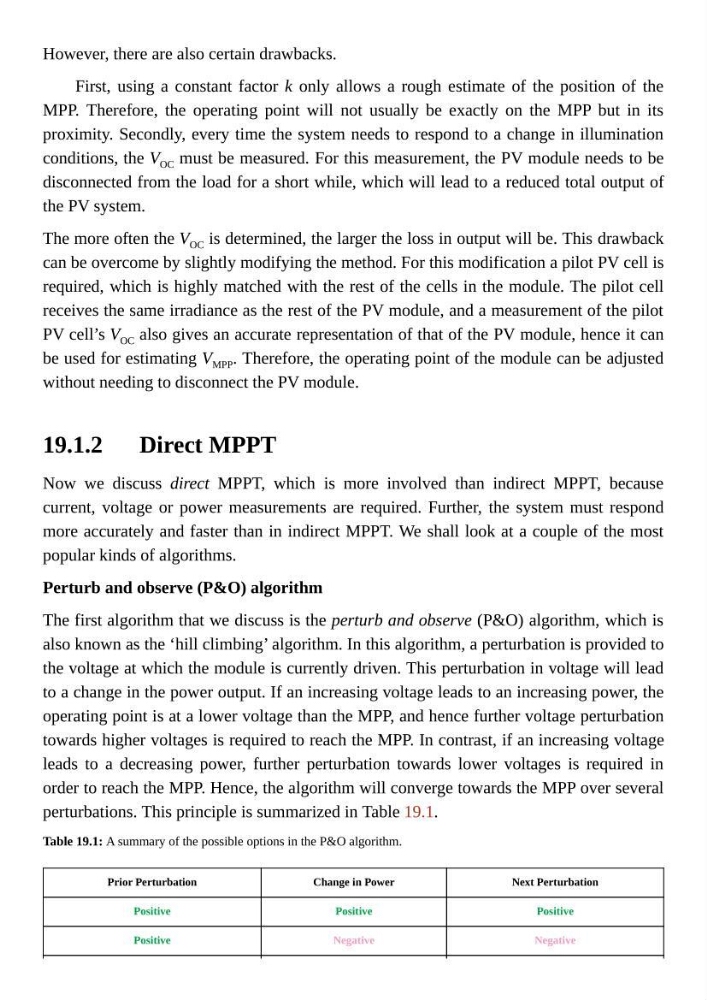
perturbations. This principle is summarized in Table 19.1.
Table 19.1: A summary of the possible options in the P&O algorithm.
Prior Perturbation
Change in Power
Next Perturbation
Positive
Positive
Positive
Positive
Negative
Negative
However, there are also certain drawbacks.
First, using a constant factor k only allows a rough estimate of the position of the
MPP. Therefore, the operating point will not usually be exactly on the MPP but in its
proximity. Secondly, every time the system needs to respond to a change in illumination
conditions, the V OC must be measured. For this measurement, the PV module needs to be
disconnected from the load for a short while, which will lead to a reduced total output of
the PV system.
The more often the V OC is determined, the larger the loss in output will be. This drawback
can be overcome by slightly modifying the method. For this modification a pilot PV cell is
required, which is highly matched with the rest of the cells in the module. The pilot cell
receives the same irradiance as the rest of the PV module, and a measurement of the pilot
PV cell’s V OC also gives an accurate representation of that of the PV module, hence it can
be used for estimating V MPP . Therefore, the operating point of the module can be adjusted
without needing to disconnect the PV module.
Direct MPPT
Now we discuss direct MPPT, which is more involved than indirect MPPT, because
current, voltage or power measurements are required. Further, the system must respond
more accurately and faster than in indirect MPPT. We shall look at a couple of the most
popular kinds of algorithms.
Perturb and observe (P&O) algorithm
The first algorithm that we discuss is the perturb and observe (P&O) algorithm, which is
also known as the ‘hill climbing’ algorithm. In this algorithm, a perturbation is provided to
the voltage at which the module is currently driven. This perturbation in voltage will lead
to a change in the power output. If an increasing voltage leads to an increasing power, the
operating point is at a lower voltage than the MPP, and hence further voltage perturbation
towards higher voltages is required to reach the MPP. In contrast, if an increasing voltage
leads to a decreasing power, further perturbation towards lower voltages is required in
order to reach the MPP. Hence, the algorithm will converge towards the MPP over several
perturbations. This principle is summarized in Table 19.1.
Table 19.1: A summary of the possible options in the P&O algorithm.
Prior Perturbation
Change in Power
Next Perturbation
Positive
Positive
Positive
Positive
Negative
Negative