

15.8.2
hence it is the radiant flux (or power) per unit solid angle and per unit projected area. Note
that L e is a directional quantity: for a surface illuminated by the Sun, it has very high
values for the solid angle range from which the Sun illuminates this surface, but very low
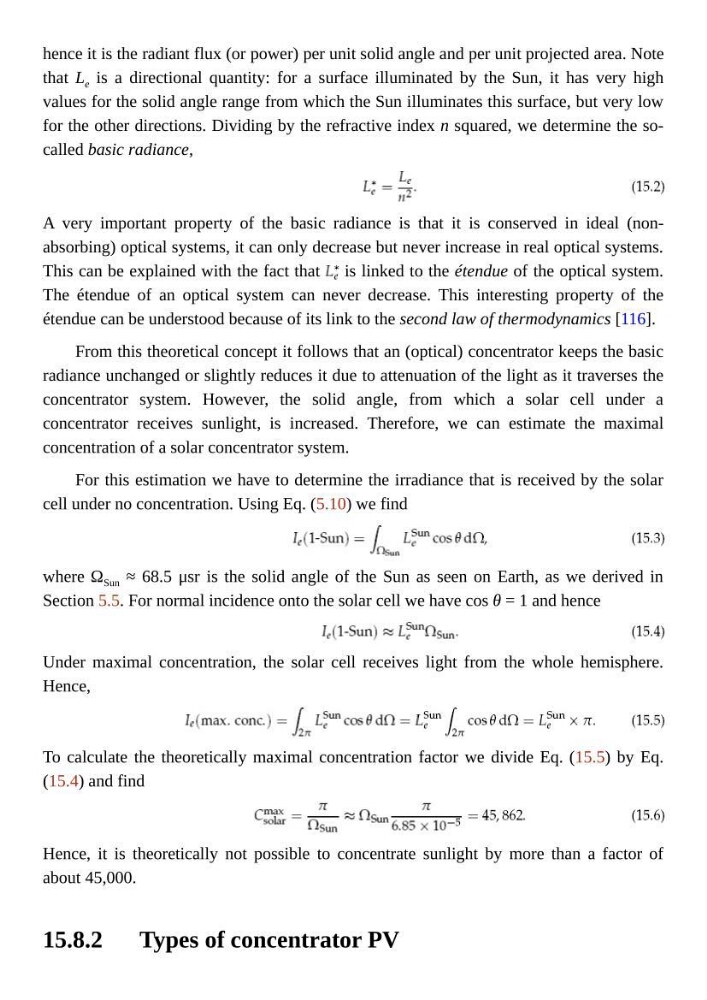
for the other directions. Dividing by the refractive index n squared, we determine the socalled basic radiance,
A very important property of the basic radiance is that it is conserved in ideal (nonabsorbing) optical systems, it can only decrease but never increase in real optical systems.
This can be explained with the fact that is linked to the étendue of the optical system.
The étendue of an optical system can never decrease. This interesting property of the
étendue can be understood because of its link to the second law of thermodynamics [116].
From this theoretical concept it follows that an (optical) concentrator keeps the basic
radiance unchanged or slightly reduces it due to attenuation of the light as it traverses the
concentrator system. However, the solid angle, from which a solar cell under a
concentrator receives sunlight, is increased. Therefore, we can estimate the maximal
concentration of a solar concentrator system.
For this estimation we have to determine the irradiance that is received by the solar
cell under no concentration. Using Eq. (5.10) we find
where Ω Sun ≈ 68.5 μsr is the solid angle of the Sun as seen on Earth, as we derived in
Section 5.5. For normal incidence onto the solar cell we have cos θ = 1 and hence
Under maximal concentration, the solar cell receives light from the whole hemisphere.
Hence,
To calculate the theoretically maximal concentration factor we divide Eq. (15.5) by Eq.
(15.4) and find
Hence, it is theoretically not possible to concentrate sunlight by more than a factor of
about 45,000.
Types of concentrator PV
hence it is the radiant flux (or power) per unit solid angle and per unit projected area. Note
that L e is a directional quantity: for a surface illuminated by the Sun, it has very high
values for the solid angle range from which the Sun illuminates this surface, but very low
for the other directions. Dividing by the refractive index n squared, we determine the socalled basic radiance,
A very important property of the basic radiance is that it is conserved in ideal (nonabsorbing) optical systems, it can only decrease but never increase in real optical systems.
This can be explained with the fact that is linked to the étendue of the optical system.
The étendue of an optical system can never decrease. This interesting property of the
étendue can be understood because of its link to the second law of thermodynamics [116].
From this theoretical concept it follows that an (optical) concentrator keeps the basic
radiance unchanged or slightly reduces it due to attenuation of the light as it traverses the
concentrator system. However, the solid angle, from which a solar cell under a
concentrator receives sunlight, is increased. Therefore, we can estimate the maximal
concentration of a solar concentrator system.
For this estimation we have to determine the irradiance that is received by the solar
cell under no concentration. Using Eq. (5.10) we find
where Ω Sun ≈ 68.5 μsr is the solid angle of the Sun as seen on Earth, as we derived in
Section 5.5. For normal incidence onto the solar cell we have cos θ = 1 and hence
Under maximal concentration, the solar cell receives light from the whole hemisphere.
Hence,
To calculate the theoretically maximal concentration factor we divide Eq. (15.5) by Eq.
(15.4) and find
Hence, it is theoretically not possible to concentrate sunlight by more than a factor of
about 45,000.
Types of concentrator PV