

15.7
15.8
15.8.1
Some examples
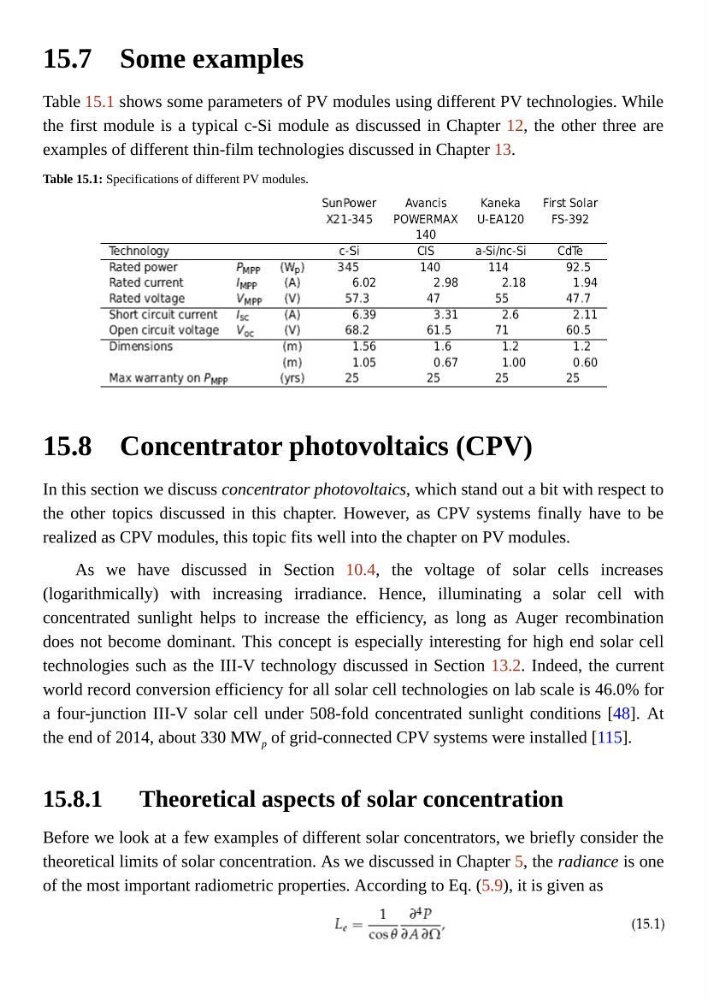
Table 15.1 shows some parameters of PV modules using different PV technologies. While
the first module is a typical c-Si module as discussed in Chapter 12, the other three are
examples of different thin-film technologies discussed in Chapter 13.
Table 15.1: Specifications of different PV modules.
Concentrator photovoltaics (CPV)
In this section we discuss concentrator photovoltaics, which stand out a bit with respect to
the other topics discussed in this chapter. However, as CPV systems finally have to be
realized as CPV modules, this topic fits well into the chapter on PV modules.
As we have discussed in Section 10.4, the voltage of solar cells increases
(logarithmically) with increasing irradiance. Hence, illuminating a solar cell with
concentrated sunlight helps to increase the efficiency, as long as Auger recombination
does not become dominant. This concept is especially interesting for high end solar cell
technologies such as the III-V technology discussed in Section 13.2. Indeed, the current
world record conversion efficiency for all solar cell technologies on lab scale is 46.0% for
a four-junction III-V solar cell under 508-fold concentrated sunlight conditions [48]. At
the end of 2014, about 330 MW p of grid-connected CPV systems were installed [115].
Theoretical aspects of solar concentration
Before we look at a few examples of different solar concentrators, we briefly consider the
theoretical limits of solar concentration. As we discussed in Chapter 5, the radiance is one
of the most important radiometric properties. According to Eq. (5.9), it is given as
15.8
15.8.1
Some examples
Table 15.1 shows some parameters of PV modules using different PV technologies. While
the first module is a typical c-Si module as discussed in Chapter 12, the other three are
examples of different thin-film technologies discussed in Chapter 13.
Table 15.1: Specifications of different PV modules.
Concentrator photovoltaics (CPV)
In this section we discuss concentrator photovoltaics, which stand out a bit with respect to
the other topics discussed in this chapter. However, as CPV systems finally have to be
realized as CPV modules, this topic fits well into the chapter on PV modules.
As we have discussed in Section 10.4, the voltage of solar cells increases
(logarithmically) with increasing irradiance. Hence, illuminating a solar cell with
concentrated sunlight helps to increase the efficiency, as long as Auger recombination
does not become dominant. This concept is especially interesting for high end solar cell
technologies such as the III-V technology discussed in Section 13.2. Indeed, the current
world record conversion efficiency for all solar cell technologies on lab scale is 46.0% for
a four-junction III-V solar cell under 508-fold concentrated sunlight conditions [48]. At
the end of 2014, about 330 MW p of grid-connected CPV systems were installed [115].
Theoretical aspects of solar concentration
Before we look at a few examples of different solar concentrators, we briefly consider the
theoretical limits of solar concentration. As we discussed in Chapter 5, the radiance is one
of the most important radiometric properties. According to Eq. (5.9), it is given as