

15.4
•
•
•
but groups of cells share one diode. For example, a module of 60 cells, connected in series
forming one string, can contain three bypass diodes, where each diode is shared by a
group of 20 cells.
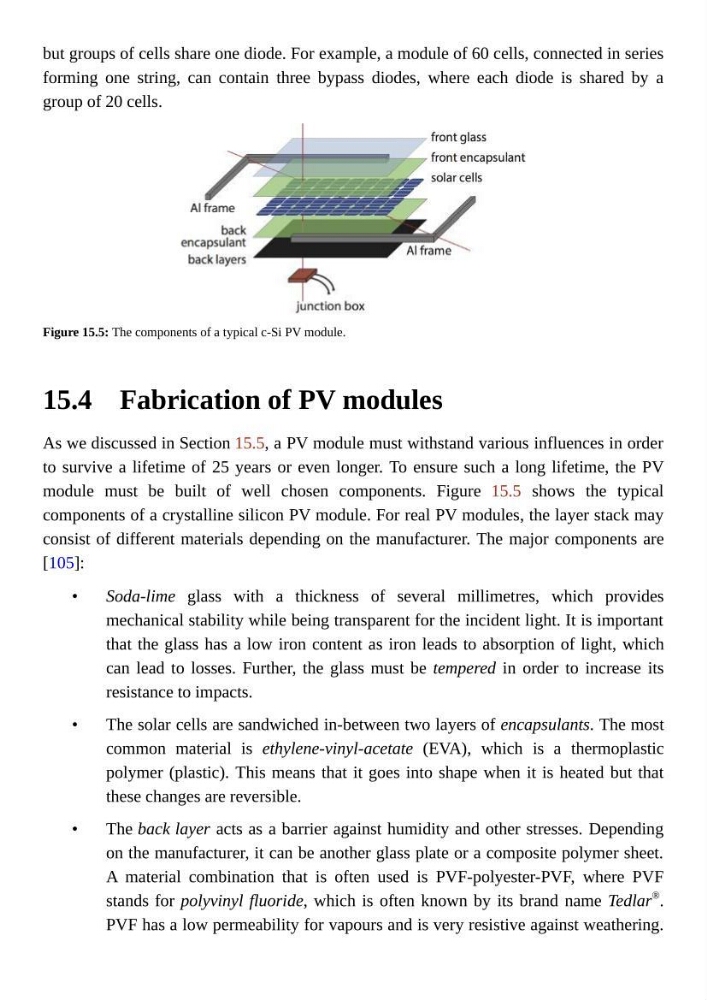
Figure 15.5: The components of a typical c-Si PV module.
Fabrication of PV modules
As we discussed in Section 15.5, a PV module must withstand various influences in order
to survive a lifetime of 25 years or even longer. To ensure such a long lifetime, the PV
module must be built of well chosen components. Figure 15.5 shows the typical
components of a crystalline silicon PV module. For real PV modules, the layer stack may
consist of different materials depending on the manufacturer. The major components are
[105]:
Soda-lime glass with a thickness of several millimetres, which provides
mechanical stability while being transparent for the incident light. It is important
that the glass has a low iron content as iron leads to absorption of light, which
can lead to losses. Further, the glass must be tempered in order to increase its
resistance to impacts.
The solar cells are sandwiched in-between two layers of encapsulants. The most
common material is ethylene-vinyl-acetate (EVA), which is a thermoplastic
polymer (plastic). This means that it goes into shape when it is heated but that
these changes are reversible.
The back layer acts as a barrier against humidity and other stresses. Depending
on the manufacturer, it can be another glass plate or a composite polymer sheet.
A material combination that is often used is PVF-polyester-PVF, where PVF
stands for polyvinyl fluoride, which is often known by its brand name Tedlar
®
.
PVF has a low permeability for vapours and is very resistive against weathering.
•
•
•
but groups of cells share one diode. For example, a module of 60 cells, connected in series
forming one string, can contain three bypass diodes, where each diode is shared by a
group of 20 cells.
Figure 15.5: The components of a typical c-Si PV module.
Fabrication of PV modules
As we discussed in Section 15.5, a PV module must withstand various influences in order
to survive a lifetime of 25 years or even longer. To ensure such a long lifetime, the PV
module must be built of well chosen components. Figure 15.5 shows the typical
components of a crystalline silicon PV module. For real PV modules, the layer stack may
consist of different materials depending on the manufacturer. The major components are
[105]:
Soda-lime glass with a thickness of several millimetres, which provides
mechanical stability while being transparent for the incident light. It is important
that the glass has a low iron content as iron leads to absorption of light, which
can lead to losses. Further, the glass must be tempered in order to increase its
resistance to impacts.
The solar cells are sandwiched in-between two layers of encapsulants. The most
common material is ethylene-vinyl-acetate (EVA), which is a thermoplastic
polymer (plastic). This means that it goes into shape when it is heated but that
these changes are reversible.
The back layer acts as a barrier against humidity and other stresses. Depending
on the manufacturer, it can be another glass plate or a composite polymer sheet.
A material combination that is often used is PVF-polyester-PVF, where PVF
stands for polyvinyl fluoride, which is often known by its brand name Tedlar
®
.
PVF has a low permeability for vapours and is very resistive against weathering.