

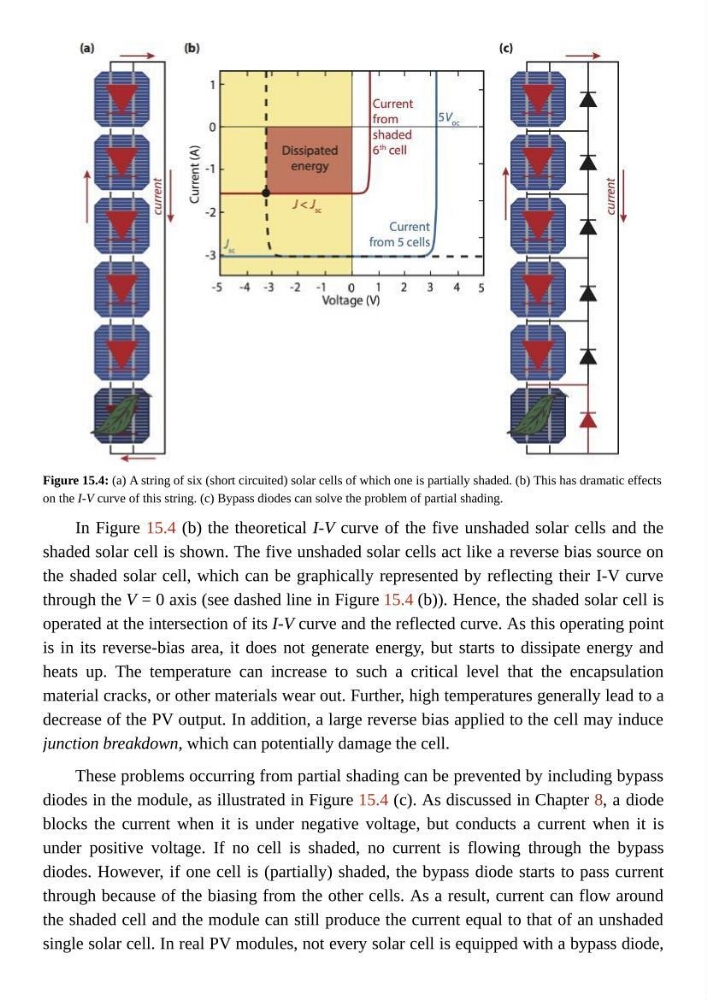
Figure 15.4: (a) A string of six (short circuited) solar cells of which one is partially shaded. (b) This has dramatic effects
on the I-V curve of this string. (c) Bypass diodes can solve the problem of partial shading.
In Figure 15.4 (b) the theoretical I-V curve of the five unshaded solar cells and the
shaded solar cell is shown. The five unshaded solar cells act like a reverse bias source on
the shaded solar cell, which can be graphically represented by reflecting their I-V curve
through the V = 0 axis (see dashed line in Figure 15.4 (b)). Hence, the shaded solar cell is
operated at the intersection of its I-V curve and the reflected curve. As this operating point
is in its reverse-bias area, it does not generate energy, but starts to dissipate energy and
heats up. The temperature can increase to such a critical level that the encapsulation
material cracks, or other materials wear out. Further, high temperatures generally lead to a
decrease of the PV output. In addition, a large reverse bias applied to the cell may induce
junction breakdown, which can potentially damage the cell.
These problems occurring from partial shading can be prevented by including bypass
diodes in the module, as illustrated in Figure 15.4 (c). As discussed in Chapter 8, a diode
blocks the current when it is under negative voltage, but conducts a current when it is
under positive voltage. If no cell is shaded, no current is flowing through the bypass
diodes. However, if one cell is (partially) shaded, the bypass diode starts to pass current
through because of the biasing from the other cells. As a result, current can flow around
the shaded cell and the module can still produce the current equal to that of an unshaded
single solar cell. In real PV modules, not every solar cell is equipped with a bypass diode,
on the I-V curve of this string. (c) Bypass diodes can solve the problem of partial shading.
In Figure 15.4 (b) the theoretical I-V curve of the five unshaded solar cells and the
shaded solar cell is shown. The five unshaded solar cells act like a reverse bias source on
the shaded solar cell, which can be graphically represented by reflecting their I-V curve
through the V = 0 axis (see dashed line in Figure 15.4 (b)). Hence, the shaded solar cell is
operated at the intersection of its I-V curve and the reflected curve. As this operating point
is in its reverse-bias area, it does not generate energy, but starts to dissipate energy and
heats up. The temperature can increase to such a critical level that the encapsulation
material cracks, or other materials wear out. Further, high temperatures generally lead to a
decrease of the PV output. In addition, a large reverse bias applied to the cell may induce
junction breakdown, which can potentially damage the cell.
These problems occurring from partial shading can be prevented by including bypass
diodes in the module, as illustrated in Figure 15.4 (c). As discussed in Chapter 8, a diode
blocks the current when it is under negative voltage, but conducts a current when it is
under positive voltage. If no cell is shaded, no current is flowing through the bypass
diodes. However, if one cell is (partially) shaded, the bypass diode starts to pass current
through because of the biasing from the other cells. As a result, current can flow around
the shaded cell and the module can still produce the current equal to that of an unshaded
single solar cell. In real PV modules, not every solar cell is equipped with a bypass diode,