

14.4.2
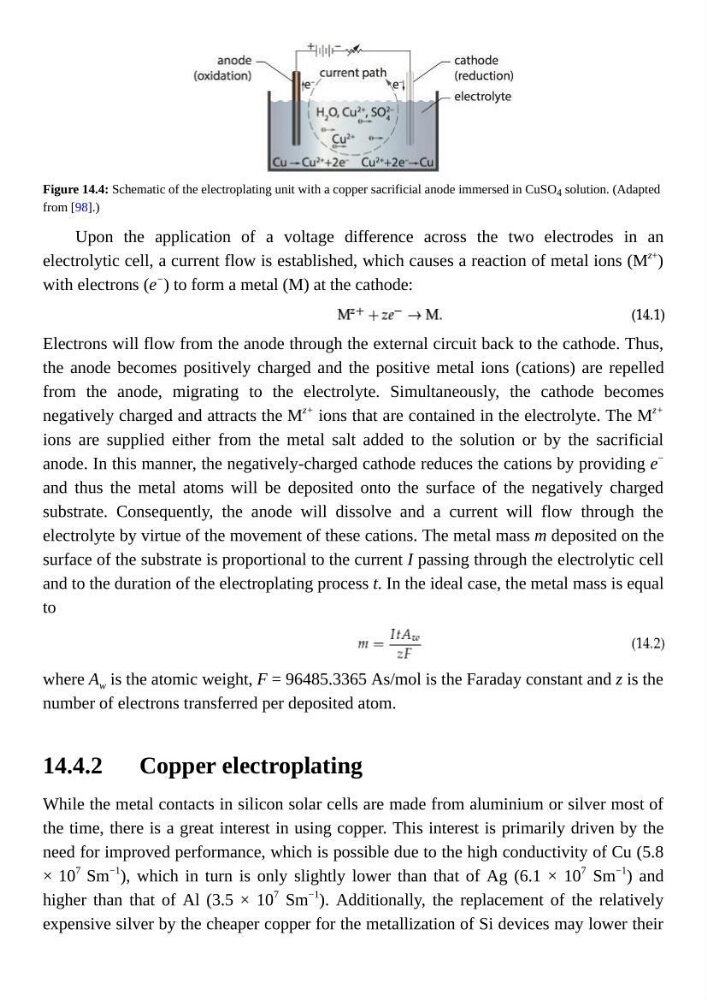
Figure 14.4: Schematic of the electroplating unit with a copper sacrificial anode immersed in CuSO 4 solution. (Adapted
from [98].)
Upon the application of a voltage difference across the two electrodes in an
electrolytic cell, a current flow is established, which causes a reaction of metal ions (M
z+
)
with electrons (e
−
) to form a metal (M) at the cathode:
Electrons will flow from the anode through the external circuit back to the cathode. Thus,
the anode becomes positively charged and the positive metal ions (cations) are repelled
from the anode, migrating to the electrolyte. Simultaneously, the cathode becomes
negatively charged and attracts the M
z+
ions that are contained in the electrolyte. The M
z+
ions are supplied either from the metal salt added to the solution or by the sacrificial
anode. In this manner, the negatively-charged cathode reduces the cations by providing e
−
and thus the metal atoms will be deposited onto the surface of the negatively charged
substrate. Consequently, the anode will dissolve and a current will flow through the
electrolyte by virtue of the movement of these cations. The metal mass m deposited on the
surface of the substrate is proportional to the current I passing through the electrolytic cell
and to the duration of the electroplating process t. In the ideal case, the metal mass is equal
to
where A w is the atomic weight, F = 96485.3365 As/mol is the Faraday constant and z is the
number of electrons transferred per deposited atom.
Copper electroplating
While the metal contacts in silicon solar cells are made from aluminium or silver most of
the time, there is a great interest in using copper. This interest is primarily driven by the
need for improved performance, which is possible due to the high conductivity of Cu (5.8
× 10
7
Sm
−1 ), which in turn is only slightly lower than that of Ag (6.1 × 10
7
Sm
−1 ) and
higher than that of Al (3.5 × 10
7
Sm
−1
). Additionally, the replacement of the relatively
expensive silver by the cheaper copper for the metallization of Si devices may lower their
Figure 14.4: Schematic of the electroplating unit with a copper sacrificial anode immersed in CuSO 4 solution. (Adapted
from [98].)
Upon the application of a voltage difference across the two electrodes in an
electrolytic cell, a current flow is established, which causes a reaction of metal ions (M
z+
)
with electrons (e
−
) to form a metal (M) at the cathode:
Electrons will flow from the anode through the external circuit back to the cathode. Thus,
the anode becomes positively charged and the positive metal ions (cations) are repelled
from the anode, migrating to the electrolyte. Simultaneously, the cathode becomes
negatively charged and attracts the M
z+
ions that are contained in the electrolyte. The M
z+
ions are supplied either from the metal salt added to the solution or by the sacrificial
anode. In this manner, the negatively-charged cathode reduces the cations by providing e
−
and thus the metal atoms will be deposited onto the surface of the negatively charged
substrate. Consequently, the anode will dissolve and a current will flow through the
electrolyte by virtue of the movement of these cations. The metal mass m deposited on the
surface of the substrate is proportional to the current I passing through the electrolytic cell
and to the duration of the electroplating process t. In the ideal case, the metal mass is equal
to
where A w is the atomic weight, F = 96485.3365 As/mol is the Faraday constant and z is the
number of electrons transferred per deposited atom.
Copper electroplating
While the metal contacts in silicon solar cells are made from aluminium or silver most of
the time, there is a great interest in using copper. This interest is primarily driven by the
need for improved performance, which is possible due to the high conductivity of Cu (5.8
× 10
7
Sm
−1 ), which in turn is only slightly lower than that of Ag (6.1 × 10
7
Sm
−1 ) and
higher than that of Al (3.5 × 10
7
Sm
−1
). Additionally, the replacement of the relatively
expensive silver by the cheaper copper for the metallization of Si devices may lower their