

14.2
14.2.1
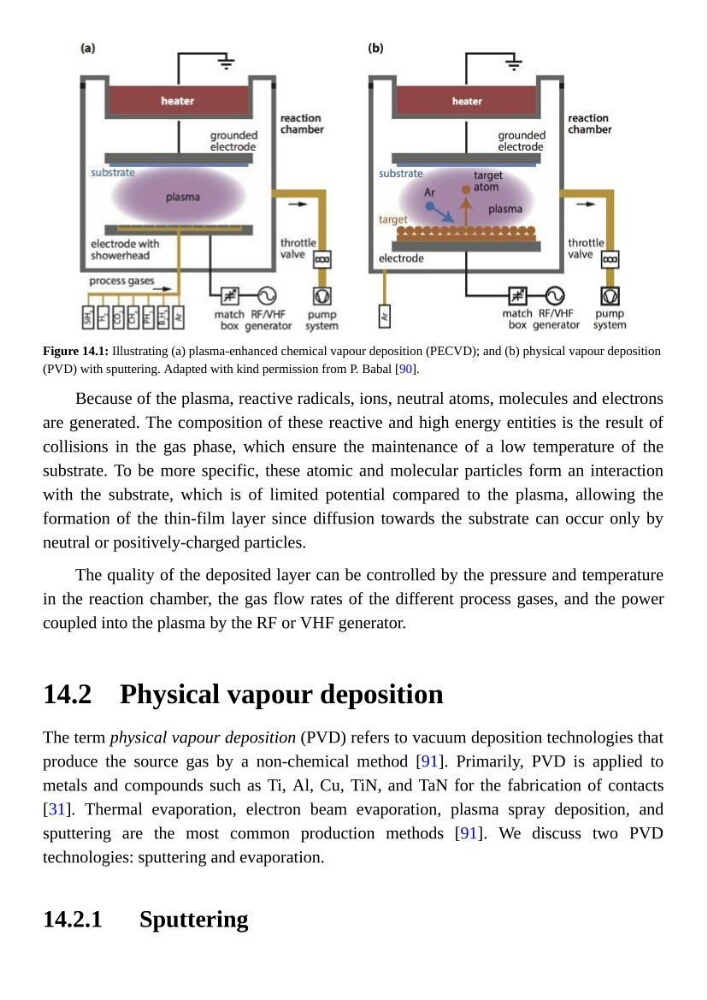
Figure 14.1: Illustrating (a) plasma-enhanced chemical vapour deposition (PECVD); and (b) physical vapour deposition
(PVD) with sputtering. Adapted with kind permission from P. Babal [90].
Because of the plasma, reactive radicals, ions, neutral atoms, molecules and electrons
are generated. The composition of these reactive and high energy entities is the result of
collisions in the gas phase, which ensure the maintenance of a low temperature of the
substrate. To be more specific, these atomic and molecular particles form an interaction
with the substrate, which is of limited potential compared to the plasma, allowing the
formation of the thin-film layer since diffusion towards the substrate can occur only by
neutral or positively-charged particles.
The quality of the deposited layer can be controlled by the pressure and temperature
in the reaction chamber, the gas flow rates of the different process gases, and the power
coupled into the plasma by the RF or VHF generator.
Physical vapour deposition
The term physical vapour deposition (PVD) refers to vacuum deposition technologies that
produce the source gas by a non-chemical method [91]. Primarily, PVD is applied to
metals and compounds such as Ti, Al, Cu, TiN, and TaN for the fabrication of contacts
[31]. Thermal evaporation, electron beam evaporation, plasma spray deposition, and
sputtering are the most common production methods [91]. We discuss two PVD
technologies: sputtering and evaporation.
Sputtering
14.2.1
Figure 14.1: Illustrating (a) plasma-enhanced chemical vapour deposition (PECVD); and (b) physical vapour deposition
(PVD) with sputtering. Adapted with kind permission from P. Babal [90].
Because of the plasma, reactive radicals, ions, neutral atoms, molecules and electrons
are generated. The composition of these reactive and high energy entities is the result of
collisions in the gas phase, which ensure the maintenance of a low temperature of the
substrate. To be more specific, these atomic and molecular particles form an interaction
with the substrate, which is of limited potential compared to the plasma, allowing the
formation of the thin-film layer since diffusion towards the substrate can occur only by
neutral or positively-charged particles.
The quality of the deposited layer can be controlled by the pressure and temperature
in the reaction chamber, the gas flow rates of the different process gases, and the power
coupled into the plasma by the RF or VHF generator.
Physical vapour deposition
The term physical vapour deposition (PVD) refers to vacuum deposition technologies that
produce the source gas by a non-chemical method [91]. Primarily, PVD is applied to
metals and compounds such as Ti, Al, Cu, TiN, and TaN for the fabrication of contacts
[31]. Thermal evaporation, electron beam evaporation, plasma spray deposition, and
sputtering are the most common production methods [91]. We discuss two PVD
technologies: sputtering and evaporation.
Sputtering