

13.7
13.1
13.2
(a)
(b)
(c)
(d)
13.3
(a)
(b)
(c)
13.4
Exercises
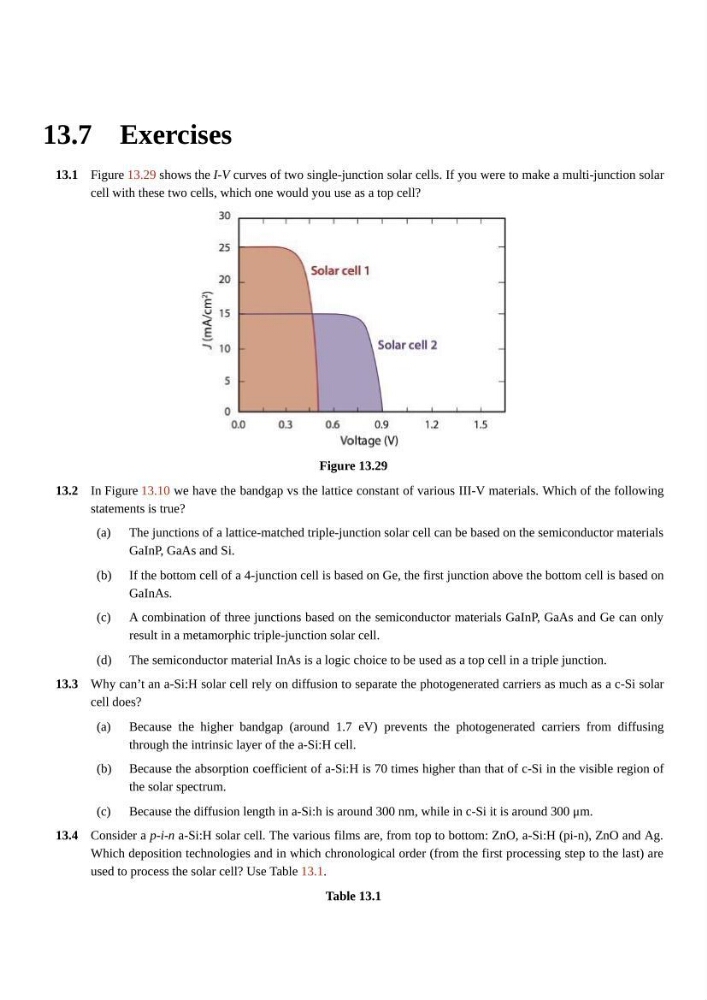
Figure 13.29 shows the I-V curves of two single-junction solar cells. If you were to make a multi-junction solar
cell with these two cells, which one would you use as a top cell?
Figure 13.29
In Figure 13.10 we have the bandgap vs the lattice constant of various III-V materials. Which of the following
statements is true?
The junctions of a lattice-matched triple-junction solar cell can be based on the semiconductor materials
GaInP, GaAs and Si.
If the bottom cell of a 4-junction cell is based on Ge, the first junction above the bottom cell is based on
GaInAs.
A combination of three junctions based on the semiconductor materials GaInP, GaAs and Ge can only
result in a metamorphic triple-junction solar cell.
The semiconductor material InAs is a logic choice to be used as a top cell in a triple junction.
Why can’t an a-Si:H solar cell rely on diffusion to separate the photogenerated carriers as much as a c-Si solar
cell does?
Because the higher bandgap (around 1.7 eV) prevents the photogenerated carriers from diffusing
through the intrinsic layer of the a-Si:H cell.
Because the absorption coefficient of a-Si:H is 70 times higher than that of c-Si in the visible region of
the solar spectrum.
Because the diffusion length in a-Si:h is around 300 nm, while in c-Si it is around 300 μm.
Consider a p-i-n a-Si:H solar cell. The various films are, from top to bottom: ZnO, a-Si:H (pi-n), ZnO and Ag.
Which deposition technologies and in which chronological order (from the first processing step to the last) are
used to process the solar cell? Use Table 13.1.
Table 13.1
13.1
13.2
(a)
(b)
(c)
(d)
13.3
(a)
(b)
(c)
13.4
Exercises
Figure 13.29 shows the I-V curves of two single-junction solar cells. If you were to make a multi-junction solar
cell with these two cells, which one would you use as a top cell?
Figure 13.29
In Figure 13.10 we have the bandgap vs the lattice constant of various III-V materials. Which of the following
statements is true?
The junctions of a lattice-matched triple-junction solar cell can be based on the semiconductor materials
GaInP, GaAs and Si.
If the bottom cell of a 4-junction cell is based on Ge, the first junction above the bottom cell is based on
GaInAs.
A combination of three junctions based on the semiconductor materials GaInP, GaAs and Ge can only
result in a metamorphic triple-junction solar cell.
The semiconductor material InAs is a logic choice to be used as a top cell in a triple junction.
Why can’t an a-Si:H solar cell rely on diffusion to separate the photogenerated carriers as much as a c-Si solar
cell does?
Because the higher bandgap (around 1.7 eV) prevents the photogenerated carriers from diffusing
through the intrinsic layer of the a-Si:H cell.
Because the absorption coefficient of a-Si:H is 70 times higher than that of c-Si in the visible region of
the solar spectrum.
Because the diffusion length in a-Si:h is around 300 nm, while in c-Si it is around 300 μm.
Consider a p-i-n a-Si:H solar cell. The various films are, from top to bottom: ZnO, a-Si:H (pi-n), ZnO and Ag.
Which deposition technologies and in which chronological order (from the first processing step to the last) are
used to process the solar cell? Use Table 13.1.
Table 13.1