

13.6.2
is 11.9% and was achieved by Sharp [77].
The major advantage of DSSC are the low production costs. A disadvantage is the
stability of the electrolyte under various weather conditions: At low temperatures the
electrolyte can freeze, which stops the device from generating power and might even
result in physical damage. High temperatures result in thermal expansion of the
electrolyte, which make encapsulating modules more complicated. Another challenge is
the high cost of the platinum electrodes, hence replacing the platinum with cheaper
materials is a topic of ongoing research. In addition, more stable and resistive electrolyte
materials must be developed. Finally, research is needed on improved dyes that enhance
the spectral and bandgap utilization of the solar cells.
As yet, no dye-sensitized PV products are available commercially.
Perovskite solar cells
A rapidly emerging PV technology is that of perovskite solar cells that has seen a
tremendous increase in initial efficiency in recent years. Perovskite cells with 2.2% were
reported in 2006. Cells with 6.5% were reported in 2011 and since then the reported
efficiencies have rapidly increased with an actual (October 2014) certified record
efficiency of 17.9% [77, 87].
The mineral perovskite is named after the Russian mineralogist Lev A. Perovski
(1792–1856) and has the chemical formula CaTiO 3 . Minerals with the general formula
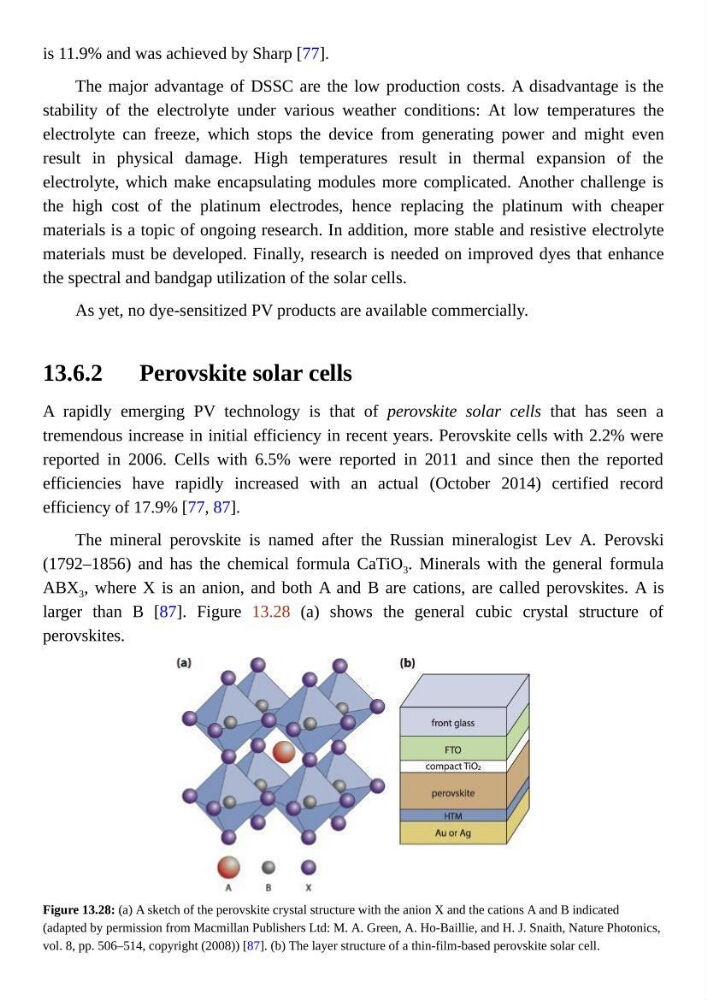
ABX 3 , where X is an anion, and both A and B are cations, are called perovskites. A is
larger than B [87]. Figure 13.28 (a) shows the general cubic crystal structure of
perovskites.
Figure 13.28: (a) A sketch of the perovskite crystal structure with the anion X and the cations A and B indicated
(adapted by permission from Macmillan Publishers Ltd: M. A. Green, A. Ho-Baillie, and H. J. Snaith, Nature Photonics,
vol. 8, pp. 506–514, copyright (2008)) [87]. (b) The layer structure of a thin-film-based perovskite solar cell.
is 11.9% and was achieved by Sharp [77].
The major advantage of DSSC are the low production costs. A disadvantage is the
stability of the electrolyte under various weather conditions: At low temperatures the
electrolyte can freeze, which stops the device from generating power and might even
result in physical damage. High temperatures result in thermal expansion of the
electrolyte, which make encapsulating modules more complicated. Another challenge is
the high cost of the platinum electrodes, hence replacing the platinum with cheaper
materials is a topic of ongoing research. In addition, more stable and resistive electrolyte
materials must be developed. Finally, research is needed on improved dyes that enhance
the spectral and bandgap utilization of the solar cells.
As yet, no dye-sensitized PV products are available commercially.
Perovskite solar cells
A rapidly emerging PV technology is that of perovskite solar cells that has seen a
tremendous increase in initial efficiency in recent years. Perovskite cells with 2.2% were
reported in 2006. Cells with 6.5% were reported in 2011 and since then the reported
efficiencies have rapidly increased with an actual (October 2014) certified record
efficiency of 17.9% [77, 87].
The mineral perovskite is named after the Russian mineralogist Lev A. Perovski
(1792–1856) and has the chemical formula CaTiO 3 . Minerals with the general formula
ABX 3 , where X is an anion, and both A and B are cations, are called perovskites. A is
larger than B [87]. Figure 13.28 (a) shows the general cubic crystal structure of
perovskites.
Figure 13.28: (a) A sketch of the perovskite crystal structure with the anion X and the cations A and B indicated
(adapted by permission from Macmillan Publishers Ltd: M. A. Green, A. Ho-Baillie, and H. J. Snaith, Nature Photonics,
vol. 8, pp. 506–514, copyright (2008)) [87]. (b) The layer structure of a thin-film-based perovskite solar cell.