

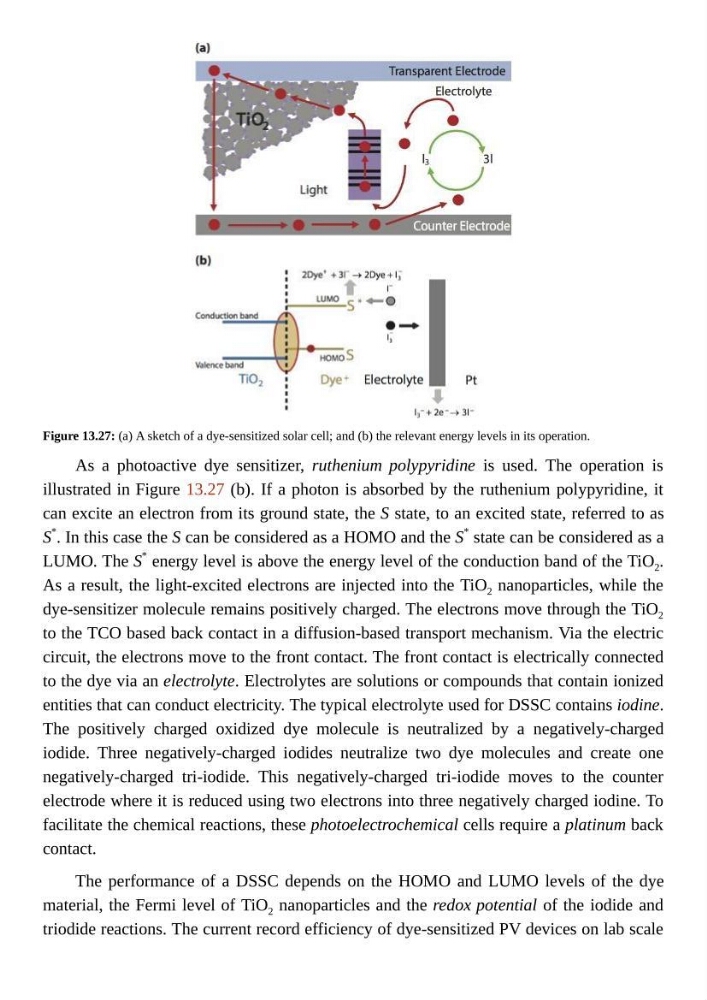
Figure 13.27: (a) A sketch of a dye-sensitized solar cell; and (b) the relevant energy levels in its operation.
As a photoactive dye sensitizer, ruthenium polypyridine is used. The operation is
illustrated in Figure 13.27 (b). If a photon is absorbed by the ruthenium polypyridine, it
can excite an electron from its ground state, the S state, to an excited state, referred to as
S
* . In this case the S can be considered as a HOMO and the S
*
state can be considered as a
LUMO. The S
*
energy level is above the energy level of the conduction band of the TiO 2 .
As a result, the light-excited electrons are injected into the TiO 2 nanoparticles, while the
dye-sensitizer molecule remains positively charged. The electrons move through the TiO 2
to the TCO based back contact in a diffusion-based transport mechanism. Via the electric
circuit, the electrons move to the front contact. The front contact is electrically connected
to the dye via an electrolyte. Electrolytes are solutions or compounds that contain ionized
entities that can conduct electricity. The typical electrolyte used for DSSC contains iodine.
The positively charged oxidized dye molecule is neutralized by a negatively-charged
iodide. Three negatively-charged iodides neutralize two dye molecules and create one
negatively-charged tri-iodide. This negatively-charged tri-iodide moves to the counter
electrode where it is reduced using two electrons into three negatively charged iodine. To
facilitate the chemical reactions, these photoelectrochemical cells require a platinum back
contact.
The performance of a DSSC depends on the HOMO and LUMO levels of the dye
material, the Fermi level of TiO 2 nanoparticles and the redox potential of the iodide and
triodide reactions. The current record efficiency of dye-sensitized PV devices on lab scale
As a photoactive dye sensitizer, ruthenium polypyridine is used. The operation is
illustrated in Figure 13.27 (b). If a photon is absorbed by the ruthenium polypyridine, it
can excite an electron from its ground state, the S state, to an excited state, referred to as
S
* . In this case the S can be considered as a HOMO and the S
*
state can be considered as a
LUMO. The S
*
energy level is above the energy level of the conduction band of the TiO 2 .
As a result, the light-excited electrons are injected into the TiO 2 nanoparticles, while the
dye-sensitizer molecule remains positively charged. The electrons move through the TiO 2
to the TCO based back contact in a diffusion-based transport mechanism. Via the electric
circuit, the electrons move to the front contact. The front contact is electrically connected
to the dye via an electrolyte. Electrolytes are solutions or compounds that contain ionized
entities that can conduct electricity. The typical electrolyte used for DSSC contains iodine.
The positively charged oxidized dye molecule is neutralized by a negatively-charged
iodide. Three negatively-charged iodides neutralize two dye molecules and create one
negatively-charged tri-iodide. This negatively-charged tri-iodide moves to the counter
electrode where it is reduced using two electrons into three negatively charged iodine. To
facilitate the chemical reactions, these photoelectrochemical cells require a platinum back
contact.
The performance of a DSSC depends on the HOMO and LUMO levels of the dye
material, the Fermi level of TiO 2 nanoparticles and the redox potential of the iodide and
triodide reactions. The current record efficiency of dye-sensitized PV devices on lab scale