

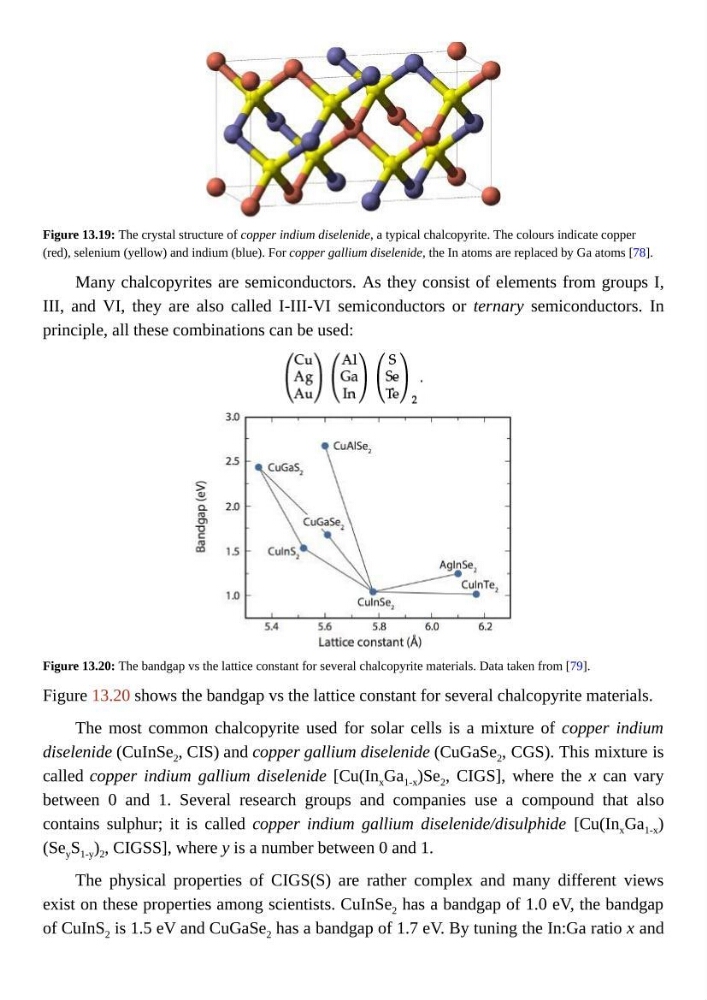
Figure 13.19: The crystal structure of copper indium diselenide, a typical chalcopyrite. The colours indicate copper
(red), selenium (yellow) and indium (blue). For copper gallium diselenide, the In atoms are replaced by Ga atoms [78].
Many chalcopyrites are semiconductors. As they consist of elements from groups I,
III, and VI, they are also called I-III-VI semiconductors or ternary semiconductors. In
principle, all these combinations can be used:
Figure 13.20: The bandgap vs the lattice constant for several chalcopyrite materials. Data taken from [79].
Figure 13.20 shows the bandgap vs the lattice constant for several chalcopyrite materials.
The most common chalcopyrite used for solar cells is a mixture of copper indium
diselenide (CuInSe 2 , CIS) and copper gallium diselenide (CuGaSe 2 , CGS). This mixture is
called copper indium gallium diselenide [Cu(In x Ga 1-x )Se 2 , CIGS], where the x can vary
between 0 and 1. Several research groups and companies use a compound that also
contains sulphur; it is called copper indium gallium diselenide/disulphide [Cu(In x Ga 1-x )
(Se y S 1-y ) 2 , CIGSS], where y is a number between 0 and 1.
The physical properties of CIGS(S) are rather complex and many different views
exist on these properties among scientists. CuInSe 2 has a bandgap of 1.0 eV, the bandgap
of CuInS 2 is 1.5 eV and CuGaSe 2 has a bandgap of 1.7 eV. By tuning the In:Ga ratio x and
(red), selenium (yellow) and indium (blue). For copper gallium diselenide, the In atoms are replaced by Ga atoms [78].
Many chalcopyrites are semiconductors. As they consist of elements from groups I,
III, and VI, they are also called I-III-VI semiconductors or ternary semiconductors. In
principle, all these combinations can be used:
Figure 13.20: The bandgap vs the lattice constant for several chalcopyrite materials. Data taken from [79].
Figure 13.20 shows the bandgap vs the lattice constant for several chalcopyrite materials.
The most common chalcopyrite used for solar cells is a mixture of copper indium
diselenide (CuInSe 2 , CIS) and copper gallium diselenide (CuGaSe 2 , CGS). This mixture is
called copper indium gallium diselenide [Cu(In x Ga 1-x )Se 2 , CIGS], where the x can vary
between 0 and 1. Several research groups and companies use a compound that also
contains sulphur; it is called copper indium gallium diselenide/disulphide [Cu(In x Ga 1-x )
(Se y S 1-y ) 2 , CIGSS], where y is a number between 0 and 1.
The physical properties of CIGS(S) are rather complex and many different views
exist on these properties among scientists. CuInSe 2 has a bandgap of 1.0 eV, the bandgap
of CuInS 2 is 1.5 eV and CuGaSe 2 has a bandgap of 1.7 eV. By tuning the In:Ga ratio x and