

orientation and structure is repeated in all directions. For amorphous materials this is not
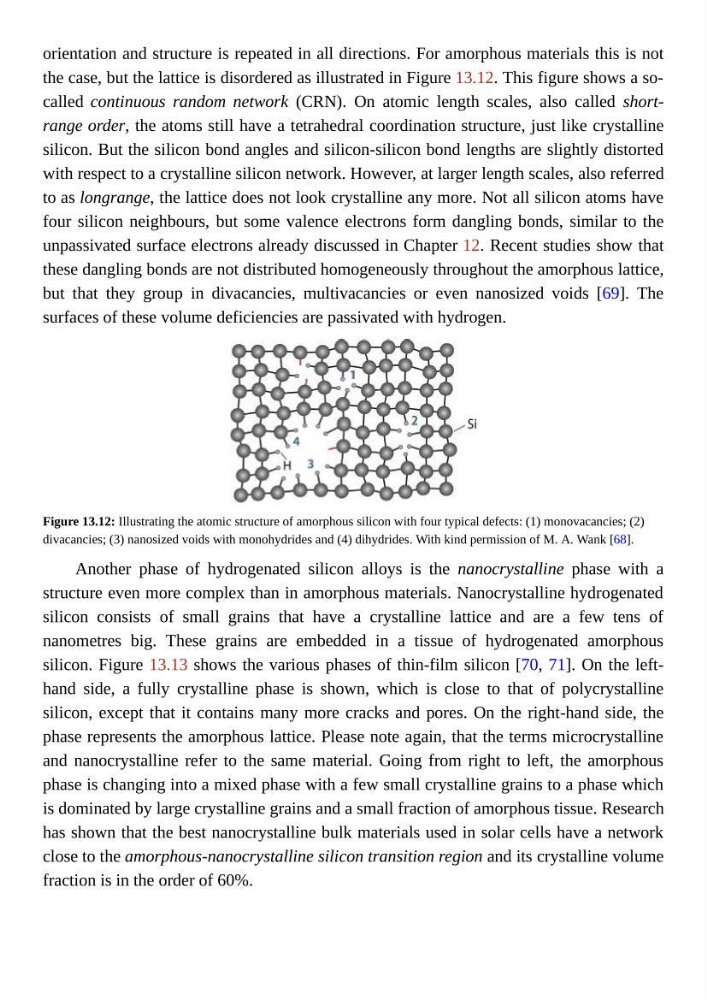
the case, but the lattice is disordered as illustrated in Figure 13.12. This figure shows a socalled continuous random network (CRN). On atomic length scales, also called shortrange order, the atoms still have a tetrahedral coordination structure, just like crystalline
silicon. But the silicon bond angles and silicon-silicon bond lengths are slightly distorted
with respect to a crystalline silicon network. However, at larger length scales, also referred
to as longrange, the lattice does not look crystalline any more. Not all silicon atoms have
four silicon neighbours, but some valence electrons form dangling bonds, similar to the
unpassivated surface electrons already discussed in Chapter 12. Recent studies show that
these dangling bonds are not distributed homogeneously throughout the amorphous lattice,
but that they group in divacancies, multivacancies or even nanosized voids [69]. The
surfaces of these volume deficiencies are passivated with hydrogen.
Figure 13.12: Illustrating the atomic structure of amorphous silicon with four typical defects: (1) monovacancies; (2)
divacancies; (3) nanosized voids with monohydrides and (4) dihydrides. With kind permission of M. A. Wank [68].
Another phase of hydrogenated silicon alloys is the nanocrystalline phase with a
structure even more complex than in amorphous materials. Nanocrystalline hydrogenated
silicon consists of small grains that have a crystalline lattice and are a few tens of
nanometres big. These grains are embedded in a tissue of hydrogenated amorphous
silicon. Figure 13.13 shows the various phases of thin-film silicon [70, 71]. On the lefthand side, a fully crystalline phase is shown, which is close to that of polycrystalline
silicon, except that it contains many more cracks and pores. On the right-hand side, the
phase represents the amorphous lattice. Please note again, that the terms microcrystalline
and nanocrystalline refer to the same material. Going from right to left, the amorphous
phase is changing into a mixed phase with a few small crystalline grains to a phase which
is dominated by large crystalline grains and a small fraction of amorphous tissue. Research
has shown that the best nanocrystalline bulk materials used in solar cells have a network
close to the amorphous-nanocrystalline silicon transition region and its crystalline volume
fraction is in the order of 60%.
the case, but the lattice is disordered as illustrated in Figure 13.12. This figure shows a socalled continuous random network (CRN). On atomic length scales, also called shortrange order, the atoms still have a tetrahedral coordination structure, just like crystalline
silicon. But the silicon bond angles and silicon-silicon bond lengths are slightly distorted
with respect to a crystalline silicon network. However, at larger length scales, also referred
to as longrange, the lattice does not look crystalline any more. Not all silicon atoms have
four silicon neighbours, but some valence electrons form dangling bonds, similar to the
unpassivated surface electrons already discussed in Chapter 12. Recent studies show that
these dangling bonds are not distributed homogeneously throughout the amorphous lattice,
but that they group in divacancies, multivacancies or even nanosized voids [69]. The
surfaces of these volume deficiencies are passivated with hydrogen.
Figure 13.12: Illustrating the atomic structure of amorphous silicon with four typical defects: (1) monovacancies; (2)
divacancies; (3) nanosized voids with monohydrides and (4) dihydrides. With kind permission of M. A. Wank [68].
Another phase of hydrogenated silicon alloys is the nanocrystalline phase with a
structure even more complex than in amorphous materials. Nanocrystalline hydrogenated
silicon consists of small grains that have a crystalline lattice and are a few tens of
nanometres big. These grains are embedded in a tissue of hydrogenated amorphous
silicon. Figure 13.13 shows the various phases of thin-film silicon [70, 71]. On the lefthand side, a fully crystalline phase is shown, which is close to that of polycrystalline
silicon, except that it contains many more cracks and pores. On the right-hand side, the
phase represents the amorphous lattice. Please note again, that the terms microcrystalline
and nanocrystalline refer to the same material. Going from right to left, the amorphous
phase is changing into a mixed phase with a few small crystalline grains to a phase which
is dominated by large crystalline grains and a small fraction of amorphous tissue. Research
has shown that the best nanocrystalline bulk materials used in solar cells have a network
close to the amorphous-nanocrystalline silicon transition region and its crystalline volume
fraction is in the order of 60%.