

utilization up to the lowest bandgap (0.67 eV) of
The maximal theoretical current that could be generated when absorbing AM0 for all
wavelengths shorter than 1,850 nm, which corresponds to 0.67 eV, is 62 mA/cm
2 . The
average EQE of the solar cell is thus 86%, which is a very impressive value. Further, this
cell has a very high fill factor of 0.85, which means that it has a conversion efficiency of
29.5% under AM0 illumination.
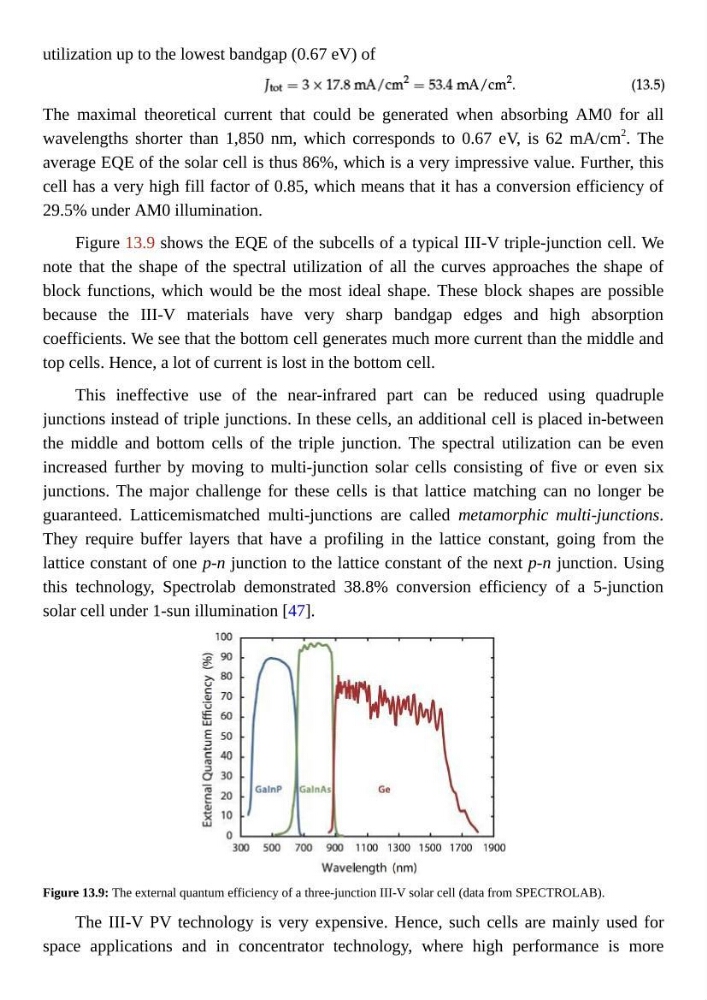
Figure 13.9 shows the EQE of the subcells of a typical III-V triple-junction cell. We
note that the shape of the spectral utilization of all the curves approaches the shape of
block functions, which would be the most ideal shape. These block shapes are possible
because the III-V materials have very sharp bandgap edges and high absorption
coefficients. We see that the bottom cell generates much more current than the middle and
top cells. Hence, a lot of current is lost in the bottom cell.
This ineffective use of the near-infrared part can be reduced using quadruple
junctions instead of triple junctions. In these cells, an additional cell is placed in-between
the middle and bottom cells of the triple junction. The spectral utilization can be even
increased further by moving to multi-junction solar cells consisting of five or even six
junctions. The major challenge for these cells is that lattice matching can no longer be
guaranteed. Latticemismatched multi-junctions are called metamorphic multi-junctions.
They require buffer layers that have a profiling in the lattice constant, going from the
lattice constant of one p-n junction to the lattice constant of the next p-n junction. Using
this technology, Spectrolab demonstrated 38.8% conversion efficiency of a 5-junction
solar cell under 1-sun illumination [47].
Figure 13.9: The external quantum efficiency of a three-junction III-V solar cell (data from SPECTROLAB).
The III-V PV technology is very expensive. Hence, such cells are mainly used for
space applications and in concentrator technology, where high performance is more
The maximal theoretical current that could be generated when absorbing AM0 for all
wavelengths shorter than 1,850 nm, which corresponds to 0.67 eV, is 62 mA/cm
2 . The
average EQE of the solar cell is thus 86%, which is a very impressive value. Further, this
cell has a very high fill factor of 0.85, which means that it has a conversion efficiency of
29.5% under AM0 illumination.
Figure 13.9 shows the EQE of the subcells of a typical III-V triple-junction cell. We
note that the shape of the spectral utilization of all the curves approaches the shape of
block functions, which would be the most ideal shape. These block shapes are possible
because the III-V materials have very sharp bandgap edges and high absorption
coefficients. We see that the bottom cell generates much more current than the middle and
top cells. Hence, a lot of current is lost in the bottom cell.
This ineffective use of the near-infrared part can be reduced using quadruple
junctions instead of triple junctions. In these cells, an additional cell is placed in-between
the middle and bottom cells of the triple junction. The spectral utilization can be even
increased further by moving to multi-junction solar cells consisting of five or even six
junctions. The major challenge for these cells is that lattice matching can no longer be
guaranteed. Latticemismatched multi-junctions are called metamorphic multi-junctions.
They require buffer layers that have a profiling in the lattice constant, going from the
lattice constant of one p-n junction to the lattice constant of the next p-n junction. Using
this technology, Spectrolab demonstrated 38.8% conversion efficiency of a 5-junction
solar cell under 1-sun illumination [47].
Figure 13.9: The external quantum efficiency of a three-junction III-V solar cell (data from SPECTROLAB).
The III-V PV technology is very expensive. Hence, such cells are mainly used for
space applications and in concentrator technology, where high performance is more