

Of all the thin-film technologies, the III-V (spoken ‘three-five’) technology results in the
highest conversion efficiencies under both AM1.5 standard test conditions and
concentrated Sun conditions. Hence, it is mainly used in space applications and
concentrator photovoltaics (CPV), which we discuss in Section 15.8.
As some concepts use a crystalline germanium or a GaAs wafer as substrate, it might
not be considered as a real thin-film PV technology, in contrast to thin-film silicon, CdTe,
CIGS or organic PV, which we will discuss later in this chapter. However, the III-V based
absorber layers themselves can be considered as thin compared to the thickness of
crystalline silicon wafers.
The III-V materials are based on the elements with three valence electrons like
aluminium (Al), gallium (Ga) or indium (In) and elements with five valence electrons like
phosphorus (P) or arsenic (As). Various different semiconductor materials such as gallium
arsenide (GaAs), gallium phosphide (GaP), indium phosphide (InP), indium arsenide
(InAs), and more complex alloys like GaInAs, GaInP, AlGaInAs and AlGaInP have been
explored.
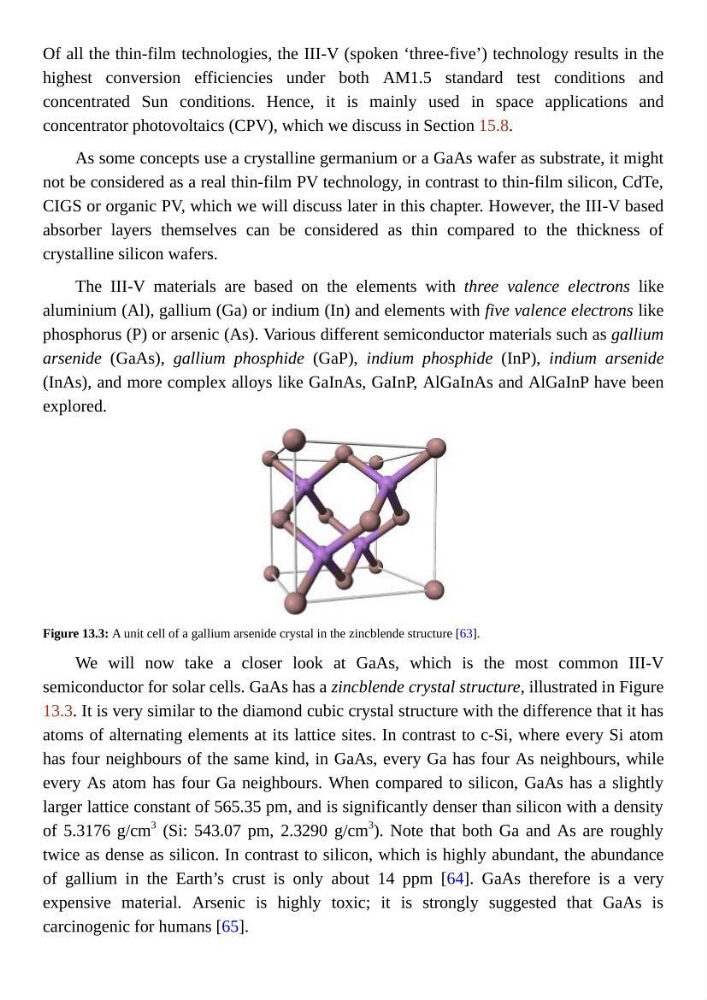
Figure 13.3: A unit cell of a gallium arsenide crystal in the zincblende structure [63].
We will now take a closer look at GaAs, which is the most common III-V
semiconductor for solar cells. GaAs has a zincblende crystal structure, illustrated in Figure
13.3. It is very similar to the diamond cubic crystal structure with the difference that it has
atoms of alternating elements at its lattice sites. In contrast to c-Si, where every Si atom
has four neighbours of the same kind, in GaAs, every Ga has four As neighbours, while
every As atom has four Ga neighbours. When compared to silicon, GaAs has a slightly
larger lattice constant of 565.35 pm, and is significantly denser than silicon with a density
of 5.3176 g/cm
3
(Si: 543.07 pm, 2.3290 g/cm
3
). Note that both Ga and As are roughly
twice as dense as silicon. In contrast to silicon, which is highly abundant, the abundance
of gallium in the Earth’s crust is only about 14 ppm [64]. GaAs therefore is a very
expensive material. Arsenic is highly toxic; it is strongly suggested that GaAs is
carcinogenic for humans [65].
highest conversion efficiencies under both AM1.5 standard test conditions and
concentrated Sun conditions. Hence, it is mainly used in space applications and
concentrator photovoltaics (CPV), which we discuss in Section 15.8.
As some concepts use a crystalline germanium or a GaAs wafer as substrate, it might
not be considered as a real thin-film PV technology, in contrast to thin-film silicon, CdTe,
CIGS or organic PV, which we will discuss later in this chapter. However, the III-V based
absorber layers themselves can be considered as thin compared to the thickness of
crystalline silicon wafers.
The III-V materials are based on the elements with three valence electrons like
aluminium (Al), gallium (Ga) or indium (In) and elements with five valence electrons like
phosphorus (P) or arsenic (As). Various different semiconductor materials such as gallium
arsenide (GaAs), gallium phosphide (GaP), indium phosphide (InP), indium arsenide
(InAs), and more complex alloys like GaInAs, GaInP, AlGaInAs and AlGaInP have been
explored.
Figure 13.3: A unit cell of a gallium arsenide crystal in the zincblende structure [63].
We will now take a closer look at GaAs, which is the most common III-V
semiconductor for solar cells. GaAs has a zincblende crystal structure, illustrated in Figure
13.3. It is very similar to the diamond cubic crystal structure with the difference that it has
atoms of alternating elements at its lattice sites. In contrast to c-Si, where every Si atom
has four neighbours of the same kind, in GaAs, every Ga has four As neighbours, while
every As atom has four Ga neighbours. When compared to silicon, GaAs has a slightly
larger lattice constant of 565.35 pm, and is significantly denser than silicon with a density
of 5.3176 g/cm
3
(Si: 543.07 pm, 2.3290 g/cm
3
). Note that both Ga and As are roughly
twice as dense as silicon. In contrast to silicon, which is highly abundant, the abundance
of gallium in the Earth’s crust is only about 14 ppm [64]. GaAs therefore is a very
expensive material. Arsenic is highly toxic; it is strongly suggested that GaAs is
carcinogenic for humans [65].