

the interface defects as much as possible, the area of the metal-semiconductor interface
must be minimized and the emitter directly below the interface should be heavily doped,
which is indicated with n
++
. The sides of the metal contacts are buried in the insulating
passivation layer. The area below the contact has been heavily doped. These two
approaches reduce the recombination and collection losses at the metal contact.
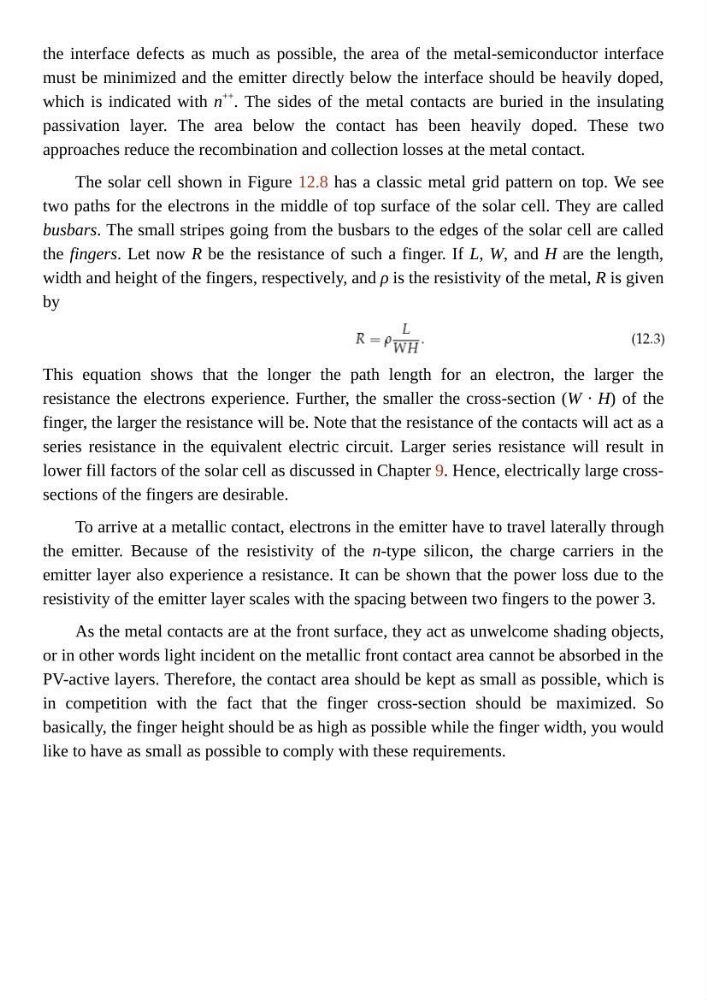
The solar cell shown in Figure 12.8 has a classic metal grid pattern on top. We see
two paths for the electrons in the middle of top surface of the solar cell. They are called
busbars. The small stripes going from the busbars to the edges of the solar cell are called
the fingers. Let now R be the resistance of such a finger. If L, W, and H are the length,
width and height of the fingers, respectively, and ρ is the resistivity of the metal, R is given
by
This equation shows that the longer the path length for an electron, the larger the
resistance the electrons experience. Further, the smaller the cross-section (W · H) of the
finger, the larger the resistance will be. Note that the resistance of the contacts will act as a
series resistance in the equivalent electric circuit. Larger series resistance will result in
lower fill factors of the solar cell as discussed in Chapter 9. Hence, electrically large crosssections of the fingers are desirable.
To arrive at a metallic contact, electrons in the emitter have to travel laterally through
the emitter. Because of the resistivity of the n-type silicon, the charge carriers in the
emitter layer also experience a resistance. It can be shown that the power loss due to the
resistivity of the emitter layer scales with the spacing between two fingers to the power 3.
As the metal contacts are at the front surface, they act as unwelcome shading objects,
or in other words light incident on the metallic front contact area cannot be absorbed in the
PV-active layers. Therefore, the contact area should be kept as small as possible, which is
in competition with the fact that the finger cross-section should be maximized. So
basically, the finger height should be as high as possible while the finger width, you would
like to have as small as possible to comply with these requirements.
must be minimized and the emitter directly below the interface should be heavily doped,
which is indicated with n
++
. The sides of the metal contacts are buried in the insulating
passivation layer. The area below the contact has been heavily doped. These two
approaches reduce the recombination and collection losses at the metal contact.
The solar cell shown in Figure 12.8 has a classic metal grid pattern on top. We see
two paths for the electrons in the middle of top surface of the solar cell. They are called
busbars. The small stripes going from the busbars to the edges of the solar cell are called
the fingers. Let now R be the resistance of such a finger. If L, W, and H are the length,
width and height of the fingers, respectively, and ρ is the resistivity of the metal, R is given
by
This equation shows that the longer the path length for an electron, the larger the
resistance the electrons experience. Further, the smaller the cross-section (W · H) of the
finger, the larger the resistance will be. Note that the resistance of the contacts will act as a
series resistance in the equivalent electric circuit. Larger series resistance will result in
lower fill factors of the solar cell as discussed in Chapter 9. Hence, electrically large crosssections of the fingers are desirable.
To arrive at a metallic contact, electrons in the emitter have to travel laterally through
the emitter. Because of the resistivity of the n-type silicon, the charge carriers in the
emitter layer also experience a resistance. It can be shown that the power loss due to the
resistivity of the emitter layer scales with the spacing between two fingers to the power 3.
As the metal contacts are at the front surface, they act as unwelcome shading objects,
or in other words light incident on the metallic front contact area cannot be absorbed in the
PV-active layers. Therefore, the contact area should be kept as small as possible, which is
in competition with the fact that the finger cross-section should be maximized. So
basically, the finger height should be as high as possible while the finger width, you would
like to have as small as possible to comply with these requirements.