

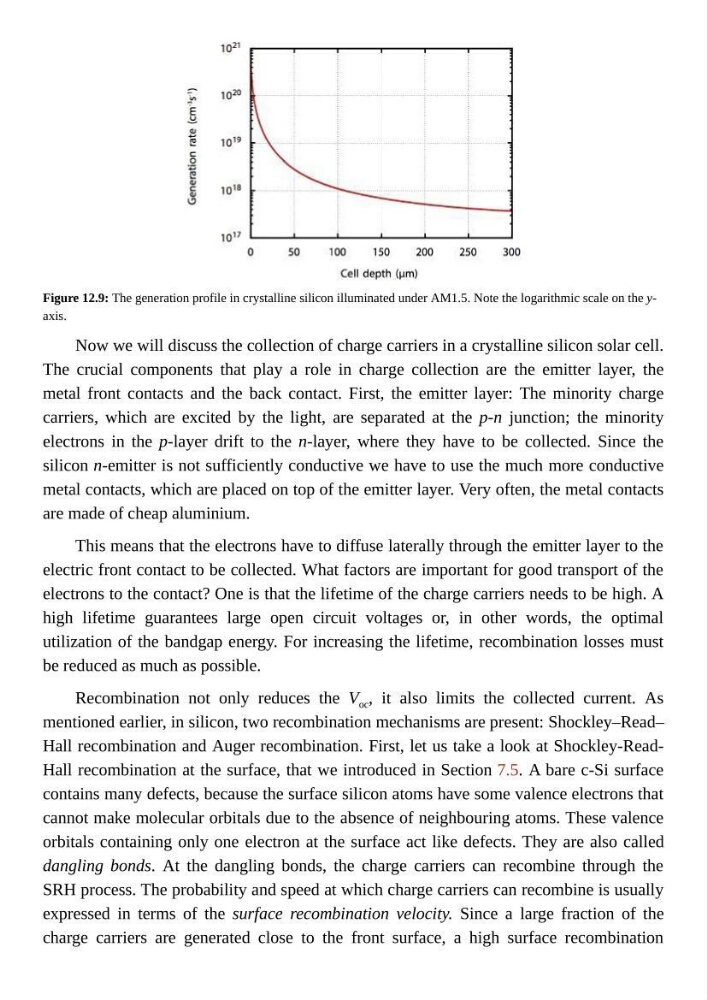
Figure 12.9: The generation profile in crystalline silicon illuminated under AM1.5. Note the logarithmic scale on the yaxis.
Now we will discuss the collection of charge carriers in a crystalline silicon solar cell.
The crucial components that play a role in charge collection are the emitter layer, the
metal front contacts and the back contact. First, the emitter layer: The minority charge
carriers, which are excited by the light, are separated at the p-n junction; the minority
electrons in the p-layer drift to the n-layer, where they have to be collected. Since the
silicon n-emitter is not sufficiently conductive we have to use the much more conductive
metal contacts, which are placed on top of the emitter layer. Very often, the metal contacts
are made of cheap aluminium.
This means that the electrons have to diffuse laterally through the emitter layer to the
electric front contact to be collected. What factors are important for good transport of the
electrons to the contact? One is that the lifetime of the charge carriers needs to be high. A
high lifetime guarantees large open circuit voltages or, in other words, the optimal
utilization of the bandgap energy. For increasing the lifetime, recombination losses must
be reduced as much as possible.
Recombination not only reduces the V oc , it also limits the collected current. As
mentioned earlier, in silicon, two recombination mechanisms are present: Shockley–Read–
Hall recombination and Auger recombination. First, let us take a look at Shockley-ReadHall recombination at the surface, that we introduced in Section 7.5. A bare c-Si surface
contains many defects, because the surface silicon atoms have some valence electrons that
cannot make molecular orbitals due to the absence of neighbouring atoms. These valence
orbitals containing only one electron at the surface act like defects. They are also called
dangling bonds. At the dangling bonds, the charge carriers can recombine through the
SRH process. The probability and speed at which charge carriers can recombine is usually
expressed in terms of the surface recombination velocity. Since a large fraction of the
charge carriers are generated close to the front surface, a high surface recombination
Now we will discuss the collection of charge carriers in a crystalline silicon solar cell.
The crucial components that play a role in charge collection are the emitter layer, the
metal front contacts and the back contact. First, the emitter layer: The minority charge
carriers, which are excited by the light, are separated at the p-n junction; the minority
electrons in the p-layer drift to the n-layer, where they have to be collected. Since the
silicon n-emitter is not sufficiently conductive we have to use the much more conductive
metal contacts, which are placed on top of the emitter layer. Very often, the metal contacts
are made of cheap aluminium.
This means that the electrons have to diffuse laterally through the emitter layer to the
electric front contact to be collected. What factors are important for good transport of the
electrons to the contact? One is that the lifetime of the charge carriers needs to be high. A
high lifetime guarantees large open circuit voltages or, in other words, the optimal
utilization of the bandgap energy. For increasing the lifetime, recombination losses must
be reduced as much as possible.
Recombination not only reduces the V oc , it also limits the collected current. As
mentioned earlier, in silicon, two recombination mechanisms are present: Shockley–Read–
Hall recombination and Auger recombination. First, let us take a look at Shockley-ReadHall recombination at the surface, that we introduced in Section 7.5. A bare c-Si surface
contains many defects, because the surface silicon atoms have some valence electrons that
cannot make molecular orbitals due to the absence of neighbouring atoms. These valence
orbitals containing only one electron at the surface act like defects. They are also called
dangling bonds. At the dangling bonds, the charge carriers can recombine through the
SRH process. The probability and speed at which charge carriers can recombine is usually
expressed in terms of the surface recombination velocity. Since a large fraction of the
charge carriers are generated close to the front surface, a high surface recombination