

hydrogen is cleaned and thereafter recycled back in to the reactor. The Siemens process
consumes a lot of energy.
Polysilicon granules can also be produced using Fluid Bed Reactors (not shown in
Figure 12.7). This process is operated at lower temperatures and consumes much less
energy. Polycrystalline silicon can have a purity as high as 99.9999%, or in other words,
only one out of one million atoms is different from Si.
The last approach we briefly mention is that of upgraded metallurgical silicon (not
shown in Figure 12.7). In this process metallurgical silicon is chemically refined by
blowing gases through the silicon melt, removing the impurities. Although processing is
cheap, the silicon purity is lower than that achieved with the Siemens or the fluid bed
reactor approaches.
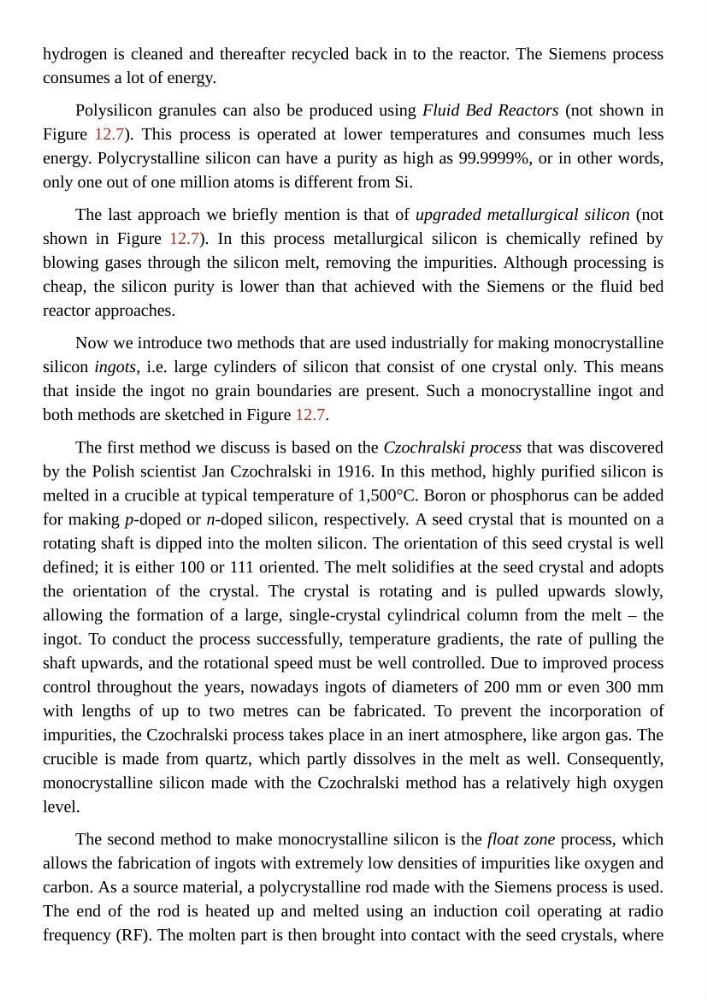
Now we introduce two methods that are used industrially for making monocrystalline
silicon ingots, i.e. large cylinders of silicon that consist of one crystal only. This means
that inside the ingot no grain boundaries are present. Such a monocrystalline ingot and
both methods are sketched in Figure 12.7.
The first method we discuss is based on the Czochralski process that was discovered
by the Polish scientist Jan Czochralski in 1916. In this method, highly purified silicon is
melted in a crucible at typical temperature of 1,500°C. Boron or phosphorus can be added
for making p-doped or n-doped silicon, respectively. A seed crystal that is mounted on a
rotating shaft is dipped into the molten silicon. The orientation of this seed crystal is well
defined; it is either 100 or 111 oriented. The melt solidifies at the seed crystal and adopts
the orientation of the crystal. The crystal is rotating and is pulled upwards slowly,
allowing the formation of a large, single-crystal cylindrical column from the melt – the
ingot. To conduct the process successfully, temperature gradients, the rate of pulling the
shaft upwards, and the rotational speed must be well controlled. Due to improved process
control throughout the years, nowadays ingots of diameters of 200 mm or even 300 mm
with lengths of up to two metres can be fabricated. To prevent the incorporation of
impurities, the Czochralski process takes place in an inert atmosphere, like argon gas. The
crucible is made from quartz, which partly dissolves in the melt as well. Consequently,
monocrystalline silicon made with the Czochralski method has a relatively high oxygen
level.
The second method to make monocrystalline silicon is the float zone process, which
allows the fabrication of ingots with extremely low densities of impurities like oxygen and
carbon. As a source material, a polycrystalline rod made with the Siemens process is used.
The end of the rod is heated up and melted using an induction coil operating at radio
frequency (RF). The molten part is then brought into contact with the seed crystals, where
consumes a lot of energy.
Polysilicon granules can also be produced using Fluid Bed Reactors (not shown in
Figure 12.7). This process is operated at lower temperatures and consumes much less
energy. Polycrystalline silicon can have a purity as high as 99.9999%, or in other words,
only one out of one million atoms is different from Si.
The last approach we briefly mention is that of upgraded metallurgical silicon (not
shown in Figure 12.7). In this process metallurgical silicon is chemically refined by
blowing gases through the silicon melt, removing the impurities. Although processing is
cheap, the silicon purity is lower than that achieved with the Siemens or the fluid bed
reactor approaches.
Now we introduce two methods that are used industrially for making monocrystalline
silicon ingots, i.e. large cylinders of silicon that consist of one crystal only. This means
that inside the ingot no grain boundaries are present. Such a monocrystalline ingot and
both methods are sketched in Figure 12.7.
The first method we discuss is based on the Czochralski process that was discovered
by the Polish scientist Jan Czochralski in 1916. In this method, highly purified silicon is
melted in a crucible at typical temperature of 1,500°C. Boron or phosphorus can be added
for making p-doped or n-doped silicon, respectively. A seed crystal that is mounted on a
rotating shaft is dipped into the molten silicon. The orientation of this seed crystal is well
defined; it is either 100 or 111 oriented. The melt solidifies at the seed crystal and adopts
the orientation of the crystal. The crystal is rotating and is pulled upwards slowly,
allowing the formation of a large, single-crystal cylindrical column from the melt – the
ingot. To conduct the process successfully, temperature gradients, the rate of pulling the
shaft upwards, and the rotational speed must be well controlled. Due to improved process
control throughout the years, nowadays ingots of diameters of 200 mm or even 300 mm
with lengths of up to two metres can be fabricated. To prevent the incorporation of
impurities, the Czochralski process takes place in an inert atmosphere, like argon gas. The
crucible is made from quartz, which partly dissolves in the melt as well. Consequently,
monocrystalline silicon made with the Czochralski method has a relatively high oxygen
level.
The second method to make monocrystalline silicon is the float zone process, which
allows the fabrication of ingots with extremely low densities of impurities like oxygen and
carbon. As a source material, a polycrystalline rod made with the Siemens process is used.
The end of the rod is heated up and melted using an induction coil operating at radio
frequency (RF). The molten part is then brought into contact with the seed crystals, where