

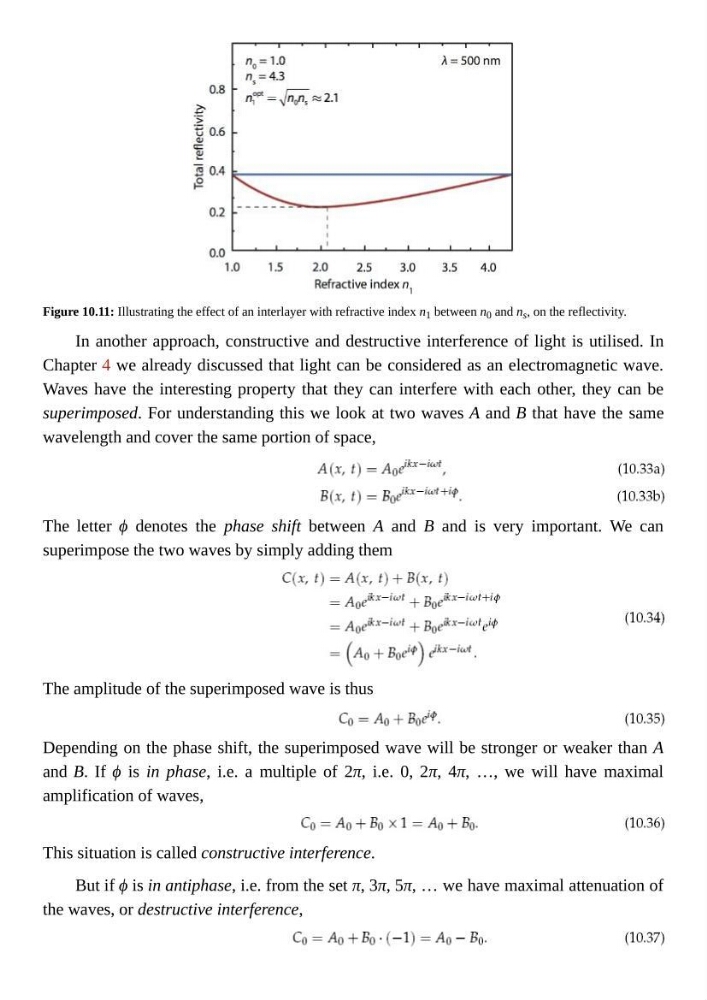
Figure 10.11: Illustrating the effect of an interlayer with refractive index n 1 between n 0 and n s , on the reflectivity.
In another approach, constructive and destructive interference of light is utilised. In
Chapter 4 we already discussed that light can be considered as an electromagnetic wave.
Waves have the interesting property that they can interfere with each other, they can be
superimposed. For understanding this we look at two waves A and B that have the same
wavelength and cover the same portion of space,
The letter ϕ denotes the phase shift between A and B and is very important. We can
superimpose the two waves by simply adding them
The amplitude of the superimposed wave is thus
Depending on the phase shift, the superimposed wave will be stronger or weaker than A
and B. If ϕ is in phase, i.e. a multiple of 2π, i.e. 0, 2π, 4π, …, we will have maximal
amplification of waves,
This situation is called constructive interference.
But if ϕ is in antiphase, i.e. from the set π, 3π, 5π, … we have maximal attenuation of
the waves, or destructive interference,
In another approach, constructive and destructive interference of light is utilised. In
Chapter 4 we already discussed that light can be considered as an electromagnetic wave.
Waves have the interesting property that they can interfere with each other, they can be
superimposed. For understanding this we look at two waves A and B that have the same
wavelength and cover the same portion of space,
The letter ϕ denotes the phase shift between A and B and is very important. We can
superimpose the two waves by simply adding them
The amplitude of the superimposed wave is thus
Depending on the phase shift, the superimposed wave will be stronger or weaker than A
and B. If ϕ is in phase, i.e. a multiple of 2π, i.e. 0, 2π, 4π, …, we will have maximal
amplification of waves,
This situation is called constructive interference.
But if ϕ is in antiphase, i.e. from the set π, 3π, 5π, … we have maximal attenuation of
the waves, or destructive interference,