

10.3.1
neglected. Now we will discuss several loss mechanisms that have to be taken into
account for realistic non-ideal solar cells. At the end of this section we will derive at an
equation for the efficiency, where all these important losses are taken into account.
Optical losses
For the Shockley-Queisser limit, we only took the bandgap energy E G into account for
deriving the efficiency limit. However, the real performance is also strongly influenced by
the optical properties given as the complex refractive index ñ = n − ik, which is a function
of the wavelength.
As we already discussed in Section 4.3, part of the light is reflected and the other part
is transmitted when light arrives on an interface between two media. The interface is
therefore characterised by the wavelength-dependent reflectivity R(λ) and transmittance
T(λ). All the reflections and transmissions at the different interfaces in the solar cell result
in a total reflectance between the solar cell and the surrounding air. Hence, a part of the
incident energy that can be converted into a usable energy by the solar cell is lost by
reflection. We shall denote the total effective reflectivity in the wavelength range of
interest as R
*
.
As we will discuss in more detail in Chapter 12, in most c-Si solar cells thin metal
strips are placed on the front side of the solar cell that serve as front electrodes. The
metalcovered area does not allow the light to enter the solar cell because it reflects or
slightly absorbs the incident light. The area that is covered by the electrode effectively
decreases the active area of the solar cell. We denote the total area of the cell as A tot and
the cell area that is not covered by the electrode as A f , the fraction of the active area of the
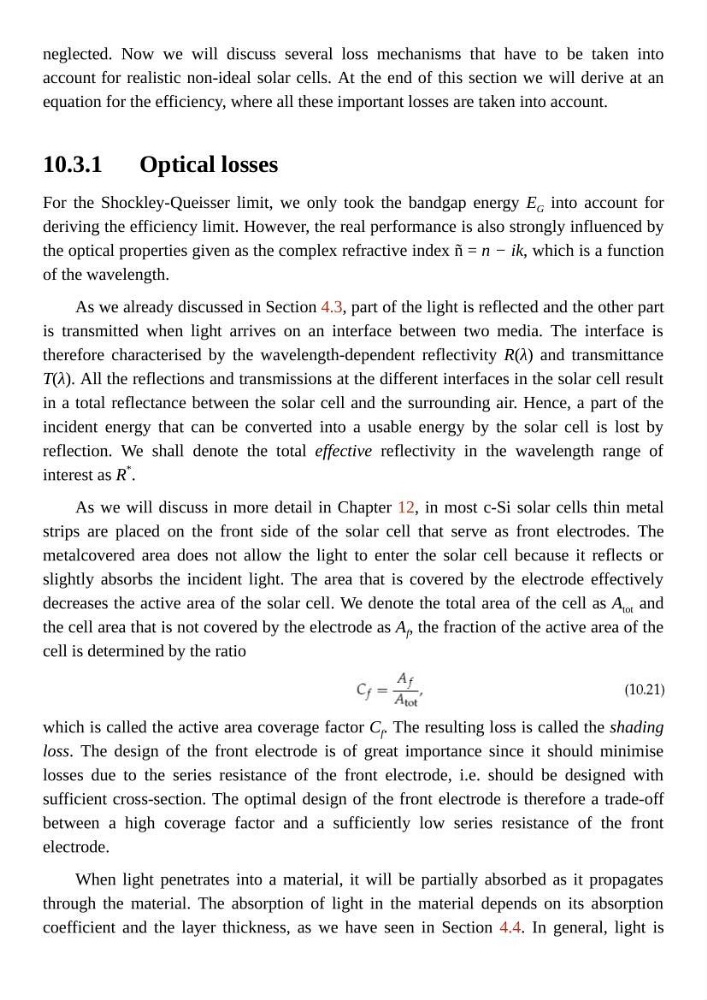
cell is determined by the ratio
which is called the active area coverage factor C f . The resulting loss is called the shading
loss. The design of the front electrode is of great importance since it should minimise
losses due to the series resistance of the front electrode, i.e. should be designed with
sufficient cross-section. The optimal design of the front electrode is therefore a trade-off
between a high coverage factor and a sufficiently low series resistance of the front
electrode.
When light penetrates into a material, it will be partially absorbed as it propagates
through the material. The absorption of light in the material depends on its absorption
coefficient and the layer thickness, as we have seen in Section 4.4. In general, light is
neglected. Now we will discuss several loss mechanisms that have to be taken into
account for realistic non-ideal solar cells. At the end of this section we will derive at an
equation for the efficiency, where all these important losses are taken into account.
Optical losses
For the Shockley-Queisser limit, we only took the bandgap energy E G into account for
deriving the efficiency limit. However, the real performance is also strongly influenced by
the optical properties given as the complex refractive index ñ = n − ik, which is a function
of the wavelength.
As we already discussed in Section 4.3, part of the light is reflected and the other part
is transmitted when light arrives on an interface between two media. The interface is
therefore characterised by the wavelength-dependent reflectivity R(λ) and transmittance
T(λ). All the reflections and transmissions at the different interfaces in the solar cell result
in a total reflectance between the solar cell and the surrounding air. Hence, a part of the
incident energy that can be converted into a usable energy by the solar cell is lost by
reflection. We shall denote the total effective reflectivity in the wavelength range of
interest as R
*
.
As we will discuss in more detail in Chapter 12, in most c-Si solar cells thin metal
strips are placed on the front side of the solar cell that serve as front electrodes. The
metalcovered area does not allow the light to enter the solar cell because it reflects or
slightly absorbs the incident light. The area that is covered by the electrode effectively
decreases the active area of the solar cell. We denote the total area of the cell as A tot and
the cell area that is not covered by the electrode as A f , the fraction of the active area of the
cell is determined by the ratio
which is called the active area coverage factor C f . The resulting loss is called the shading
loss. The design of the front electrode is of great importance since it should minimise
losses due to the series resistance of the front electrode, i.e. should be designed with
sufficient cross-section. The optimal design of the front electrode is therefore a trade-off
between a high coverage factor and a sufficiently low series resistance of the front
electrode.
When light penetrates into a material, it will be partially absorbed as it propagates
through the material. The absorption of light in the material depends on its absorption
coefficient and the layer thickness, as we have seen in Section 4.4. In general, light is