

10.2.3
10.3
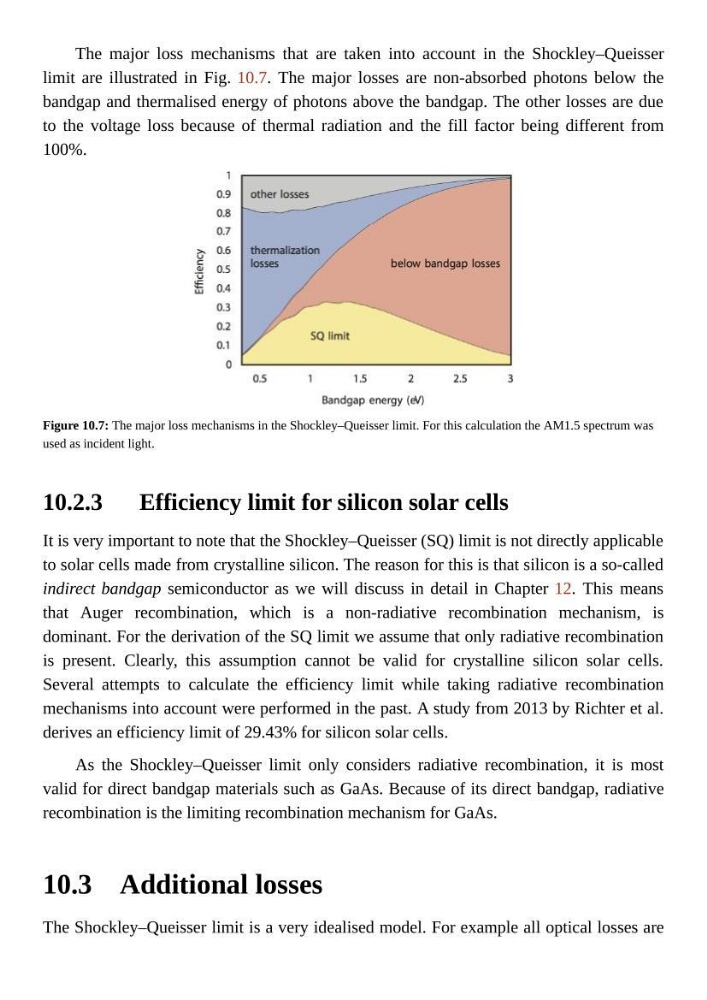
The major loss mechanisms that are taken into account in the Shockley–Queisser
limit are illustrated in Fig. 10.7. The major losses are non-absorbed photons below the
bandgap and thermalised energy of photons above the bandgap. The other losses are due
to the voltage loss because of thermal radiation and the fill factor being different from
100%.
Figure 10.7: The major loss mechanisms in the Shockley–Queisser limit. For this calculation the AM1.5 spectrum was
used as incident light.
Efficiency limit for silicon solar cells
It is very important to note that the Shockley–Queisser (SQ) limit is not directly applicable
to solar cells made from crystalline silicon. The reason for this is that silicon is a so-called
indirect bandgap semiconductor as we will discuss in detail in Chapter 12. This means
that Auger recombination, which is a non-radiative recombination mechanism, is
dominant. For the derivation of the SQ limit we assume that only radiative recombination
is present. Clearly, this assumption cannot be valid for crystalline silicon solar cells.
Several attempts to calculate the efficiency limit while taking radiative recombination
mechanisms into account were performed in the past. A study from 2013 by Richter et al.
derives an efficiency limit of 29.43% for silicon solar cells.
As the Shockley–Queisser limit only considers radiative recombination, it is most
valid for direct bandgap materials such as GaAs. Because of its direct bandgap, radiative
recombination is the limiting recombination mechanism for GaAs.
Additional losses
The Shockley–Queisser limit is a very idealised model. For example all optical losses are
10.3
The major loss mechanisms that are taken into account in the Shockley–Queisser
limit are illustrated in Fig. 10.7. The major losses are non-absorbed photons below the
bandgap and thermalised energy of photons above the bandgap. The other losses are due
to the voltage loss because of thermal radiation and the fill factor being different from
100%.
Figure 10.7: The major loss mechanisms in the Shockley–Queisser limit. For this calculation the AM1.5 spectrum was
used as incident light.
Efficiency limit for silicon solar cells
It is very important to note that the Shockley–Queisser (SQ) limit is not directly applicable
to solar cells made from crystalline silicon. The reason for this is that silicon is a so-called
indirect bandgap semiconductor as we will discuss in detail in Chapter 12. This means
that Auger recombination, which is a non-radiative recombination mechanism, is
dominant. For the derivation of the SQ limit we assume that only radiative recombination
is present. Clearly, this assumption cannot be valid for crystalline silicon solar cells.
Several attempts to calculate the efficiency limit while taking radiative recombination
mechanisms into account were performed in the past. A study from 2013 by Richter et al.
derives an efficiency limit of 29.43% for silicon solar cells.
As the Shockley–Queisser limit only considers radiative recombination, it is most
valid for direct bandgap materials such as GaAs. Because of its direct bandgap, radiative
recombination is the limiting recombination mechanism for GaAs.
Additional losses
The Shockley–Queisser limit is a very idealised model. For example all optical losses are