

(d)
(e)
(f)
(g)
(i)
(ii)
(iii)
(h)
i)
ii)
iii)
8.8
(a)
(b)
(c)
(d)
(e)
(f)
(g)
(h)
8.9
(a)
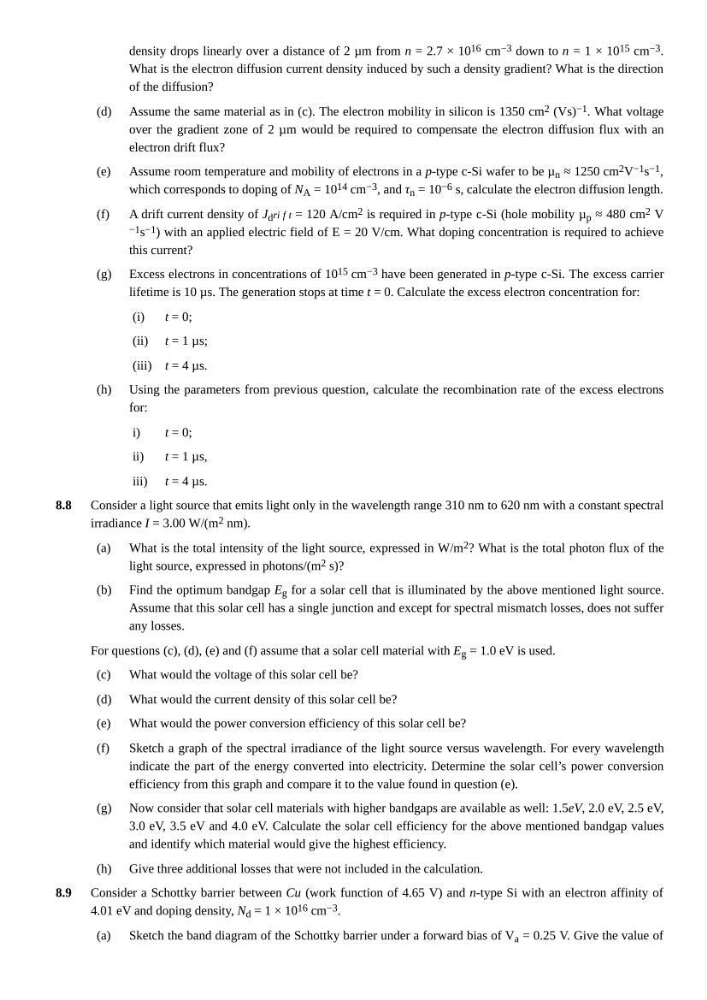
density drops linearly over a distance of 2 µm from n = 2.7 × 10 16 cm −3 down to n = 1 × 10 15 cm −3 .
What is the electron diffusion current density induced by such a density gradient? What is the direction
of the diffusion?
Assume the same material as in (c). The electron mobility in silicon is 1350 cm 2 (Vs) −1 . What voltage
over the gradient zone of 2 µm would be required to compensate the electron diffusion flux with an
electron drift flux?
Assume room temperature and mobility of electrons in a p-type c-Si wafer to be µ n ≈ 1250 cm 2 V −1 s −1 ,
which corresponds to doping of N A = 10 14 cm −3 , and τ n = 10 −6 s, calculate the electron diffusion length.
A drift current density of J d ri f t = 120 A/cm 2 is required in p-type c-Si (hole mobility µ p ≈ 480 cm 2 V
−1 s −1 ) with an applied electric field of E = 20 V/cm. What doping concentration is required to achieve
this current?
Excess electrons in concentrations of 10 15 cm −3 have been generated in p-type c-Si. The excess carrier
lifetime is 10 µs. The generation stops at time t = 0. Calculate the excess electron concentration for:
t = 0;
t = 1 µs;
t = 4 µs.
Using the parameters from previous question, calculate the recombination rate of the excess electrons
for:
t = 0;
t = 1 µs,
t = 4 µs.
Consider a light source that emits light only in the wavelength range 310 nm to 620 nm with a constant spectral
irradiance I = 3.00 W/(m 2 nm).
What is the total intensity of the light source, expressed in W/m 2 ? What is the total photon flux of the
light source, expressed in photons/(m 2 s)?
Find the optimum bandgap E g for a solar cell that is illuminated by the above mentioned light source.
Assume that this solar cell has a single junction and except for spectral mismatch losses, does not suffer
any losses.
For questions (c), (d), (e) and (f) assume that a solar cell material with E g = 1.0 eV is used.
What would the voltage of this solar cell be?
What would the current density of this solar cell be?
What would the power conversion efficiency of this solar cell be?
Sketch a graph of the spectral irradiance of the light source versus wavelength. For every wavelength
indicate the part of the energy converted into electricity. Determine the solar cell’s power conversion
efficiency from this graph and compare it to the value found in question (e).
Now consider that solar cell materials with higher bandgaps are available as well: 1.5eV, 2.0 eV, 2.5 eV,
3.0 eV, 3.5 eV and 4.0 eV. Calculate the solar cell efficiency for the above mentioned bandgap values
and identify which material would give the highest efficiency.
Give three additional losses that were not included in the calculation.
Consider a Schottky barrier between Cu (work function of 4.65 V) and n-type Si with an electron affinity of
4.01 eV and doping density, N d = 1 × 10 16 cm −3 .
Sketch the band diagram of the Schottky barrier under a forward bias of V a = 0.25 V. Give the value of
(e)
(f)
(g)
(i)
(ii)
(iii)
(h)
i)
ii)
iii)
8.8
(a)
(b)
(c)
(d)
(e)
(f)
(g)
(h)
8.9
(a)
density drops linearly over a distance of 2 µm from n = 2.7 × 10 16 cm −3 down to n = 1 × 10 15 cm −3 .
What is the electron diffusion current density induced by such a density gradient? What is the direction
of the diffusion?
Assume the same material as in (c). The electron mobility in silicon is 1350 cm 2 (Vs) −1 . What voltage
over the gradient zone of 2 µm would be required to compensate the electron diffusion flux with an
electron drift flux?
Assume room temperature and mobility of electrons in a p-type c-Si wafer to be µ n ≈ 1250 cm 2 V −1 s −1 ,
which corresponds to doping of N A = 10 14 cm −3 , and τ n = 10 −6 s, calculate the electron diffusion length.
A drift current density of J d ri f t = 120 A/cm 2 is required in p-type c-Si (hole mobility µ p ≈ 480 cm 2 V
−1 s −1 ) with an applied electric field of E = 20 V/cm. What doping concentration is required to achieve
this current?
Excess electrons in concentrations of 10 15 cm −3 have been generated in p-type c-Si. The excess carrier
lifetime is 10 µs. The generation stops at time t = 0. Calculate the excess electron concentration for:
t = 0;
t = 1 µs;
t = 4 µs.
Using the parameters from previous question, calculate the recombination rate of the excess electrons
for:
t = 0;
t = 1 µs,
t = 4 µs.
Consider a light source that emits light only in the wavelength range 310 nm to 620 nm with a constant spectral
irradiance I = 3.00 W/(m 2 nm).
What is the total intensity of the light source, expressed in W/m 2 ? What is the total photon flux of the
light source, expressed in photons/(m 2 s)?
Find the optimum bandgap E g for a solar cell that is illuminated by the above mentioned light source.
Assume that this solar cell has a single junction and except for spectral mismatch losses, does not suffer
any losses.
For questions (c), (d), (e) and (f) assume that a solar cell material with E g = 1.0 eV is used.
What would the voltage of this solar cell be?
What would the current density of this solar cell be?
What would the power conversion efficiency of this solar cell be?
Sketch a graph of the spectral irradiance of the light source versus wavelength. For every wavelength
indicate the part of the energy converted into electricity. Determine the solar cell’s power conversion
efficiency from this graph and compare it to the value found in question (e).
Now consider that solar cell materials with higher bandgaps are available as well: 1.5eV, 2.0 eV, 2.5 eV,
3.0 eV, 3.5 eV and 4.0 eV. Calculate the solar cell efficiency for the above mentioned bandgap values
and identify which material would give the highest efficiency.
Give three additional losses that were not included in the calculation.
Consider a Schottky barrier between Cu (work function of 4.65 V) and n-type Si with an electron affinity of
4.01 eV and doping density, N d = 1 × 10 16 cm −3 .
Sketch the band diagram of the Schottky barrier under a forward bias of V a = 0.25 V. Give the value of