

8.2
where L N and L P are the minority-carriers diffusion length for electrons and holes,
respectively, and W is the width of the depletion region. It means that only carriers
generated in the depletion region and in the regions up to the minority-carrier diffusion
length from the depletion region can contribute to the photogenerated current. When
designing the thickness of a solar cell, Eq. (8.34) must be considered. The thickness of the
absorber should not be greater than the region from which the carriers contribute to the
photogenerated current.
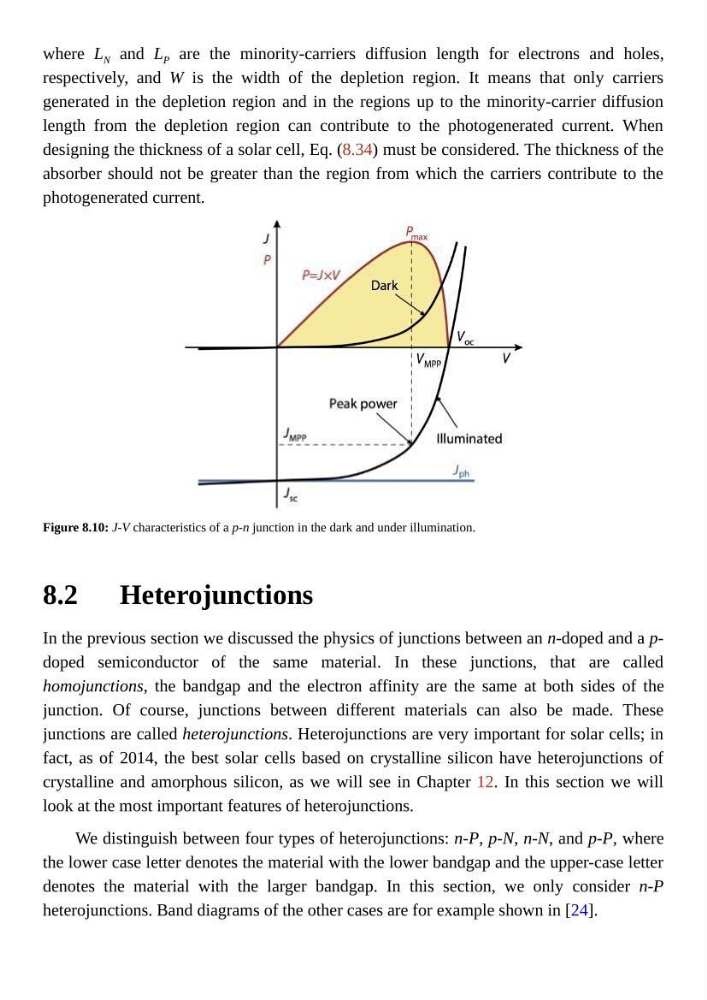
Figure 8.10: J-V characteristics of a p-n junction in the dark and under illumination.
Heterojunctions
In the previous section we discussed the physics of junctions between an n-doped and a pdoped semiconductor of the same material. In these junctions, that are called
homojunctions, the bandgap and the electron affinity are the same at both sides of the
junction. Of course, junctions between different materials can also be made. These
junctions are called heterojunctions. Heterojunctions are very important for solar cells; in
fact, as of 2014, the best solar cells based on crystalline silicon have heterojunctions of
crystalline and amorphous silicon, as we will see in Chapter 12. In this section we will
look at the most important features of heterojunctions.
We distinguish between four types of heterojunctions: n-P, p-N, n-N, and p-P, where
the lower case letter denotes the material with the lower bandgap and the upper-case letter
denotes the material with the larger bandgap. In this section, we only consider n-P
heterojunctions. Band diagrams of the other cases are for example shown in [24].
where L N and L P are the minority-carriers diffusion length for electrons and holes,
respectively, and W is the width of the depletion region. It means that only carriers
generated in the depletion region and in the regions up to the minority-carrier diffusion
length from the depletion region can contribute to the photogenerated current. When
designing the thickness of a solar cell, Eq. (8.34) must be considered. The thickness of the
absorber should not be greater than the region from which the carriers contribute to the
photogenerated current.
Figure 8.10: J-V characteristics of a p-n junction in the dark and under illumination.
Heterojunctions
In the previous section we discussed the physics of junctions between an n-doped and a pdoped semiconductor of the same material. In these junctions, that are called
homojunctions, the bandgap and the electron affinity are the same at both sides of the
junction. Of course, junctions between different materials can also be made. These
junctions are called heterojunctions. Heterojunctions are very important for solar cells; in
fact, as of 2014, the best solar cells based on crystalline silicon have heterojunctions of
crystalline and amorphous silicon, as we will see in Chapter 12. In this section we will
look at the most important features of heterojunctions.
We distinguish between four types of heterojunctions: n-P, p-N, n-N, and p-P, where
the lower case letter denotes the material with the lower bandgap and the upper-case letter
denotes the material with the larger bandgap. In this section, we only consider n-P
heterojunctions. Band diagrams of the other cases are for example shown in [24].