

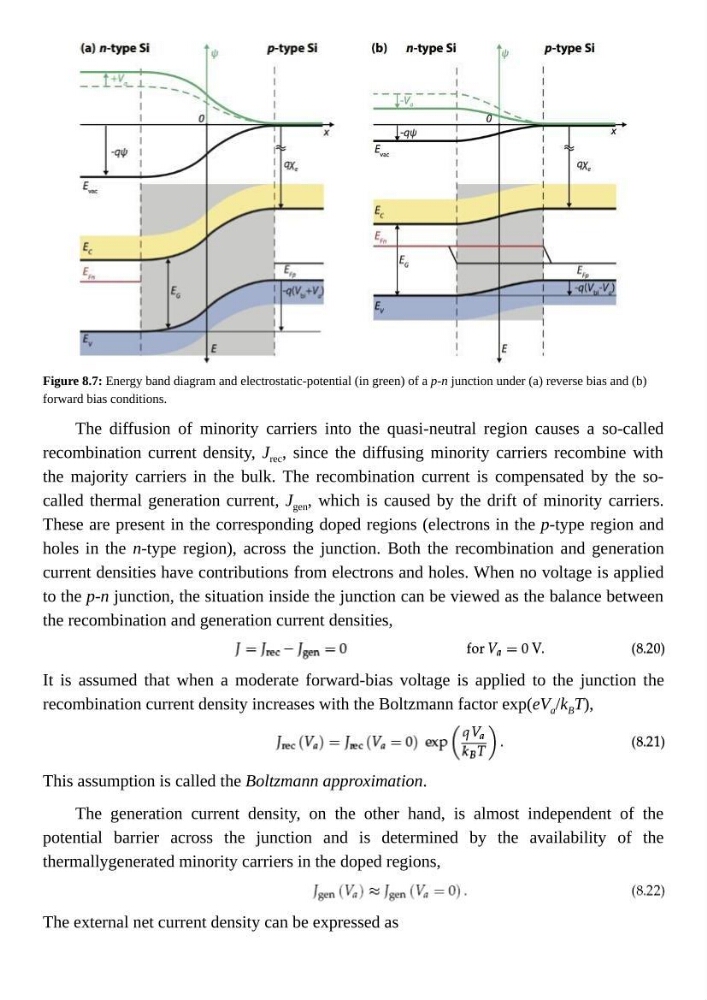
Figure 8.7: Energy band diagram and electrostatic-potential (in green) of a p-n junction under (a) reverse bias and (b)
forward bias conditions.
The diffusion of minority carriers into the quasi-neutral region causes a so-called
recombination current density, J rec , since the diffusing minority carriers recombine with
the majority carriers in the bulk. The recombination current is compensated by the socalled thermal generation current, J gen , which is caused by the drift of minority carriers.
These are present in the corresponding doped regions (electrons in the p-type region and
holes in the n-type region), across the junction. Both the recombination and generation
current densities have contributions from electrons and holes. When no voltage is applied
to the p-n junction, the situation inside the junction can be viewed as the balance between
the recombination and generation current densities,
It is assumed that when a moderate forward-bias voltage is applied to the junction the
recombination current density increases with the Boltzmann factor exp(eV a /k B T),
This assumption is called the Boltzmann approximation.
The generation current density, on the other hand, is almost independent of the
potential barrier across the junction and is determined by the availability of the
thermallygenerated minority carriers in the doped regions,
The external net current density can be expressed as
forward bias conditions.
The diffusion of minority carriers into the quasi-neutral region causes a so-called
recombination current density, J rec , since the diffusing minority carriers recombine with
the majority carriers in the bulk. The recombination current is compensated by the socalled thermal generation current, J gen , which is caused by the drift of minority carriers.
These are present in the corresponding doped regions (electrons in the p-type region and
holes in the n-type region), across the junction. Both the recombination and generation
current densities have contributions from electrons and holes. When no voltage is applied
to the p-n junction, the situation inside the junction can be viewed as the balance between
the recombination and generation current densities,
It is assumed that when a moderate forward-bias voltage is applied to the junction the
recombination current density increases with the Boltzmann factor exp(eV a /k B T),
This assumption is called the Boltzmann approximation.
The generation current density, on the other hand, is almost independent of the
potential barrier across the junction and is determined by the availability of the
thermallygenerated minority carriers in the doped regions,
The external net current density can be expressed as