

8.1.2
Figure 8.2: Formation of a space-charge region, when n-type and p-type semiconductors are brought together to form a
junction. The coloured part represents the space-charge region.
The space charge around the metallurgical junction results in the formation of an
internal electric field which forces the charge carriers to move in the opposite direction
than the concentration gradient. The diffusion currents continue to flow until the forces
acting on the charge carriers, namely the concentration gradient and the internal electrical
field, compensate each other. The driving force for the charge transport does not exist any
more and no net current flows through the p-n junction.
The p-n junction under equilibrium
The p-n junction represents a system of charged particles in diffusive equilibrium in which
the electrochemical potential is constant and independent of position. The electrochemical potential describes an average energy of electrons and is represented by the
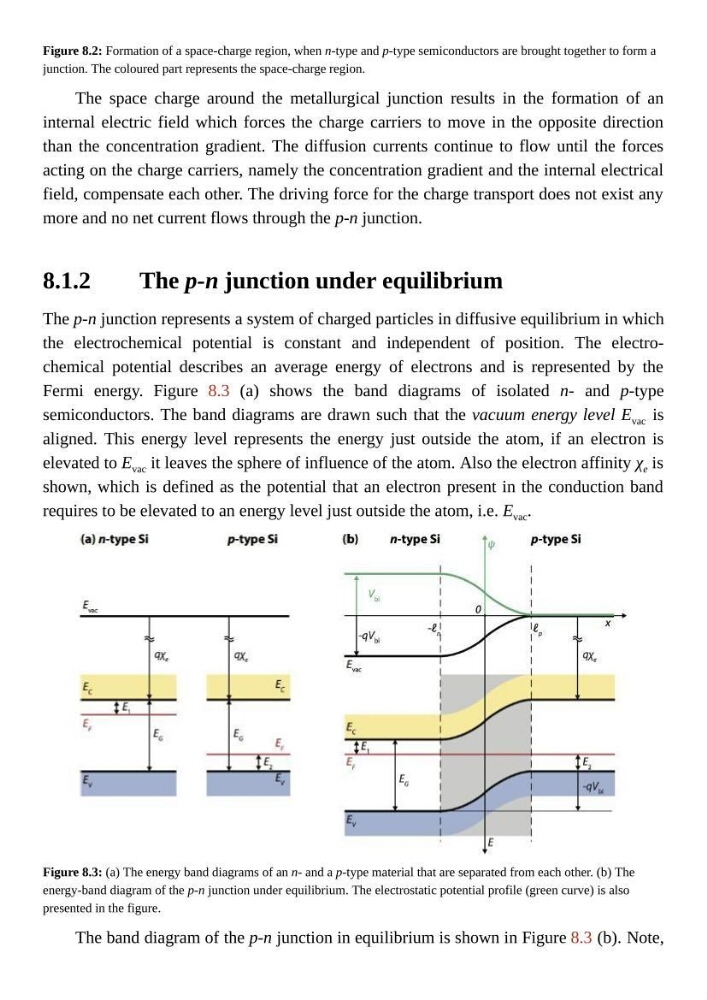
Fermi energy. Figure 8.3 (a) shows the band diagrams of isolated n- and p-type
semiconductors. The band diagrams are drawn such that the vacuum energy level E vac is
aligned. This energy level represents the energy just outside the atom, if an electron is
elevated to E vac it leaves the sphere of influence of the atom. Also the electron affinity χ e is
shown, which is defined as the potential that an electron present in the conduction band
requires to be elevated to an energy level just outside the atom, i.e. E vac .
Figure 8.3: (a) The energy band diagrams of an n- and a p-type material that are separated from each other. (b) The
energy-band diagram of the p-n junction under equilibrium. The electrostatic potential profile (green curve) is also
presented in the figure.
The band diagram of the p-n junction in equilibrium is shown in Figure 8.3 (b). Note,
Figure 8.2: Formation of a space-charge region, when n-type and p-type semiconductors are brought together to form a
junction. The coloured part represents the space-charge region.
The space charge around the metallurgical junction results in the formation of an
internal electric field which forces the charge carriers to move in the opposite direction
than the concentration gradient. The diffusion currents continue to flow until the forces
acting on the charge carriers, namely the concentration gradient and the internal electrical
field, compensate each other. The driving force for the charge transport does not exist any
more and no net current flows through the p-n junction.
The p-n junction under equilibrium
The p-n junction represents a system of charged particles in diffusive equilibrium in which
the electrochemical potential is constant and independent of position. The electrochemical potential describes an average energy of electrons and is represented by the
Fermi energy. Figure 8.3 (a) shows the band diagrams of isolated n- and p-type
semiconductors. The band diagrams are drawn such that the vacuum energy level E vac is
aligned. This energy level represents the energy just outside the atom, if an electron is
elevated to E vac it leaves the sphere of influence of the atom. Also the electron affinity χ e is
shown, which is defined as the potential that an electron present in the conduction band
requires to be elevated to an energy level just outside the atom, i.e. E vac .
Figure 8.3: (a) The energy band diagrams of an n- and a p-type material that are separated from each other. (b) The
energy-band diagram of the p-n junction under equilibrium. The electrostatic potential profile (green curve) is also
presented in the figure.
The band diagram of the p-n junction in equilibrium is shown in Figure 8.3 (b). Note,