

7.5
For an n-type semiconductor under high-injection conditions, as it occurs for example
for concentrator photovoltaics (CPV) with very high irradiance values, the lifetime can be
approximated with
where Δn = n − n 0 = p − p 0 is the excess carrier density [34]. Under these circumstances
Auger recombination might also become important for direct bandgap materials such as
gallium arsenide.
Surface recombination
All the recombination mechanisms that we discussed so far are bulk recombination
mechanisms, which can happen inside the bulk of a semiconductor. For example,
impurities can cause trap states within the semiconductor bandgap leading to Shockley–
Read–Hall recombination. However, in semiconductor devices, not only is bulk
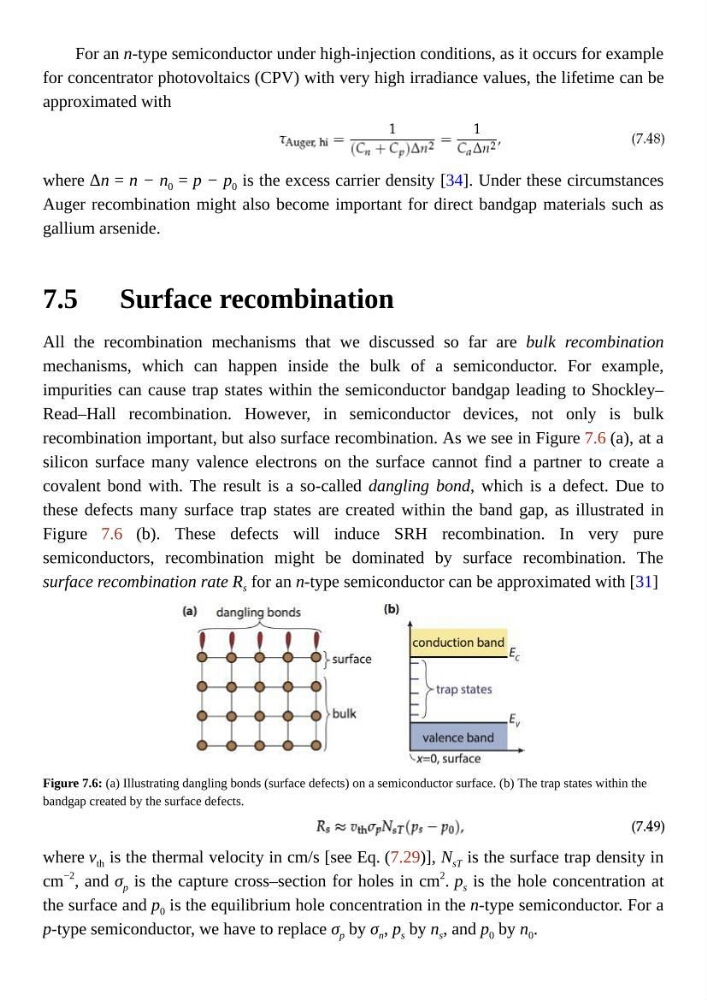
recombination important, but also surface recombination. As we see in Figure 7.6 (a), at a
silicon surface many valence electrons on the surface cannot find a partner to create a
covalent bond with. The result is a so-called dangling bond, which is a defect. Due to
these defects many surface trap states are created within the band gap, as illustrated in
Figure 7.6 (b). These defects will induce SRH recombination. In very pure
semiconductors, recombination might be dominated by surface recombination. The
surface recombination rate R s for an n-type semiconductor can be approximated with [31]
Figure 7.6: (a) Illustrating dangling bonds (surface defects) on a semiconductor surface. (b) The trap states within the
bandgap created by the surface defects.
where v th is the thermal velocity in cm/s [see Eq. (7.29)], N sT is the surface trap density in
cm
−2 , and σ p is the capture cross–section for holes in cm
2
. p s is the hole concentration at
the surface and p 0 is the equilibrium hole concentration in the n-type semiconductor. For a
p-type semiconductor, we have to replace σ p by σ n , p s by n s , and p 0 by n 0 .
For an n-type semiconductor under high-injection conditions, as it occurs for example
for concentrator photovoltaics (CPV) with very high irradiance values, the lifetime can be
approximated with
where Δn = n − n 0 = p − p 0 is the excess carrier density [34]. Under these circumstances
Auger recombination might also become important for direct bandgap materials such as
gallium arsenide.
Surface recombination
All the recombination mechanisms that we discussed so far are bulk recombination
mechanisms, which can happen inside the bulk of a semiconductor. For example,
impurities can cause trap states within the semiconductor bandgap leading to Shockley–
Read–Hall recombination. However, in semiconductor devices, not only is bulk
recombination important, but also surface recombination. As we see in Figure 7.6 (a), at a
silicon surface many valence electrons on the surface cannot find a partner to create a
covalent bond with. The result is a so-called dangling bond, which is a defect. Due to
these defects many surface trap states are created within the band gap, as illustrated in
Figure 7.6 (b). These defects will induce SRH recombination. In very pure
semiconductors, recombination might be dominated by surface recombination. The
surface recombination rate R s for an n-type semiconductor can be approximated with [31]
Figure 7.6: (a) Illustrating dangling bonds (surface defects) on a semiconductor surface. (b) The trap states within the
bandgap created by the surface defects.
where v th is the thermal velocity in cm/s [see Eq. (7.29)], N sT is the surface trap density in
cm
−2 , and σ p is the capture cross–section for holes in cm
2
. p s is the hole concentration at
the surface and p 0 is the equilibrium hole concentration in the n-type semiconductor. For a
p-type semiconductor, we have to replace σ p by σ n , p s by n s , and p 0 by n 0 .