

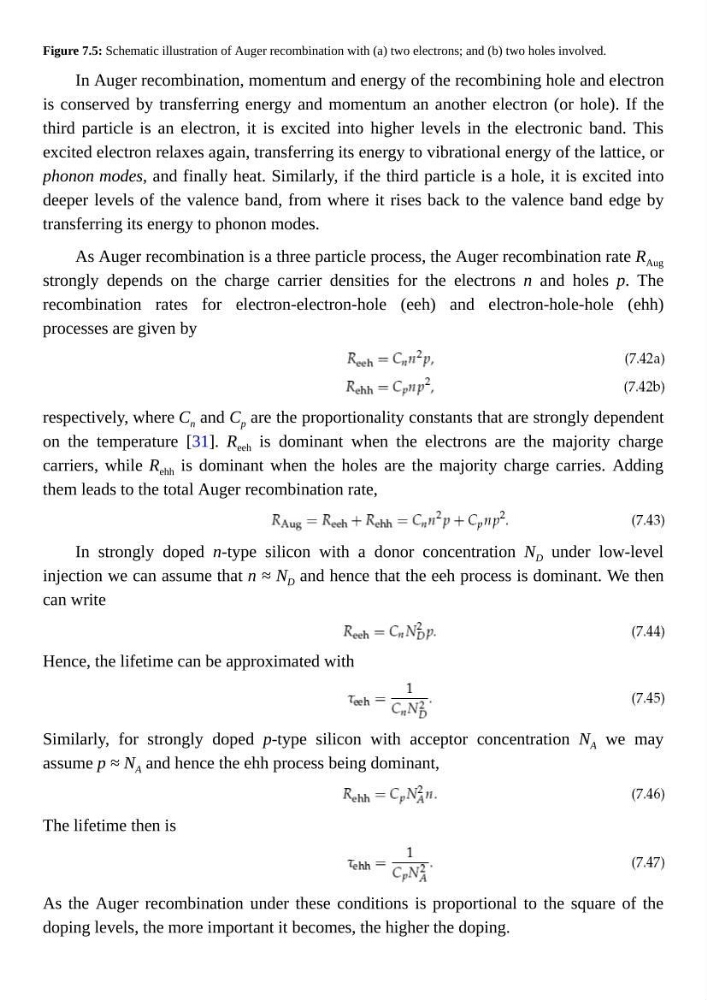
Figure 7.5: Schematic illustration of Auger recombination with (a) two electrons; and (b) two holes involved.
In Auger recombination, momentum and energy of the recombining hole and electron
is conserved by transferring energy and momentum an another electron (or hole). If the
third particle is an electron, it is excited into higher levels in the electronic band. This
excited electron relaxes again, transferring its energy to vibrational energy of the lattice, or
phonon modes, and finally heat. Similarly, if the third particle is a hole, it is excited into
deeper levels of the valence band, from where it rises back to the valence band edge by
transferring its energy to phonon modes.
As Auger recombination is a three particle process, the Auger recombination rate R Aug
strongly depends on the charge carrier densities for the electrons n and holes p. The
recombination rates for electron-electron-hole (eeh) and electron-hole-hole (ehh)
processes are given by
respectively, where C n and C p are the proportionality constants that are strongly dependent
on the temperature [31]. R eeh is dominant when the electrons are the majority charge
carriers, while R ehh is dominant when the holes are the majority charge carries. Adding
them leads to the total Auger recombination rate,
In strongly doped n-type silicon with a donor concentration N D under low-level
injection we can assume that n ≈ N D and hence that the eeh process is dominant. We then
can write
Hence, the lifetime can be approximated with
Similarly, for strongly doped p-type silicon with acceptor concentration N A we may
assume p ≈ N A and hence the ehh process being dominant,
The lifetime then is
As the Auger recombination under these conditions is proportional to the square of the
doping levels, the more important it becomes, the higher the doping.
In Auger recombination, momentum and energy of the recombining hole and electron
is conserved by transferring energy and momentum an another electron (or hole). If the
third particle is an electron, it is excited into higher levels in the electronic band. This
excited electron relaxes again, transferring its energy to vibrational energy of the lattice, or
phonon modes, and finally heat. Similarly, if the third particle is a hole, it is excited into
deeper levels of the valence band, from where it rises back to the valence band edge by
transferring its energy to phonon modes.
As Auger recombination is a three particle process, the Auger recombination rate R Aug
strongly depends on the charge carrier densities for the electrons n and holes p. The
recombination rates for electron-electron-hole (eeh) and electron-hole-hole (ehh)
processes are given by
respectively, where C n and C p are the proportionality constants that are strongly dependent
on the temperature [31]. R eeh is dominant when the electrons are the majority charge
carriers, while R ehh is dominant when the holes are the majority charge carries. Adding
them leads to the total Auger recombination rate,
In strongly doped n-type silicon with a donor concentration N D under low-level
injection we can assume that n ≈ N D and hence that the eeh process is dominant. We then
can write
Hence, the lifetime can be approximated with
Similarly, for strongly doped p-type silicon with acceptor concentration N A we may
assume p ≈ N A and hence the ehh process being dominant,
The lifetime then is
As the Auger recombination under these conditions is proportional to the square of the
doping levels, the more important it becomes, the higher the doping.