

79
Contemporary Machining Processes
heat diffusion depth, thus improving machining accuracy. On the other hand, nonlinear light self-focusing and its interaction with the ambient air may seriously affect
machining accuracy. Polarization control and helical drilling improved machining
quality and, especially when combined, provided a higher machining accuracy.
Chavoshi and Luo (2015) reviewed machining accuracy for hybrid micromachining
processes aimed to improve the machinability of hard-to-machine materials, tool
life, geometrical accuracy, surface integrity, and machining efficiency. Analysis of
accuracy issues of electrochemical nanomachining can be found in Han et al. (2020).
In direct-writing electrochemical nanomachining, machining accuracy depends on
the size and shape of a tip orifice, as well as the hydrophilicity of both the tip and
substrate. For template electroforming in the scale of a few nanometers, the key issue
is to avoid defects and cavities in the electroplating layer, especially for fabrication of
3D nanostructures with high aspect ratios.
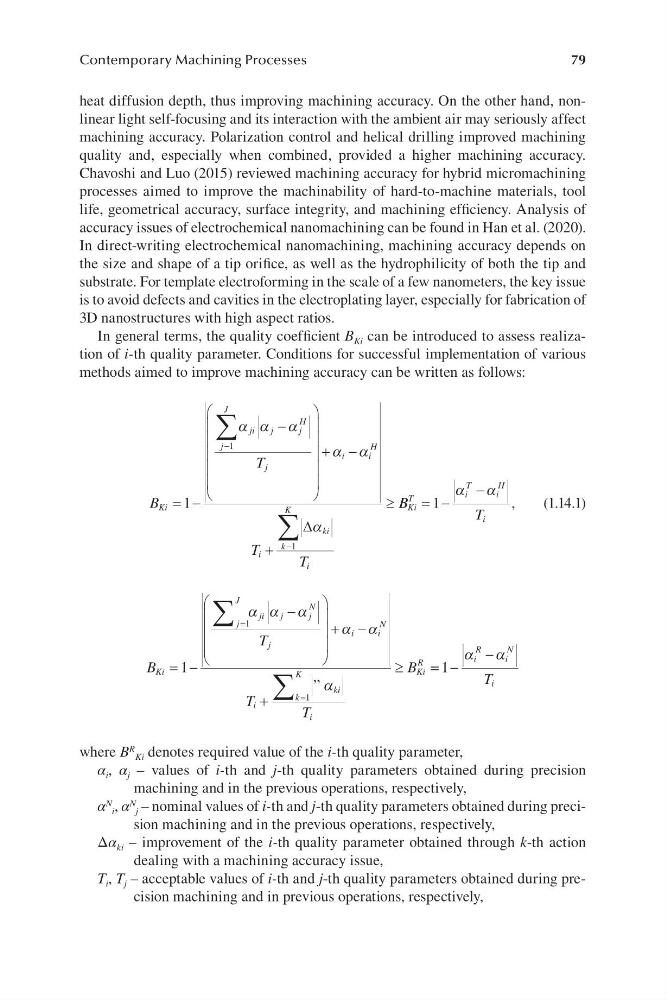
In general terms, the quality coefficient B Ki can be introduced to assess realization of i-th quality parameter. Conditions for successful implementation of various
methods aimed to improve machining accuracy can be written as follows:
B
T
T
T
Ki
ji
j
J
j
j
H
j
i
i
H
i
ki
k
K
i
= -
-
æ
è
ç
ç
ç
ç
ç
ö
ø
÷
÷
÷
÷
÷
+ -
+
³
-
-
å
å
1
1
1
a a a
a a
a
D
B B
T
Ki
T
i
T
i
H
i
= -
-
1
a a ,
(1.14.1)
B
T
T
T
B
Ki
j
J
ji
j
j
N
j
i
i
N
i
k
K
ki
i
Ki
R
= -
-
æ
è
ç
ç
ç
ö
ø
÷
÷
÷
+ -
+
³
=
=
å
å
1
1
1
a a a
a a
a
”
= = -
-
1
a a
i
R
i
N
i
T
where B R Ki denotes required value of the i-th quality parameter,
α i , α j – values of i-th and j-th quality parameters obtained during precision
machining and in the previous operations, respectively,
α N
i , α N
j – nominal values of i-th and j-th quality parameters obtained during precision machining and in the previous operations, respectively,
Δα ki – improvement of the i-th quality parameter obtained through k-th action
dealing with a machining accuracy issue,
T i , T j – acceptable values of i-th and j-th quality parameters obtained during precision machining and in previous operations, respectively,
Contemporary Machining Processes
heat diffusion depth, thus improving machining accuracy. On the other hand, nonlinear light self-focusing and its interaction with the ambient air may seriously affect
machining accuracy. Polarization control and helical drilling improved machining
quality and, especially when combined, provided a higher machining accuracy.
Chavoshi and Luo (2015) reviewed machining accuracy for hybrid micromachining
processes aimed to improve the machinability of hard-to-machine materials, tool
life, geometrical accuracy, surface integrity, and machining efficiency. Analysis of
accuracy issues of electrochemical nanomachining can be found in Han et al. (2020).
In direct-writing electrochemical nanomachining, machining accuracy depends on
the size and shape of a tip orifice, as well as the hydrophilicity of both the tip and
substrate. For template electroforming in the scale of a few nanometers, the key issue
is to avoid defects and cavities in the electroplating layer, especially for fabrication of
3D nanostructures with high aspect ratios.
In general terms, the quality coefficient B Ki can be introduced to assess realization of i-th quality parameter. Conditions for successful implementation of various
methods aimed to improve machining accuracy can be written as follows:
B
T
T
T
Ki
ji
j
J
j
j
H
j
i
i
H
i
ki
k
K
i
= -
-
æ
è
ç
ç
ç
ç
ç
ö
ø
÷
÷
÷
÷
÷
+ -
+
³
-
-
å
å
1
1
1
a a a
a a
a
D
B B
T
Ki
T
i
T
i
H
i
= -
-
1
a a ,
(1.14.1)
B
T
T
T
B
Ki
j
J
ji
j
j
N
j
i
i
N
i
k
K
ki
i
Ki
R
= -
-
æ
è
ç
ç
ç
ö
ø
÷
÷
÷
+ -
+
³
=
=
å
å
1
1
1
a a a
a a
a
”
= = -
-
1
a a
i
R
i
N
i
T
where B R Ki denotes required value of the i-th quality parameter,
α i , α j – values of i-th and j-th quality parameters obtained during precision
machining and in the previous operations, respectively,
α N
i , α N
j – nominal values of i-th and j-th quality parameters obtained during precision machining and in the previous operations, respectively,
Δα ki – improvement of the i-th quality parameter obtained through k-th action
dealing with a machining accuracy issue,
T i , T j – acceptable values of i-th and j-th quality parameters obtained during precision machining and in previous operations, respectively,