

35
Contemporary Machining Processes
c – cleaning and lubricating of the abrasive wheel during grinding of viscous
materials,
d – ultrasonic vibration-assisted (UV-A) conventional machining processes,
where a small amplitude ultrasonic vibration is applied to either the cutting
tool or the workpiece in order to intensify traditional cutting or grinding of
difficult-to-machine materials.
In the first type of USM, as shown in Figure 1.9a, the workpiece is placed in the abrasive slurry subject to intense ultrasonic vibrations. Hydrodynamic flows cause the
abrasive grains to have a velocity different from that of workpieces, due to the different densities. Thus, struck by abrasive grains, the workpiece material is removed.
The second type, as shown in Figure 1.9b, is the most widely used USM. The tool
(1) vibrates ultrasonically in the direction perpendicular to the machined surface and
is fed into the workpiece (3) by a constant force. The abrasive slurry is pumped into
the gap between the tool and workpiece, so that abrasive grains (2) act as indenters
to generate the brittle fracture in the workpiece material. Circulation of the slurry
removes the debris and supplies new abrasive grains.
The input variables of USM are related to machining, slurry, tool, and workpiece
material, as follows (Cong and Pei, 2013):
• Static load: about 0.1–30 N
• Ultrasonic vibration frequency: 20–40 kHz
• Ultrasonic vibration amplitude at the tool end: 5–50 mm
• Abrasive type (hardness): BC > SiC > SiO 2 > Al 2 O 3
• Abrasive grain size: 15–150 mm
• Abrasive weight concentration: 30–60%
• Tool materials (hardness): nimonic alloy > tungsten carbide > stainless
steel > titanium > copper
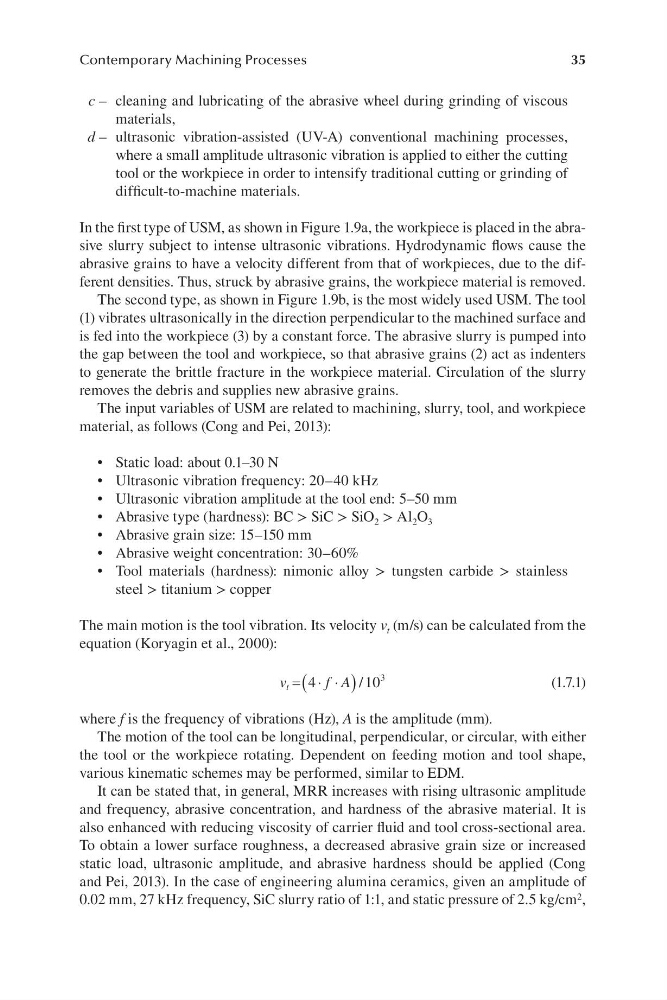
The main motion is the tool vibration. Its velocity v t (m/s) can be calculated from the
equation (Koryagin et al., 2000):
v
f A
t
/
= × ×
(
)
4
1 0
3
(1.7.1)
where f is the frequency of vibrations (Hz), A is the amplitude (mm).
The motion of the tool can be longitudinal, perpendicular, or circular, with either
the tool or the workpiece rotating. Dependent on feeding motion and tool shape,
various kinematic schemes may be performed, similar to EDM.
It can be stated that, in general, MRR increases with rising ultrasonic amplitude
and frequency, abrasive concentration, and hardness of the abrasive material. It is
also enhanced with reducing viscosity of carrier fluid and tool cross-sectional area.
To obtain a lower surface roughness, a decreased abrasive grain size or increased
static load, ultrasonic amplitude, and abrasive hardness should be applied (Cong
and Pei, 2013). In the case of engineering alumina ceramics, given an amplitude of
0.02 mm, 27 kHz frequency, SiC slurry ratio of 1:1, and static pressure of 2.5 kg/cm 2 ,
Contemporary Machining Processes
c – cleaning and lubricating of the abrasive wheel during grinding of viscous
materials,
d – ultrasonic vibration-assisted (UV-A) conventional machining processes,
where a small amplitude ultrasonic vibration is applied to either the cutting
tool or the workpiece in order to intensify traditional cutting or grinding of
difficult-to-machine materials.
In the first type of USM, as shown in Figure 1.9a, the workpiece is placed in the abrasive slurry subject to intense ultrasonic vibrations. Hydrodynamic flows cause the
abrasive grains to have a velocity different from that of workpieces, due to the different densities. Thus, struck by abrasive grains, the workpiece material is removed.
The second type, as shown in Figure 1.9b, is the most widely used USM. The tool
(1) vibrates ultrasonically in the direction perpendicular to the machined surface and
is fed into the workpiece (3) by a constant force. The abrasive slurry is pumped into
the gap between the tool and workpiece, so that abrasive grains (2) act as indenters
to generate the brittle fracture in the workpiece material. Circulation of the slurry
removes the debris and supplies new abrasive grains.
The input variables of USM are related to machining, slurry, tool, and workpiece
material, as follows (Cong and Pei, 2013):
• Static load: about 0.1–30 N
• Ultrasonic vibration frequency: 20–40 kHz
• Ultrasonic vibration amplitude at the tool end: 5–50 mm
• Abrasive type (hardness): BC > SiC > SiO 2 > Al 2 O 3
• Abrasive grain size: 15–150 mm
• Abrasive weight concentration: 30–60%
• Tool materials (hardness): nimonic alloy > tungsten carbide > stainless
steel > titanium > copper
The main motion is the tool vibration. Its velocity v t (m/s) can be calculated from the
equation (Koryagin et al., 2000):
v
f A
t
/
= × ×
(
)
4
1 0
3
(1.7.1)
where f is the frequency of vibrations (Hz), A is the amplitude (mm).
The motion of the tool can be longitudinal, perpendicular, or circular, with either
the tool or the workpiece rotating. Dependent on feeding motion and tool shape,
various kinematic schemes may be performed, similar to EDM.
It can be stated that, in general, MRR increases with rising ultrasonic amplitude
and frequency, abrasive concentration, and hardness of the abrasive material. It is
also enhanced with reducing viscosity of carrier fluid and tool cross-sectional area.
To obtain a lower surface roughness, a decreased abrasive grain size or increased
static load, ultrasonic amplitude, and abrasive hardness should be applied (Cong
and Pei, 2013). In the case of engineering alumina ceramics, given an amplitude of
0.02 mm, 27 kHz frequency, SiC slurry ratio of 1:1, and static pressure of 2.5 kg/cm 2 ,