

34
Remanufacturing and Advanced Machining
range is 7–25 μm and holes of small diameters of up to 76 μm can be obtained
(Sawant, 2020).
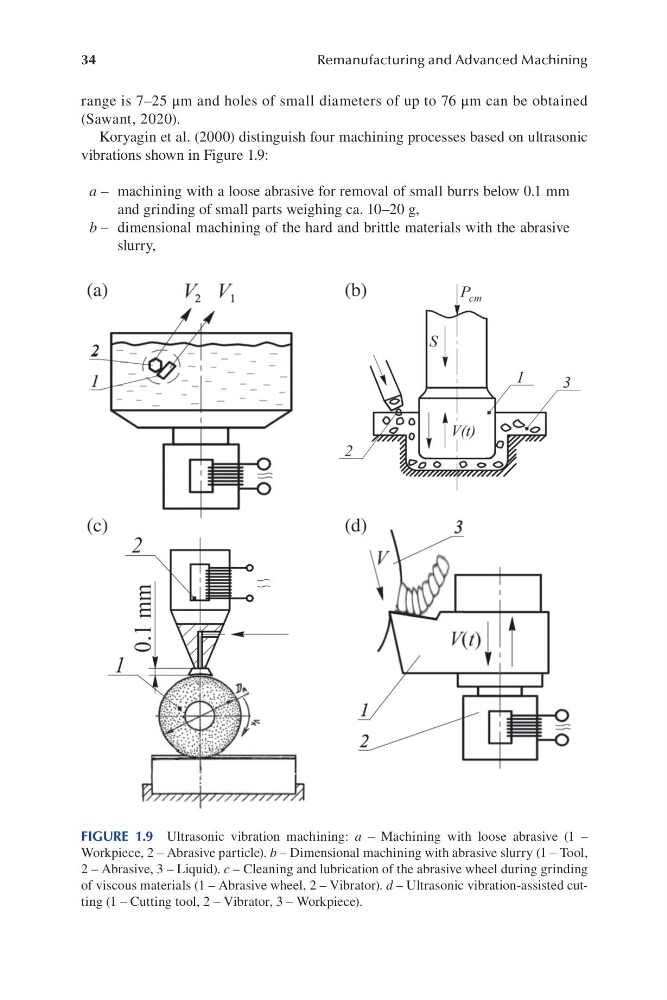
Koryagin et al. (2000) distinguish four machining processes based on ultrasonic
vibrations shown in Figure 1.9:
а – machining with a loose abrasive for removal of small burrs below 0.1 mm
and grinding of small parts weighing ca. 10–20 g,
b – dimensional machining of the hard and brittle materials with the abrasive
slurry,
FIGURE 1.9 Ultrasonic vibration machining: a – Machining with loose abrasive (1 –
Workpiece, 2 – Abrasive particle). b – Dimensional machining with abrasive slurry (1 – Tool,
2 – Abrasive, 3 – Liquid). c – Cleaning and lubrication of the abrasive wheel during grinding
of viscous materials (1 – Abrasive wheel, 2 – Vibrator). d – Ultrasonic vibration-assisted cutting (1 – Cutting tool, 2 – Vibrator, 3 – Workpiece).
Remanufacturing and Advanced Machining
range is 7–25 μm and holes of small diameters of up to 76 μm can be obtained
(Sawant, 2020).
Koryagin et al. (2000) distinguish four machining processes based on ultrasonic
vibrations shown in Figure 1.9:
а – machining with a loose abrasive for removal of small burrs below 0.1 mm
and grinding of small parts weighing ca. 10–20 g,
b – dimensional machining of the hard and brittle materials with the abrasive
slurry,
FIGURE 1.9 Ultrasonic vibration machining: a – Machining with loose abrasive (1 –
Workpiece, 2 – Abrasive particle). b – Dimensional machining with abrasive slurry (1 – Tool,
2 – Abrasive, 3 – Liquid). c – Cleaning and lubrication of the abrasive wheel during grinding
of viscous materials (1 – Abrasive wheel, 2 – Vibrator). d – Ultrasonic vibration-assisted cutting (1 – Cutting tool, 2 – Vibrator, 3 – Workpiece).