

18
Remanufacturing and Advanced Machining
blown through vibrated sand, its particles gradually move toward the vacuum filter.
The smallest fractions move first, leaving the main sand body weakened or even
destroyed. In the air promoted flow, the entire sand mass is moved until its particles
meet the barrier. When the pressure drop is maintained, the air or liquid flow finds
paths of the smallest resistance until these are clogged by air-carried fine particles.
Additionally, when brittle, thin patterns are applied, the sand is not densified from
the top, so that its upper layer is weaker than the lower ones. Moreover, the insufficient density of the sand without binders allows the molten metal to penetrate it,
impairing the surface quality of the casting. There is also a problem from the perspective of energy savings, since the mass of vibrating components is close to the
mass of sand and additional energy is consumed for the motion.
An interesting combined method of vibrating sand under vacuum is proposed
by Doroshenko (2013). Among its advantages are simplified equipment, multifactor densification of sand, controlled gas pressure and vibration frequency, and wide
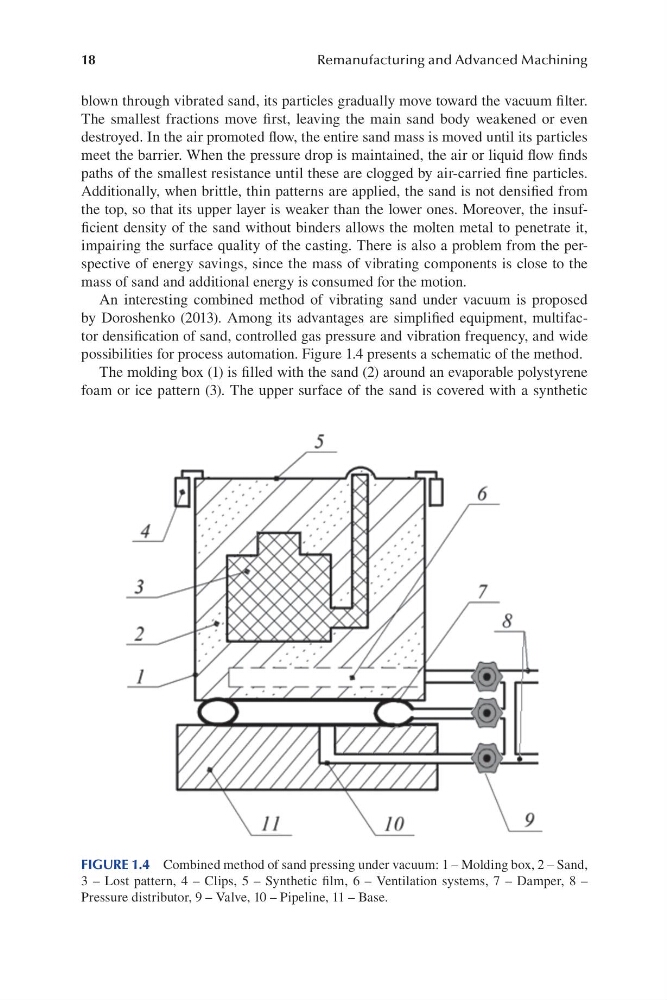
possibilities for process automation. Figure 1.4 presents a schematic of the method.
The molding box (1) is filled with the sand (2) around an evaporable polystyrene
foam or ice pattern (3). The upper surface of the sand is covered with a synthetic
FIGURE 1.4 Combined method of sand pressing under vacuum: 1 – Molding box, 2 – Sand,
3 – Lost pattern, 4 – Clips, 5 – Synthetic film, 6 – Ventilation systems, 7 – Damper, 8 –
Pressure distributor, 9 – Valve, 10 – Pipeline, 11 – Base.
Remanufacturing and Advanced Machining
blown through vibrated sand, its particles gradually move toward the vacuum filter.
The smallest fractions move first, leaving the main sand body weakened or even
destroyed. In the air promoted flow, the entire sand mass is moved until its particles
meet the barrier. When the pressure drop is maintained, the air or liquid flow finds
paths of the smallest resistance until these are clogged by air-carried fine particles.
Additionally, when brittle, thin patterns are applied, the sand is not densified from
the top, so that its upper layer is weaker than the lower ones. Moreover, the insufficient density of the sand without binders allows the molten metal to penetrate it,
impairing the surface quality of the casting. There is also a problem from the perspective of energy savings, since the mass of vibrating components is close to the
mass of sand and additional energy is consumed for the motion.
An interesting combined method of vibrating sand under vacuum is proposed
by Doroshenko (2013). Among its advantages are simplified equipment, multifactor densification of sand, controlled gas pressure and vibration frequency, and wide
possibilities for process automation. Figure 1.4 presents a schematic of the method.
The molding box (1) is filled with the sand (2) around an evaporable polystyrene
foam or ice pattern (3). The upper surface of the sand is covered with a synthetic
FIGURE 1.4 Combined method of sand pressing under vacuum: 1 – Molding box, 2 – Sand,
3 – Lost pattern, 4 – Clips, 5 – Synthetic film, 6 – Ventilation systems, 7 – Damper, 8 –
Pressure distributor, 9 – Valve, 10 – Pipeline, 11 – Base.