

17
Contemporary Machining Processes
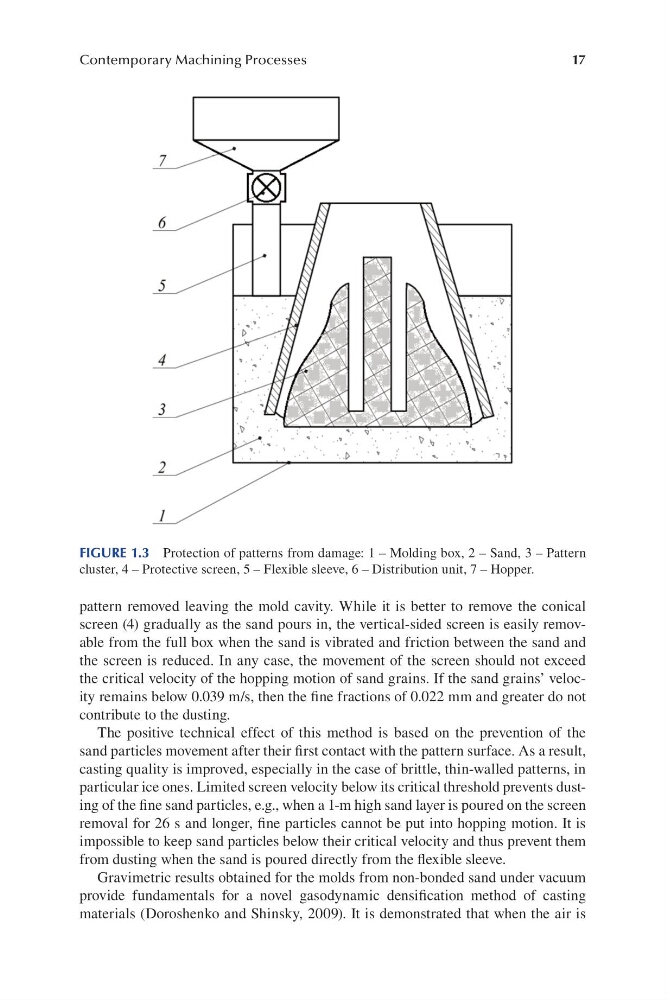
pattern removed leaving the mold cavity. While it is better to remove the conical
screen (4) gradually as the sand pours in, the vertical-sided screen is easily removable from the full box when the sand is vibrated and friction between the sand and
the screen is reduced. In any case, the movement of the screen should not exceed
the critical velocity of the hopping motion of sand grains. If the sand grains’ velocity remains below 0.039 m/s, then the fine fractions of 0.022 mm and greater do not
contribute to the dusting.
The positive technical effect of this method is based on the prevention of the
sand particles movement after their first contact with the pattern surface. As a result,
casting quality is improved, especially in the case of brittle, thin-walled patterns, in
particular ice ones. Limited screen velocity below its critical threshold prevents dusting of the fine sand particles, e.g., when a 1-m high sand layer is poured on the screen
removal for 26 s and longer, fine particles cannot be put into hopping motion. It is
impossible to keep sand particles below their critical velocity and thus prevent them
from dusting when the sand is poured directly from the flexible sleeve.
Gravimetric results obtained for the molds from non-bonded sand under vacuum
provide fundamentals for a novel gasodynamic densification method of casting
materials (Doroshenko and Shinsky, 2009). It is demonstrated that when the air is
FIGURE 1.3 Protection of patterns from damage: 1 – Molding box, 2 – Sand, 3 – Pattern
cluster, 4 – Protective screen, 5 – Flexible sleeve, 6 – Distribution unit, 7 – Hopper.
Contemporary Machining Processes
pattern removed leaving the mold cavity. While it is better to remove the conical
screen (4) gradually as the sand pours in, the vertical-sided screen is easily removable from the full box when the sand is vibrated and friction between the sand and
the screen is reduced. In any case, the movement of the screen should not exceed
the critical velocity of the hopping motion of sand grains. If the sand grains’ velocity remains below 0.039 m/s, then the fine fractions of 0.022 mm and greater do not
contribute to the dusting.
The positive technical effect of this method is based on the prevention of the
sand particles movement after their first contact with the pattern surface. As a result,
casting quality is improved, especially in the case of brittle, thin-walled patterns, in
particular ice ones. Limited screen velocity below its critical threshold prevents dusting of the fine sand particles, e.g., when a 1-m high sand layer is poured on the screen
removal for 26 s and longer, fine particles cannot be put into hopping motion. It is
impossible to keep sand particles below their critical velocity and thus prevent them
from dusting when the sand is poured directly from the flexible sleeve.
Gravimetric results obtained for the molds from non-bonded sand under vacuum
provide fundamentals for a novel gasodynamic densification method of casting
materials (Doroshenko and Shinsky, 2009). It is demonstrated that when the air is
FIGURE 1.3 Protection of patterns from damage: 1 – Molding box, 2 – Sand, 3 – Pattern
cluster, 4 – Protective screen, 5 – Flexible sleeve, 6 – Distribution unit, 7 – Hopper.