

137
Smart Machining Processes
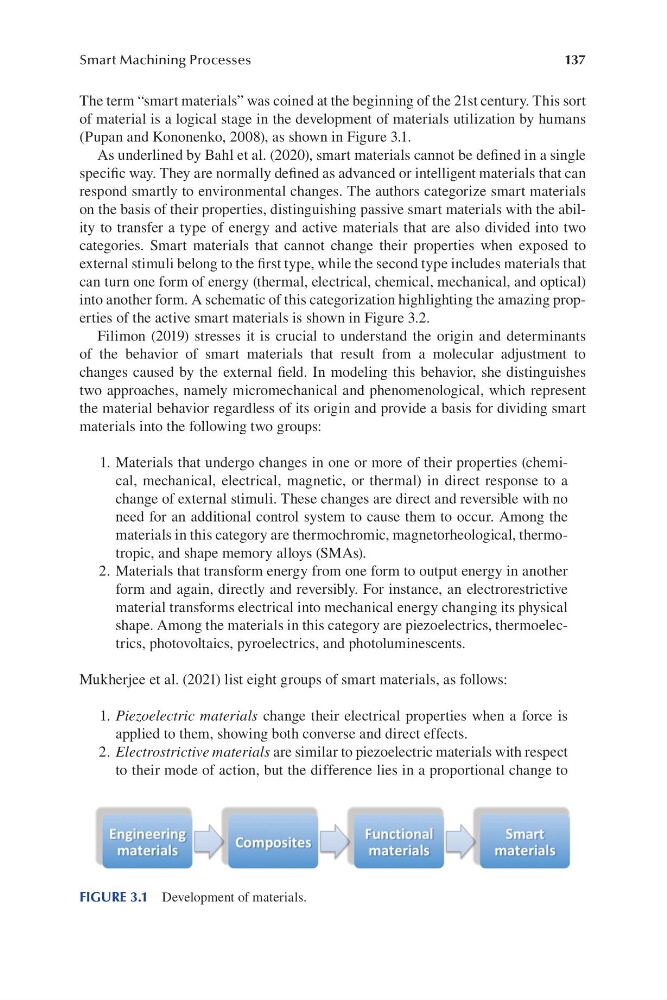
The term “smart materials” was coined at the beginning of the 21st century. This sort
of material is a logical stage in the development of materials utilization by humans
(Pupan and Kononenko, 2008), as shown in Figure 3.1.
As underlined by Bahl et al. (2020), smart materials cannot be defined in a single
specific way. They are normally defined as advanced or intelligent materials that can
respond smartly to environmental changes. The authors categorize smart materials
on the basis of their properties, distinguishing passive smart materials with the ability to transfer a type of energy and active materials that are also divided into two
categories. Smart materials that cannot change their properties when exposed to
external stimuli belong to the first type, while the second type includes materials that
can turn one form of energy (thermal, electrical, chemical, mechanical, and optical)
into another form. A schematic of this categorization highlighting the amazing properties of the active smart materials is shown in Figure 3.2.
Filimon (2019) stresses it is crucial to understand the origin and determinants
of the behavior of smart materials that result from a molecular adjustment to
changes caused by the external field. In modeling this behavior, she distinguishes
two approaches, namely micromechanical and phenomenological, which represent
the material behavior regardless of its origin and provide a basis for dividing smart
materials into the following two groups:
1. Materials that undergo changes in one or more of their properties (chemical, mechanical, electrical, magnetic, or thermal) in direct response to a
change of external stimuli. These changes are direct and reversible with no
need for an additional control system to cause them to occur. Among the
materials in this category are thermochromic, magnetorheological, thermotropic, and shape memory alloys (SMAs).
2. Materials that transform energy from one form to output energy in another
form and again, directly and reversibly. For instance, an electrorestrictive
material transforms electrical into mechanical energy changing its physical
shape. Among the materials in this category are piezoelectrics, thermoelectrics, photovoltaics, pyroelectrics, and photoluminescents.
Mukherjee et al. (2021) list eight groups of smart materials, as follows:
1. Piezoelectric materials change their electrical properties when a force is
applied to them, showing both converse and direct effects.
2. Electrostrictive materials are similar to piezoelectric materials with respect
to their mode of action, but the difference lies in a proportional change to
FIGURE 3.1 Development of materials.
Smart Machining Processes
The term “smart materials” was coined at the beginning of the 21st century. This sort
of material is a logical stage in the development of materials utilization by humans
(Pupan and Kononenko, 2008), as shown in Figure 3.1.
As underlined by Bahl et al. (2020), smart materials cannot be defined in a single
specific way. They are normally defined as advanced or intelligent materials that can
respond smartly to environmental changes. The authors categorize smart materials
on the basis of their properties, distinguishing passive smart materials with the ability to transfer a type of energy and active materials that are also divided into two
categories. Smart materials that cannot change their properties when exposed to
external stimuli belong to the first type, while the second type includes materials that
can turn one form of energy (thermal, electrical, chemical, mechanical, and optical)
into another form. A schematic of this categorization highlighting the amazing properties of the active smart materials is shown in Figure 3.2.
Filimon (2019) stresses it is crucial to understand the origin and determinants
of the behavior of smart materials that result from a molecular adjustment to
changes caused by the external field. In modeling this behavior, she distinguishes
two approaches, namely micromechanical and phenomenological, which represent
the material behavior regardless of its origin and provide a basis for dividing smart
materials into the following two groups:
1. Materials that undergo changes in one or more of their properties (chemical, mechanical, electrical, magnetic, or thermal) in direct response to a
change of external stimuli. These changes are direct and reversible with no
need for an additional control system to cause them to occur. Among the
materials in this category are thermochromic, magnetorheological, thermotropic, and shape memory alloys (SMAs).
2. Materials that transform energy from one form to output energy in another
form and again, directly and reversibly. For instance, an electrorestrictive
material transforms electrical into mechanical energy changing its physical
shape. Among the materials in this category are piezoelectrics, thermoelectrics, photovoltaics, pyroelectrics, and photoluminescents.
Mukherjee et al. (2021) list eight groups of smart materials, as follows:
1. Piezoelectric materials change their electrical properties when a force is
applied to them, showing both converse and direct effects.
2. Electrostrictive materials are similar to piezoelectric materials with respect
to their mode of action, but the difference lies in a proportional change to
FIGURE 3.1 Development of materials.