

81
Contemporary Machining Processes
where T w – acceptable dimensional wear of a tool (mm), and j w – dimensional wear
rate (μm/10 3 m).
The dimensional durability of cutting edges of a combined tool is dependent on
the compensation mechanisms applied during machining. In this respect, it may be
classified as follows: L E0 – without compensation, L Ev – with a vibrational protective
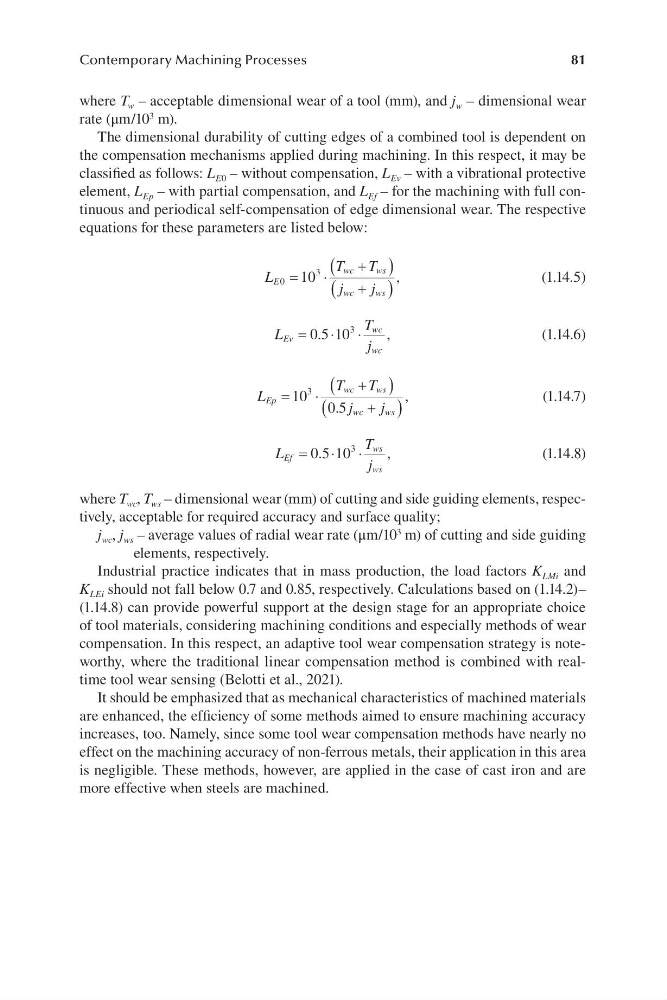
element, L Ep – with partial compensation, and L Ef – for the machining with full continuous and periodical self-compensation of edge dimensional wear. The respective
equations for these parameters are listed below:
L
T
T
j
j
E
wc
ws
wc
ws
0
3
10
=
×
+
(
)
+
(
)
,
(1.14.5)
L
T
j
Ev
wc
wc
=
×
×
0 5 10
3
.
,
(1.14.6)
L
T
T
j
j
Ep
wc
ws
wc
ws
=
×
+
(
)
+
(
)
10 0 5
3
.
,
(1.14.7)
L
T
j
Ef
ws
ws
=
×
×
0 5 10
3
.
,
(1.14.8)
where T wc , T ws – dimensional wear (mm) of cutting and side guiding elements, respectively, acceptable for required accuracy and surface quality;
j wc , j ws – average values of radial wear rate (μm/10 3 m) of cutting and side guiding
elements, respectively.
Industrial practice indicates that in mass production, the load factors K LMi and
K LEi should not fall below 0.7 and 0.85, respectively. Calculations based on (1.14.2)–
(1.14.8) can provide powerful support at the design stage for an appropriate choice
of tool materials, considering machining conditions and especially methods of wear
compensation. In this respect, an adaptive tool wear compensation strategy is noteworthy, where the traditional linear compensation method is combined with realtime tool wear sensing (Belotti et al., 2021).
It should be emphasized that as mechanical characteristics of machined materials
are enhanced, the efficiency of some methods aimed to ensure machining accuracy
increases, too. Namely, since some tool wear compensation methods have nearly no
effect on the machining accuracy of non-ferrous metals, their application in this area
is negligible. These methods, however, are applied in the case of cast iron and are
more effective when steels are machined.
Contemporary Machining Processes
where T w – acceptable dimensional wear of a tool (mm), and j w – dimensional wear
rate (μm/10 3 m).
The dimensional durability of cutting edges of a combined tool is dependent on
the compensation mechanisms applied during machining. In this respect, it may be
classified as follows: L E0 – without compensation, L Ev – with a vibrational protective
element, L Ep – with partial compensation, and L Ef – for the machining with full continuous and periodical self-compensation of edge dimensional wear. The respective
equations for these parameters are listed below:
L
T
T
j
j
E
wc
ws
wc
ws
0
3
10
=
×
+
(
)
+
(
)
,
(1.14.5)
L
T
j
Ev
wc
wc
=
×
×
0 5 10
3
.
,
(1.14.6)
L
T
T
j
j
Ep
wc
ws
wc
ws
=
×
+
(
)
+
(
)
10 0 5
3
.
,
(1.14.7)
L
T
j
Ef
ws
ws
=
×
×
0 5 10
3
.
,
(1.14.8)
where T wc , T ws – dimensional wear (mm) of cutting and side guiding elements, respectively, acceptable for required accuracy and surface quality;
j wc , j ws – average values of radial wear rate (μm/10 3 m) of cutting and side guiding
elements, respectively.
Industrial practice indicates that in mass production, the load factors K LMi and
K LEi should not fall below 0.7 and 0.85, respectively. Calculations based on (1.14.2)–
(1.14.8) can provide powerful support at the design stage for an appropriate choice
of tool materials, considering machining conditions and especially methods of wear
compensation. In this respect, an adaptive tool wear compensation strategy is noteworthy, where the traditional linear compensation method is combined with realtime tool wear sensing (Belotti et al., 2021).
It should be emphasized that as mechanical characteristics of machined materials
are enhanced, the efficiency of some methods aimed to ensure machining accuracy
increases, too. Namely, since some tool wear compensation methods have nearly no
effect on the machining accuracy of non-ferrous metals, their application in this area
is negligible. These methods, however, are applied in the case of cast iron and are
more effective when steels are machined.