

87
A further work aimed at elucidating general principles for transdermal deep
eutectic solvent formulation employed two model molecules, acarbose and ruxolitinib, as examples of hydrophilic and hydrophobic drugs, respectively (Tanner et al.
2019). Different choline-to-geranic acid proportions were used, as well as alternative carboxylic acids to replace geranic acid. The ability of the solvent systems to
deliver the active molecules across skin in vitro was correlated with 2D nuclear
magnetic resonance studies. It was observed that the transdermal transport capacity
of the deep eutectic solvent was inversely related to the strength of the interionic
interactions in the solvent. As a result, a deep eutectic solvent containing citronellic
acid was found to be the optimal vehicle for ruxolitinib.
Based on the body of work accumulated with the “CAGE” solvent, Qi and
Mitragotri have recently published a mechanistic study (Qi and Mitragotri 2019).
They measured the skin penetration of fluorescent dextran of different molecular
weights and concluded that for molecules up to 150 kilodaltons, transport was
enhanced irrespective of molecular size. Combined with their observations on lipid
extraction, they concluded that the “CAGE” formulation creates a more favorable
environment for diffusion in the skin that does not rely on physiological transport
pathways (Qi and Mitragotri 2019).
The use of ionic liquids and deep eutectic solvents for transdermal applications
was recently comprehensively reviewed by Sidat et al. (Sidat et al. 2019). In particular, they list some studies in which ionic liquids have been used in synergy with
conventional chemical penetration enhancers.
Table 5 provides a summary of work done on the transdermal applications of
deep eutectic solvents.
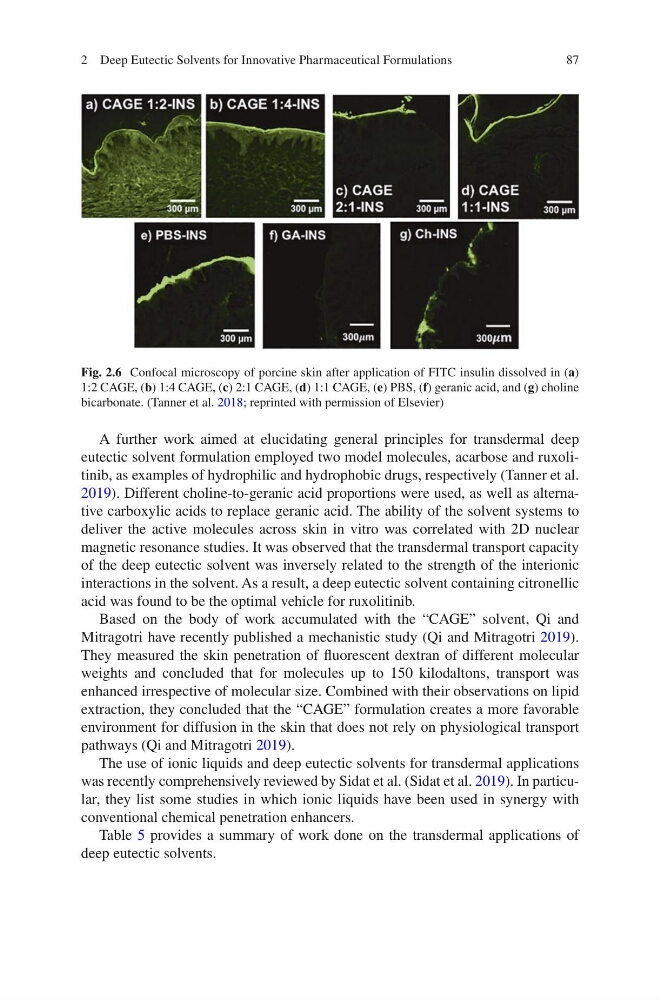
Fig. 2.6 Confocal microscopy of porcine skin after application of FITC insulin dissolved in (a)
1:2 CAGE, (b) 1:4 CAGE, (c) 2:1 CAGE, (d) 1:1 CAGE, (e) PBS, (f) geranic acid, and (g) choline
bicarbonate. (Tanner et al. 2018; reprinted with permission of Elsevier)
2 Deep Eutectic Solvents for Innovative Pharmaceutical Formulations
A further work aimed at elucidating general principles for transdermal deep
eutectic solvent formulation employed two model molecules, acarbose and ruxolitinib, as examples of hydrophilic and hydrophobic drugs, respectively (Tanner et al.
2019). Different choline-to-geranic acid proportions were used, as well as alternative carboxylic acids to replace geranic acid. The ability of the solvent systems to
deliver the active molecules across skin in vitro was correlated with 2D nuclear
magnetic resonance studies. It was observed that the transdermal transport capacity
of the deep eutectic solvent was inversely related to the strength of the interionic
interactions in the solvent. As a result, a deep eutectic solvent containing citronellic
acid was found to be the optimal vehicle for ruxolitinib.
Based on the body of work accumulated with the “CAGE” solvent, Qi and
Mitragotri have recently published a mechanistic study (Qi and Mitragotri 2019).
They measured the skin penetration of fluorescent dextran of different molecular
weights and concluded that for molecules up to 150 kilodaltons, transport was
enhanced irrespective of molecular size. Combined with their observations on lipid
extraction, they concluded that the “CAGE” formulation creates a more favorable
environment for diffusion in the skin that does not rely on physiological transport
pathways (Qi and Mitragotri 2019).
The use of ionic liquids and deep eutectic solvents for transdermal applications
was recently comprehensively reviewed by Sidat et al. (Sidat et al. 2019). In particular, they list some studies in which ionic liquids have been used in synergy with
conventional chemical penetration enhancers.
Table 5 provides a summary of work done on the transdermal applications of
deep eutectic solvents.
Fig. 2.6 Confocal microscopy of porcine skin after application of FITC insulin dissolved in (a)
1:2 CAGE, (b) 1:4 CAGE, (c) 2:1 CAGE, (d) 1:1 CAGE, (e) PBS, (f) geranic acid, and (g) choline
bicarbonate. (Tanner et al. 2018; reprinted with permission of Elsevier)
2 Deep Eutectic Solvents for Innovative Pharmaceutical Formulations