

74
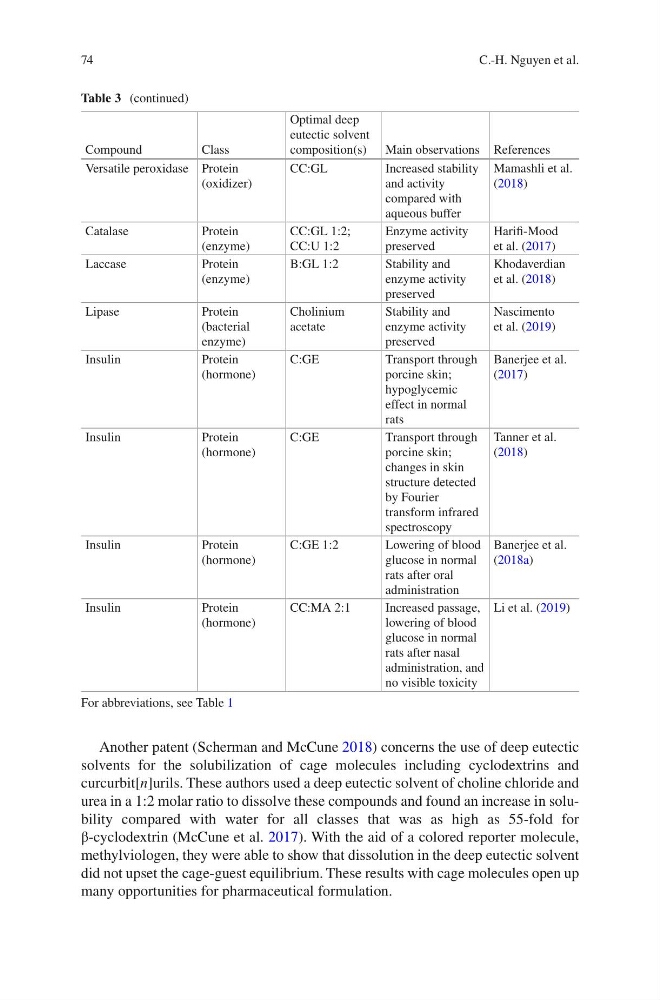
Table 3 (continued)
Compound
Class
Optimal deep
eutectic solvent
composition(s) Main observations References
Versatile peroxidase Protein
(oxidizer)
CC:GL
Increased stability
and activity
compared with
aqueous buffer
Mamashli et al.
(2018)
Catalase
Protein
(enzyme)
CC:GL 1:2;
CC:U 1:2
Enzyme activity
preserved
Harifi-Mood
et al. (2017)
Laccase
Protein
(enzyme)
B:GL 1:2
Stability and
enzyme activity
preserved
Khodaverdian
et al. (2018)
Lipase
Protein
(bacterial
enzyme)
Cholinium
acetate
Stability and
enzyme activity
preserved
Nascimento
et al. (2019)
Insulin
Protein
(hormone)
C:GE
Transport through
porcine skin;
hypoglycemic
effect in normal
rats
Banerjee et al.
(2017)
Insulin
Protein
(hormone)
C:GE
Transport through
porcine skin;
changes in skin
structure detected
by Fourier
transform infrared
spectroscopy
Tanner et al.
(2018)
Insulin
Protein
(hormone)
C:GE 1:2
Lowering of blood
glucose in normal
rats after oral
administration
Banerjee et al.
(2018a)
Insulin
Protein
(hormone)
CC:MA 2:1
Increased passage,
lowering of blood
glucose in normal
rats after nasal
administration, and
no visible toxicity
Li et al. (2019)
For abbreviations, see Table 1
Another patent (Scherman and McCune 2018) concerns the use of deep eutectic
solvents for the solubilization of cage molecules including cyclodextrins and
curcurbit[n]urils. These authors used a deep eutectic solvent of choline chloride and
urea in a 1:2 molar ratio to dissolve these compounds and found an increase in solubility compared with water for all classes that was as high as 55-fold for
β-cyclodextrin (McCune et al. 2017). With the aid of a colored reporter molecule,
methylviologen, they were able to show that dissolution in the deep eutectic solvent
did not upset the cage-guest equilibrium. These results with cage molecules open up
many opportunities for pharmaceutical formulation.
C.-H. Nguyen et al.
Table 3 (continued)
Compound
Class
Optimal deep
eutectic solvent
composition(s) Main observations References
Versatile peroxidase Protein
(oxidizer)
CC:GL
Increased stability
and activity
compared with
aqueous buffer
Mamashli et al.
(2018)
Catalase
Protein
(enzyme)
CC:GL 1:2;
CC:U 1:2
Enzyme activity
preserved
Harifi-Mood
et al. (2017)
Laccase
Protein
(enzyme)
B:GL 1:2
Stability and
enzyme activity
preserved
Khodaverdian
et al. (2018)
Lipase
Protein
(bacterial
enzyme)
Cholinium
acetate
Stability and
enzyme activity
preserved
Nascimento
et al. (2019)
Insulin
Protein
(hormone)
C:GE
Transport through
porcine skin;
hypoglycemic
effect in normal
rats
Banerjee et al.
(2017)
Insulin
Protein
(hormone)
C:GE
Transport through
porcine skin;
changes in skin
structure detected
by Fourier
transform infrared
spectroscopy
Tanner et al.
(2018)
Insulin
Protein
(hormone)
C:GE 1:2
Lowering of blood
glucose in normal
rats after oral
administration
Banerjee et al.
(2018a)
Insulin
Protein
(hormone)
CC:MA 2:1
Increased passage,
lowering of blood
glucose in normal
rats after nasal
administration, and
no visible toxicity
Li et al. (2019)
For abbreviations, see Table 1
Another patent (Scherman and McCune 2018) concerns the use of deep eutectic
solvents for the solubilization of cage molecules including cyclodextrins and
curcurbit[n]urils. These authors used a deep eutectic solvent of choline chloride and
urea in a 1:2 molar ratio to dissolve these compounds and found an increase in solubility compared with water for all classes that was as high as 55-fold for
β-cyclodextrin (McCune et al. 2017). With the aid of a colored reporter molecule,
methylviologen, they were able to show that dissolution in the deep eutectic solvent
did not upset the cage-guest equilibrium. These results with cage molecules open up
many opportunities for pharmaceutical formulation.
C.-H. Nguyen et al.