

33
ratio (Gabriele et al. 2019). Besides, a deep understanding of the impact of water on
the deep eutectic solvent’s structural arrangement will surely expand the possibility
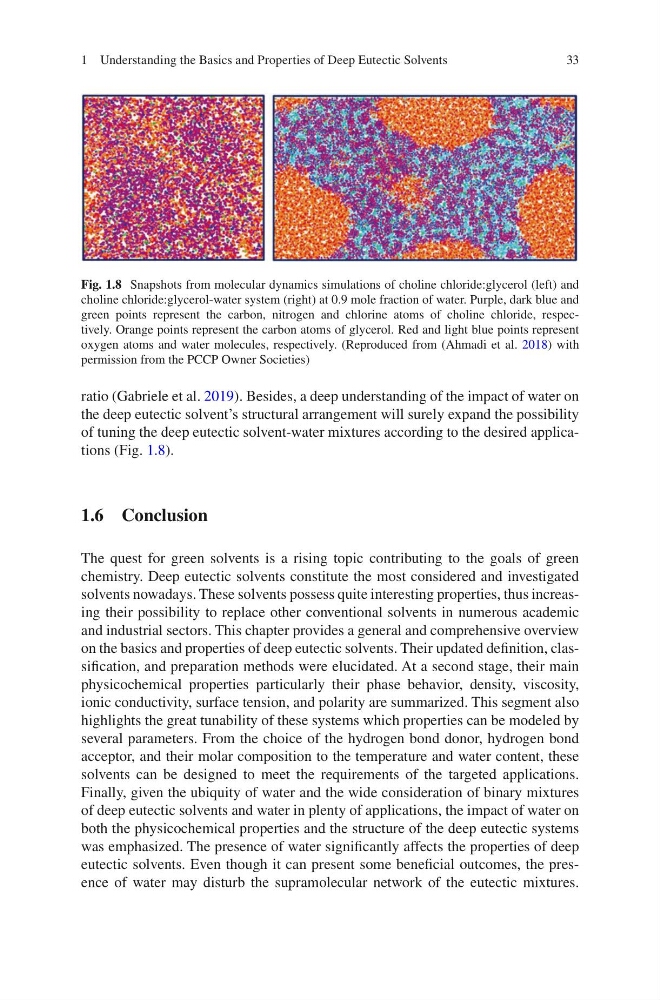
of tuning the deep eutectic solvent-water mixtures according to the desired applications (Fig. 1.8).
1.6 Conclusion
The quest for green solvents is a rising topic contributing to the goals of green
chemistry. Deep eutectic solvents constitute the most considered and investigated
solvents nowadays. These solvents possess quite interesting properties, thus increasing their possibility to replace other conventional solvents in numerous academic
and industrial sectors. This chapter provides a general and comprehensive overview
on the basics and properties of deep eutectic solvents. Their updated definition, classification, and preparation methods were elucidated. At a second stage, their main
physicochemical properties particularly their phase behavior, density, viscosity,
ionic conductivity, surface tension, and polarity are summarized. This segment also
highlights the great tunability of these systems which properties can be modeled by
several parameters. From the choice of the hydrogen bond donor, hydrogen bond
acceptor, and their molar composition to the temperature and water content, these
solvents can be designed to meet the requirements of the targeted applications.
Finally, given the ubiquity of water and the wide consideration of binary mixtures
of deep eutectic solvents and water in plenty of applications, the impact of water on
both the physicochemical properties and the structure of the deep eutectic systems
was emphasized. The presence of water significantly affects the properties of deep
eutectic solvents. Even though it can present some beneficial outcomes, the presence of water may disturb the supramolecular network of the eutectic mixtures.
Fig. 1.8 Snapshots from molecular dynamics simulations of choline chloride:glycerol (left) and
choline chloride:glycerol-water system (right) at 0.9 mole fraction of water. Purple, dark blue and
green points represent the carbon, nitrogen and chlorine atoms of choline chloride, respectively. Orange points represent the carbon atoms of glycerol. Red and light blue points represent
oxygen atoms and water molecules, respectively. (Reproduced from (Ahmadi et al. 2018) with
permission from the PCCP Owner Societies)
1 Understanding the Basics and Properties of Deep Eutectic Solvents
ratio (Gabriele et al. 2019). Besides, a deep understanding of the impact of water on
the deep eutectic solvent’s structural arrangement will surely expand the possibility
of tuning the deep eutectic solvent-water mixtures according to the desired applications (Fig. 1.8).
1.6 Conclusion
The quest for green solvents is a rising topic contributing to the goals of green
chemistry. Deep eutectic solvents constitute the most considered and investigated
solvents nowadays. These solvents possess quite interesting properties, thus increasing their possibility to replace other conventional solvents in numerous academic
and industrial sectors. This chapter provides a general and comprehensive overview
on the basics and properties of deep eutectic solvents. Their updated definition, classification, and preparation methods were elucidated. At a second stage, their main
physicochemical properties particularly their phase behavior, density, viscosity,
ionic conductivity, surface tension, and polarity are summarized. This segment also
highlights the great tunability of these systems which properties can be modeled by
several parameters. From the choice of the hydrogen bond donor, hydrogen bond
acceptor, and their molar composition to the temperature and water content, these
solvents can be designed to meet the requirements of the targeted applications.
Finally, given the ubiquity of water and the wide consideration of binary mixtures
of deep eutectic solvents and water in plenty of applications, the impact of water on
both the physicochemical properties and the structure of the deep eutectic systems
was emphasized. The presence of water significantly affects the properties of deep
eutectic solvents. Even though it can present some beneficial outcomes, the presence of water may disturb the supramolecular network of the eutectic mixtures.
Fig. 1.8 Snapshots from molecular dynamics simulations of choline chloride:glycerol (left) and
choline chloride:glycerol-water system (right) at 0.9 mole fraction of water. Purple, dark blue and
green points represent the carbon, nitrogen and chlorine atoms of choline chloride, respectively. Orange points represent the carbon atoms of glycerol. Red and light blue points represent
oxygen atoms and water molecules, respectively. (Reproduced from (Ahmadi et al. 2018) with
permission from the PCCP Owner Societies)
1 Understanding the Basics and Properties of Deep Eutectic Solvents