

32
Table 1.2 (continued)
Studied system(s)
Water content
Technique(s)
Comments
References
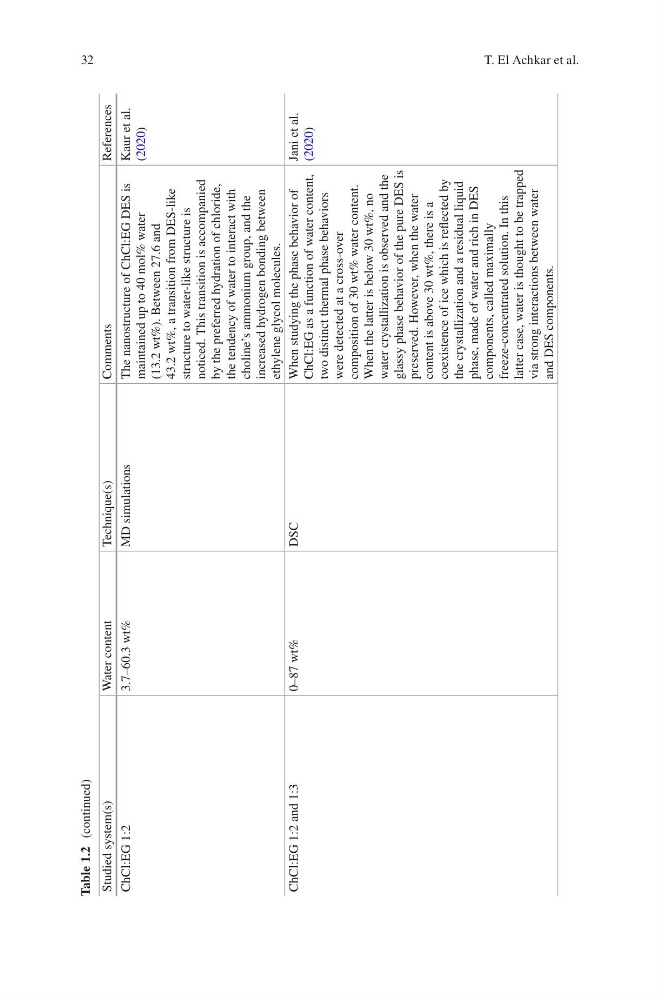
ChCl:EG 1:2
3.7–60.3 wt%
MD simulations
The nanostructure of ChCl:EG DES is
maintained up to 40 mol% water
(13.2 wt%). Between 27.6 and
43.2 wt%, a transition from DES-like
structure to water-like structure is
noticed. This transition is accompanied
by the preferred hydration of chloride,
the tendency of water to interact with
choline’s ammonium group, and the
increased hydrogen bonding between
ethylene glycol molecules.
Kaur et al.
(2020)
ChCl:EG 1:2 and 1:3
0–87 wt%
DSC
When studying the phase behavior of
ChCl:EG as a function of water content,
two distinct thermal phase behaviors
were detected at a cross-over
composition of 30 wt% water content.
When the latter is below 30 wt%, no
water crystallization is observed and the
glassy phase behavior of the pure DES is
preserved. However, when the water
content is above 30 wt%, there is a
coexistence of ice which is reflected by
the crystallization and a residual liquid
phase, made of water and rich in DES
components, called maximally
freeze-concentrated solution. In this
latter case, water is thought to be trapped
via strong interactions between water
and DES components.
Jani et al.
(2020)
T. El Achkar et al.
Table 1.2 (continued)
Studied system(s)
Water content
Technique(s)
Comments
References
ChCl:EG 1:2
3.7–60.3 wt%
MD simulations
The nanostructure of ChCl:EG DES is
maintained up to 40 mol% water
(13.2 wt%). Between 27.6 and
43.2 wt%, a transition from DES-like
structure to water-like structure is
noticed. This transition is accompanied
by the preferred hydration of chloride,
the tendency of water to interact with
choline’s ammonium group, and the
increased hydrogen bonding between
ethylene glycol molecules.
Kaur et al.
(2020)
ChCl:EG 1:2 and 1:3
0–87 wt%
DSC
When studying the phase behavior of
ChCl:EG as a function of water content,
two distinct thermal phase behaviors
were detected at a cross-over
composition of 30 wt% water content.
When the latter is below 30 wt%, no
water crystallization is observed and the
glassy phase behavior of the pure DES is
preserved. However, when the water
content is above 30 wt%, there is a
coexistence of ice which is reflected by
the crystallization and a residual liquid
phase, made of water and rich in DES
components, called maximally
freeze-concentrated solution. In this
latter case, water is thought to be trapped
via strong interactions between water
and DES components.
Jani et al.
(2020)
T. El Achkar et al.