

285
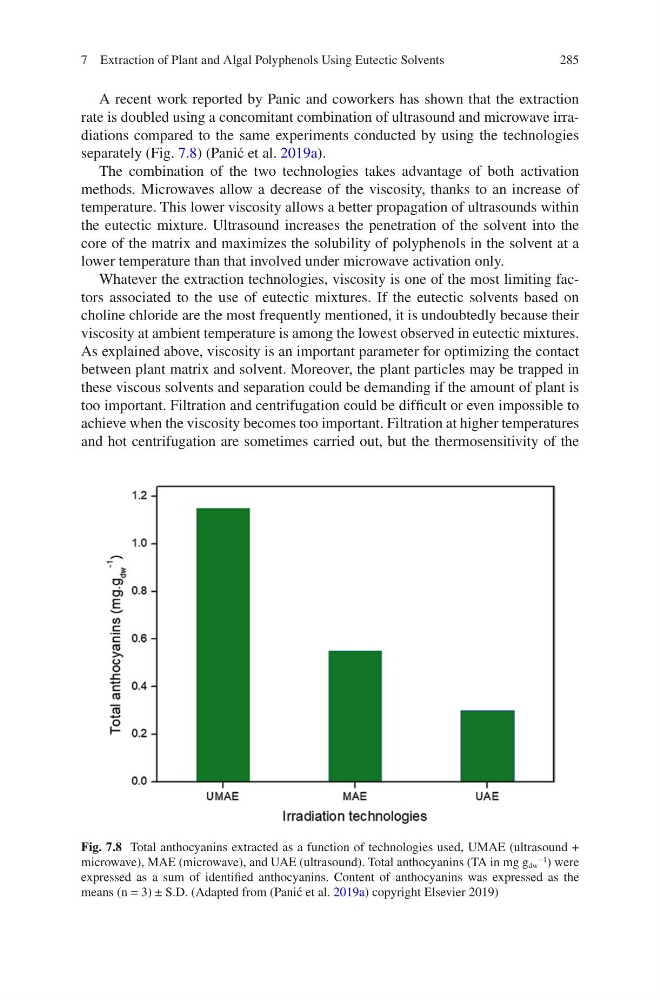
A recent work reported by Panic and coworkers has shown that the extraction
rate is doubled using a concomitant combination of ultrasound and microwave irradiations compared to the same experiments conducted by using the technologies
separately (Fig. 7.8) (Panić et al. 2019a).
The combination of the two technologies takes advantage of both activation
methods. Microwaves allow a decrease of the viscosity, thanks to an increase of
temperature. This lower viscosity allows a better propagation of ultrasounds within
the eutectic mixture. Ultrasound increases the penetration of the solvent into the
core of the matrix and maximizes the solubility of polyphenols in the solvent at a
lower temperature than that involved under microwave activation only.
Whatever the extraction technologies, viscosity is one of the most limiting factors associated to the use of eutectic mixtures. If the eutectic solvents based on
choline chloride are the most frequently mentioned, it is undoubtedly because their
viscosity at ambient temperature is among the lowest observed in eutectic mixtures.
As explained above, viscosity is an important parameter for optimizing the contact
between plant matrix and solvent. Moreover, the plant particles may be trapped in
these viscous solvents and separation could be demanding if the amount of plant is
too important. Filtration and centrifugation could be difficult or even impossible to
achieve when the viscosity becomes too important. Filtration at higher temperatures
and hot centrifugation are sometimes carried out, but the thermosensitivity of the
Fig. 7.8 Total anthocyanins extracted as a function of technologies used, UMAE (ultrasound +
microwave), MAE (microwave), and UAE (ultrasound). Total anthocyanins (TA in mg g dw
−1
) were
expressed as a sum of identified anthocyanins. Content of anthocyanins was expressed as the
means (n = 3) ± S.D. (Adapted from (Panić et al. 2019a) copyright Elsevier 2019)
7 Extraction of Plant and Algal Polyphenols Using Eutectic Solvents
A recent work reported by Panic and coworkers has shown that the extraction
rate is doubled using a concomitant combination of ultrasound and microwave irradiations compared to the same experiments conducted by using the technologies
separately (Fig. 7.8) (Panić et al. 2019a).
The combination of the two technologies takes advantage of both activation
methods. Microwaves allow a decrease of the viscosity, thanks to an increase of
temperature. This lower viscosity allows a better propagation of ultrasounds within
the eutectic mixture. Ultrasound increases the penetration of the solvent into the
core of the matrix and maximizes the solubility of polyphenols in the solvent at a
lower temperature than that involved under microwave activation only.
Whatever the extraction technologies, viscosity is one of the most limiting factors associated to the use of eutectic mixtures. If the eutectic solvents based on
choline chloride are the most frequently mentioned, it is undoubtedly because their
viscosity at ambient temperature is among the lowest observed in eutectic mixtures.
As explained above, viscosity is an important parameter for optimizing the contact
between plant matrix and solvent. Moreover, the plant particles may be trapped in
these viscous solvents and separation could be demanding if the amount of plant is
too important. Filtration and centrifugation could be difficult or even impossible to
achieve when the viscosity becomes too important. Filtration at higher temperatures
and hot centrifugation are sometimes carried out, but the thermosensitivity of the
Fig. 7.8 Total anthocyanins extracted as a function of technologies used, UMAE (ultrasound +
microwave), MAE (microwave), and UAE (ultrasound). Total anthocyanins (TA in mg g dw
−1
) were
expressed as a sum of identified anthocyanins. Content of anthocyanins was expressed as the
means (n = 3) ± S.D. (Adapted from (Panić et al. 2019a) copyright Elsevier 2019)
7 Extraction of Plant and Algal Polyphenols Using Eutectic Solvents