

226
when using deep eutectic solvent containing xylitol compared to those containing
other alcohols because of the high viscosity of the first one. According to the authors,
viscosities of deep eutectic solvents prepared with solid hydrogen bond donors were
higher than those prepared with liquid hydrogen bond donors (Cao et al. 2018). Bi
et al. (2013) showed that the amounts of the flavonoids extracted increased with
decreasing choline chloride/hydrogen bond donor ratio from 1/1 to 1/5 (mol/mol)
due to a decrease in viscosity (Bi et al. 2013). That means that the viscosity decreases
when decreasing choline chloride concentration. However, Abbott et al. (2011)
found the opposite result with choline chloride/glycerol deep eutectic solvent
(Fig. 6.18). For example, at 20 °C, viscosities of this solvent with a choline chloride/
glycerol molar ratio of 1:4, 1:3, and 1:2 were 503, 450, and 376 cP, respectively.
This drastic decrease of the glycerol viscosity upon addition of choline chloride was
attributed to the partial rupture of the intermolecular hydrogen bond network of
glycerol (Abbott et al. 2011). Deep eutectic solvents with a high viscosity are good
for the single-drop microextraction techniques because they facilitate the suspension of the drop at the end of the needle of a microsyringe.
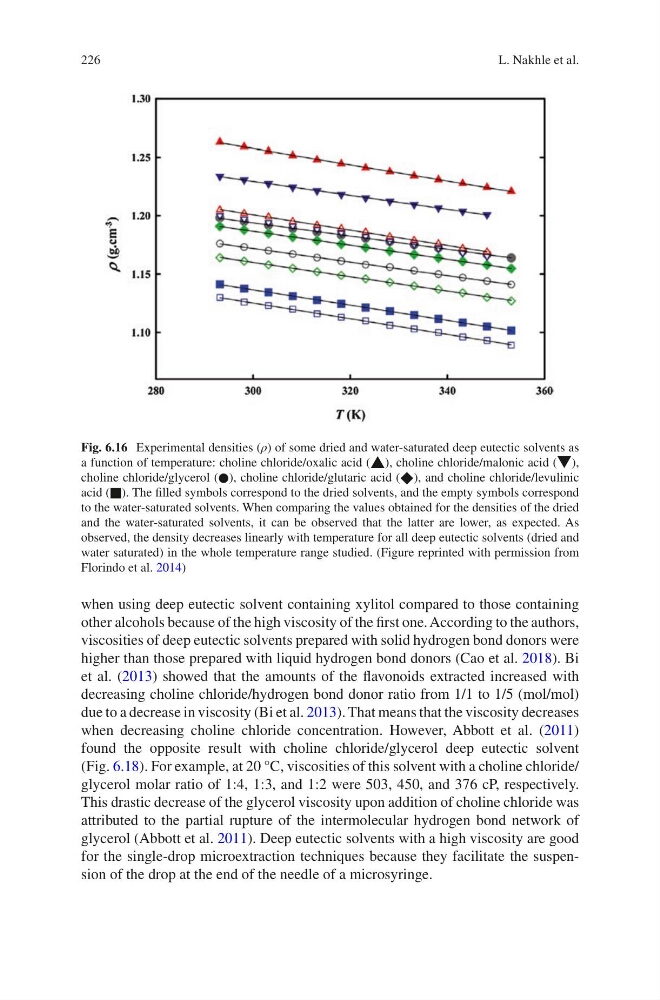
Fig. 6.16 Experimental densities (ρ) of some dried and water-saturated deep eutectic solvents as
a function of temperature: choline chloride/oxalic acid (▲), choline chloride/malonic acid (▼),
choline chloride/glycerol (●), choline chloride/glutaric acid (◆), and choline chloride/levulinic
acid (■). The filled symbols correspond to the dried solvents, and the empty symbols correspond
to the water-saturated solvents. When comparing the values obtained for the densities of the dried
and the water-saturated solvents, it can be observed that the latter are lower, as expected. As
observed, the density decreases linearly with temperature for all deep eutectic solvents (dried and
water saturated) in the whole temperature range studied. (Figure reprinted with permission from
Florindo et al. 2014)
L. Nakhle et al.
when using deep eutectic solvent containing xylitol compared to those containing
other alcohols because of the high viscosity of the first one. According to the authors,
viscosities of deep eutectic solvents prepared with solid hydrogen bond donors were
higher than those prepared with liquid hydrogen bond donors (Cao et al. 2018). Bi
et al. (2013) showed that the amounts of the flavonoids extracted increased with
decreasing choline chloride/hydrogen bond donor ratio from 1/1 to 1/5 (mol/mol)
due to a decrease in viscosity (Bi et al. 2013). That means that the viscosity decreases
when decreasing choline chloride concentration. However, Abbott et al. (2011)
found the opposite result with choline chloride/glycerol deep eutectic solvent
(Fig. 6.18). For example, at 20 °C, viscosities of this solvent with a choline chloride/
glycerol molar ratio of 1:4, 1:3, and 1:2 were 503, 450, and 376 cP, respectively.
This drastic decrease of the glycerol viscosity upon addition of choline chloride was
attributed to the partial rupture of the intermolecular hydrogen bond network of
glycerol (Abbott et al. 2011). Deep eutectic solvents with a high viscosity are good
for the single-drop microextraction techniques because they facilitate the suspension of the drop at the end of the needle of a microsyringe.
Fig. 6.16 Experimental densities (ρ) of some dried and water-saturated deep eutectic solvents as
a function of temperature: choline chloride/oxalic acid (▲), choline chloride/malonic acid (▼),
choline chloride/glycerol (●), choline chloride/glutaric acid (◆), and choline chloride/levulinic
acid (■). The filled symbols correspond to the dried solvents, and the empty symbols correspond
to the water-saturated solvents. When comparing the values obtained for the densities of the dried
and the water-saturated solvents, it can be observed that the latter are lower, as expected. As
observed, the density decreases linearly with temperature for all deep eutectic solvents (dried and
water saturated) in the whole temperature range studied. (Figure reprinted with permission from
Florindo et al. 2014)
L. Nakhle et al.