

204
B; however, other dyes were extracted also with methanol (Wang et al. 2017). Cao
et al. (2018) applied a vortex extraction method for the extraction of proanthocyanidin. Sixteen different deep eutectic solvents were tested, and it was concluded that
organic acid-based deep eutectic solvents were better that alcohol-based ones, and
this was related to the higher polarity of the organic acid-based ones suitable for the
extraction of the hydrophilic proanthocyanidin. Extraction yield with deep eutectic
solvent (22.19 ± 0.71 mg/g) was much higher than those with conventional organic
solvents (70% methanol (7.87 ± 0.21 mg/g), 70% ethanol (7.84 ± 0.10 mg/g), and
70% acetone (13.26 ± 0.54 mg/g)) (Cao et al. 2018).
6.2.5 Heating and Stirring
The heating and stirring method is the simplest one. It is based on the solubilization
of the target analytes in the deep eutectic solvent under heating and stirring conditions (Guo et al. 2013; Das et al. 2016; Bağda et al. 2017; Saravana et al. 2018a, b).
The latter are optimized depending on the target compound (Ribeiro et al. 2013;
Helalat–Nezhad et al. 2015; Athanasiadis et al. 2018). Centrifugation and filtration
steps can be used to separate the deep eutectic solvent phase from the sample solution. Table 6.8 presents examples of the application of heating and stirring extraction technique with deep eutectic solvents as extraction solvents.
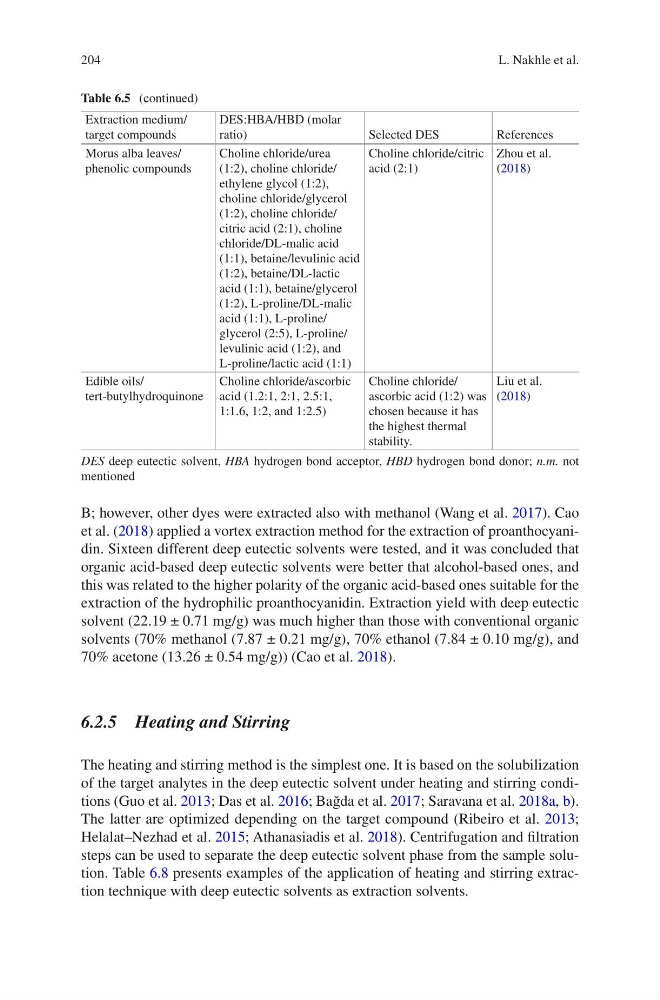
Table 6.5 (continued)
Extraction medium/
target compounds
DES:HBA/HBD (molar
ratio)
Selected DES
References
Morus alba leaves/
phenolic compounds
Choline chloride/urea
(1:2), choline chloride/
ethylene glycol (1:2),
choline chloride/glycerol
(1:2), choline chloride/
citric acid (2:1), choline
chloride/DL-malic acid
(1:1), betaine/levulinic acid
(1:2), betaine/DL-lactic
acid (1:1), betaine/glycerol
(1:2), L-proline/DL-malic
acid (1:1), L-proline/
glycerol (2:5), L-proline/
levulinic acid (1:2), and
L-proline/lactic acid (1:1)
Choline chloride/citric
acid (2:1)
Zhou et al.
(2018)
Edible oils/
tert-butylhydroquinone
Choline chloride/ascorbic
acid (1.2:1, 2:1, 2.5:1,
1:1.6, 1:2, and 1:2.5)
Choline chloride/
ascorbic acid (1:2) was
chosen because it has
the highest thermal
stability.
Liu et al.
(2018)
DES deep eutectic solvent, HBA hydrogen bond acceptor, HBD hydrogen bond donor; n.m. not
mentioned
L. Nakhle et al.
B; however, other dyes were extracted also with methanol (Wang et al. 2017). Cao
et al. (2018) applied a vortex extraction method for the extraction of proanthocyanidin. Sixteen different deep eutectic solvents were tested, and it was concluded that
organic acid-based deep eutectic solvents were better that alcohol-based ones, and
this was related to the higher polarity of the organic acid-based ones suitable for the
extraction of the hydrophilic proanthocyanidin. Extraction yield with deep eutectic
solvent (22.19 ± 0.71 mg/g) was much higher than those with conventional organic
solvents (70% methanol (7.87 ± 0.21 mg/g), 70% ethanol (7.84 ± 0.10 mg/g), and
70% acetone (13.26 ± 0.54 mg/g)) (Cao et al. 2018).
6.2.5 Heating and Stirring
The heating and stirring method is the simplest one. It is based on the solubilization
of the target analytes in the deep eutectic solvent under heating and stirring conditions (Guo et al. 2013; Das et al. 2016; Bağda et al. 2017; Saravana et al. 2018a, b).
The latter are optimized depending on the target compound (Ribeiro et al. 2013;
Helalat–Nezhad et al. 2015; Athanasiadis et al. 2018). Centrifugation and filtration
steps can be used to separate the deep eutectic solvent phase from the sample solution. Table 6.8 presents examples of the application of heating and stirring extraction technique with deep eutectic solvents as extraction solvents.
Table 6.5 (continued)
Extraction medium/
target compounds
DES:HBA/HBD (molar
ratio)
Selected DES
References
Morus alba leaves/
phenolic compounds
Choline chloride/urea
(1:2), choline chloride/
ethylene glycol (1:2),
choline chloride/glycerol
(1:2), choline chloride/
citric acid (2:1), choline
chloride/DL-malic acid
(1:1), betaine/levulinic acid
(1:2), betaine/DL-lactic
acid (1:1), betaine/glycerol
(1:2), L-proline/DL-malic
acid (1:1), L-proline/
glycerol (2:5), L-proline/
levulinic acid (1:2), and
L-proline/lactic acid (1:1)
Choline chloride/citric
acid (2:1)
Zhou et al.
(2018)
Edible oils/
tert-butylhydroquinone
Choline chloride/ascorbic
acid (1.2:1, 2:1, 2.5:1,
1:1.6, 1:2, and 1:2.5)
Choline chloride/
ascorbic acid (1:2) was
chosen because it has
the highest thermal
stability.
Liu et al.
(2018)
DES deep eutectic solvent, HBA hydrogen bond acceptor, HBD hydrogen bond donor; n.m. not
mentioned
L. Nakhle et al.