

192
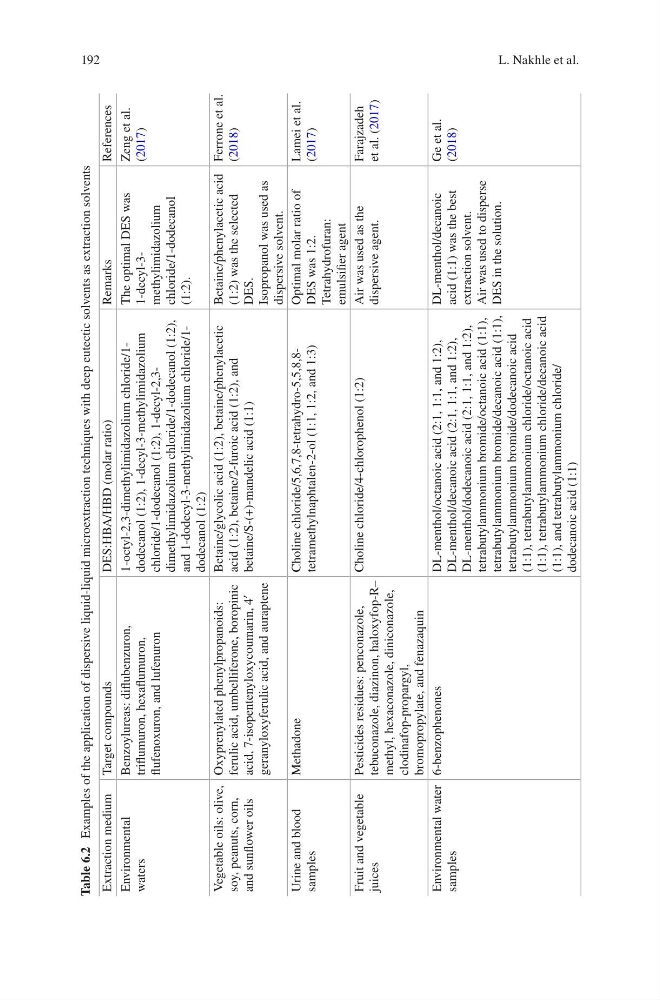
Table 6.2 Examples of the application of dispersive liquid-liquid microextraction techniques with deep eutectic solvents as extraction solvents
Extraction medium Target compounds
DES:HBA/HBD (molar ratio)
Remarks
References
Environmental
waters
Benzoylureas: diflubenzuron,
triflumuron, hexaflumuron,
flufenoxuron, and lufenuron
1-octyl-2,3-dimethylimidazolium chloride/1dodecanol (1:2), 1-decyl-3-methylimidazolium
chloride/1-dodecanol (1:2), 1-decyl-2,3dimethylimidazolium chloride/1-dodecanol (1:2),
and 1-dodecyl-3-methylimidazolium chloride/1dodecanol (1:2)
The optimal DES was
1-decyl-3methylimidazolium
chloride/1-dodecanol
(1:2).
Zeng et al.
(2017)
Vegetable oils: olive,
soy, peanuts, corn,
and sunflower oils
Oxyprenylated phenylpropanoids:
ferulic acid, umbelliferone, boropinic
acid, 7-isopentenyloxycoumarin, 4′
geranyloxyferulic acid, and auraptene
Betaine/glycolic acid (1:2), betaine/phenylacetic
acid (1:2), betaine/2-furoic acid (1:2), and
betaine/S-(+)-mandelic acid (1:1)
Betaine/phenylacetic acid
(1:2) was the selected
DES.
Isopropanol was used as
dispersive solvent.
Ferrone et al.
(2018)
Urine and blood
samples
Methadone
Choline chloride/5,6,7,8-tetrahydro-5,5,8,8tetramethylnaphtalen- 2-ol (1:1, 1:2, and 1:3)
Optimal molar ratio of
DES was 1:2.
Tetrahydrofuran:
emulsifier agent
Lamei et al.
(2017)
Fruit and vegetable
juices
Pesticides residues: penconazole,
tebuconazole, diazinon, haloxyfop-R–
methyl, hexaconazole, diniconazole,
clodinafop-propargyl,
bromopropylate, and fenazaquin
Choline chloride/4-chlorophenol (1:2)
Air was used as the
dispersive agent.
Farajzadeh
et al. (2017)
Environmental water
samples
6-benzophenones
DL-menthol/octanoic acid (2:1, 1:1, and 1:2),
DL-menthol/decanoic acid (2:1, 1:1, and 1:2),
DL-menthol/dodecanoic acid (2:1, 1:1, and 1:2),
tetrabutylammonium bromide/octanoic acid (1:1),
tetrabutylammonium bromide/decanoic acid (1:1),
tetrabutylammonium bromide/dodecanoic acid
(1:1), tetrabutylammonium chloride/octanoic acid
(1:1), tetrabutylammonium chloride/decanoic acid
(1:1), and tetrabutylammonium chloride/
dodecanoic acid (1:1)
DL-menthol/decanoic
acid (1:1) was the best
extraction solvent.
Air was used to disperse
DES in the solution.
Ge et al.
(2018)
L. Nakhle et al.
Table 6.2 Examples of the application of dispersive liquid-liquid microextraction techniques with deep eutectic solvents as extraction solvents
Extraction medium Target compounds
DES:HBA/HBD (molar ratio)
Remarks
References
Environmental
waters
Benzoylureas: diflubenzuron,
triflumuron, hexaflumuron,
flufenoxuron, and lufenuron
1-octyl-2,3-dimethylimidazolium chloride/1dodecanol (1:2), 1-decyl-3-methylimidazolium
chloride/1-dodecanol (1:2), 1-decyl-2,3dimethylimidazolium chloride/1-dodecanol (1:2),
and 1-dodecyl-3-methylimidazolium chloride/1dodecanol (1:2)
The optimal DES was
1-decyl-3methylimidazolium
chloride/1-dodecanol
(1:2).
Zeng et al.
(2017)
Vegetable oils: olive,
soy, peanuts, corn,
and sunflower oils
Oxyprenylated phenylpropanoids:
ferulic acid, umbelliferone, boropinic
acid, 7-isopentenyloxycoumarin, 4′
geranyloxyferulic acid, and auraptene
Betaine/glycolic acid (1:2), betaine/phenylacetic
acid (1:2), betaine/2-furoic acid (1:2), and
betaine/S-(+)-mandelic acid (1:1)
Betaine/phenylacetic acid
(1:2) was the selected
DES.
Isopropanol was used as
dispersive solvent.
Ferrone et al.
(2018)
Urine and blood
samples
Methadone
Choline chloride/5,6,7,8-tetrahydro-5,5,8,8tetramethylnaphtalen- 2-ol (1:1, 1:2, and 1:3)
Optimal molar ratio of
DES was 1:2.
Tetrahydrofuran:
emulsifier agent
Lamei et al.
(2017)
Fruit and vegetable
juices
Pesticides residues: penconazole,
tebuconazole, diazinon, haloxyfop-R–
methyl, hexaconazole, diniconazole,
clodinafop-propargyl,
bromopropylate, and fenazaquin
Choline chloride/4-chlorophenol (1:2)
Air was used as the
dispersive agent.
Farajzadeh
et al. (2017)
Environmental water
samples
6-benzophenones
DL-menthol/octanoic acid (2:1, 1:1, and 1:2),
DL-menthol/decanoic acid (2:1, 1:1, and 1:2),
DL-menthol/dodecanoic acid (2:1, 1:1, and 1:2),
tetrabutylammonium bromide/octanoic acid (1:1),
tetrabutylammonium bromide/decanoic acid (1:1),
tetrabutylammonium bromide/dodecanoic acid
(1:1), tetrabutylammonium chloride/octanoic acid
(1:1), tetrabutylammonium chloride/decanoic acid
(1:1), and tetrabutylammonium chloride/
dodecanoic acid (1:1)
DL-menthol/decanoic
acid (1:1) was the best
extraction solvent.
Air was used to disperse
DES in the solution.
Ge et al.
(2018)
L. Nakhle et al.