

7
related to the structure of phenolic compounds which acted as strong hydrogen
bond donors (Abranches et al. 2019). On another note, two recent studies reported
the use of cyclodextrins, which are nontoxic cyclic oligosaccharides, as hydrogen
bond acceptors resulting in the formation of liquid supramolecular mixtures at room
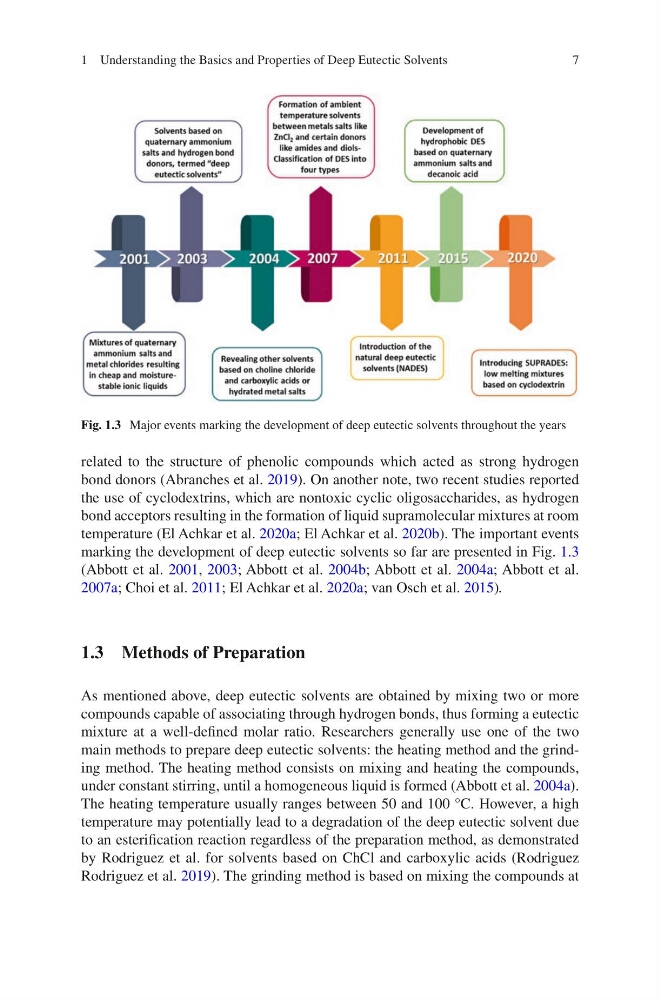
temperature (El Achkar et al. 2020a; El Achkar et al. 2020b). The important events
marking the development of deep eutectic solvents so far are presented in Fig. 1.3
(Abbott et al. 2001, 2003; Abbott et al. 2004b; Abbott et al. 2004a; Abbott et al.
2007a; Choi et al. 2011; El Achkar et al. 2020a; van Osch et al. 2015).
1.3 Methods of Preparation
As mentioned above, deep eutectic solvents are obtained by mixing two or more
compounds capable of associating through hydrogen bonds, thus forming a eutectic
mixture at a well-defined molar ratio. Researchers generally use one of the two
main methods to prepare deep eutectic solvents: the heating method and the grinding method. The heating method consists on mixing and heating the compounds,
under constant stirring, until a homogeneous liquid is formed (Abbott et al. 2004a).
The heating temperature usually ranges between 50 and 100 °C. However, a high
temperature may potentially lead to a degradation of the deep eutectic solvent due
to an esterification reaction regardless of the preparation method, as demonstrated
by Rodriguez et al. for solvents based on ChCl and carboxylic acids (Rodriguez
Rodriguez et al. 2019). The grinding method is based on mixing the compounds at
Fig. 1.3 Major events marking the development of deep eutectic solvents throughout the years
1 Understanding the Basics and Properties of Deep Eutectic Solvents
related to the structure of phenolic compounds which acted as strong hydrogen
bond donors (Abranches et al. 2019). On another note, two recent studies reported
the use of cyclodextrins, which are nontoxic cyclic oligosaccharides, as hydrogen
bond acceptors resulting in the formation of liquid supramolecular mixtures at room
temperature (El Achkar et al. 2020a; El Achkar et al. 2020b). The important events
marking the development of deep eutectic solvents so far are presented in Fig. 1.3
(Abbott et al. 2001, 2003; Abbott et al. 2004b; Abbott et al. 2004a; Abbott et al.
2007a; Choi et al. 2011; El Achkar et al. 2020a; van Osch et al. 2015).
1.3 Methods of Preparation
As mentioned above, deep eutectic solvents are obtained by mixing two or more
compounds capable of associating through hydrogen bonds, thus forming a eutectic
mixture at a well-defined molar ratio. Researchers generally use one of the two
main methods to prepare deep eutectic solvents: the heating method and the grinding method. The heating method consists on mixing and heating the compounds,
under constant stirring, until a homogeneous liquid is formed (Abbott et al. 2004a).
The heating temperature usually ranges between 50 and 100 °C. However, a high
temperature may potentially lead to a degradation of the deep eutectic solvent due
to an esterification reaction regardless of the preparation method, as demonstrated
by Rodriguez et al. for solvents based on ChCl and carboxylic acids (Rodriguez
Rodriguez et al. 2019). The grinding method is based on mixing the compounds at
Fig. 1.3 Major events marking the development of deep eutectic solvents throughout the years
1 Understanding the Basics and Properties of Deep Eutectic Solvents