

173
hydrophobic deep eutectic solvents can be used for the extraction of metal species.
Trioctylphosphine oxide has many uses as an extractant, including primary processing of nuclear materials and treatment of radioactive waste to extract uranyl
([UO 2 ]
2+
) ions (Jianchen and Chongli 2001; Bayliss and Langley 2003), and is usually used as <0.5 M solutions in kerosene or other hydrocarbon diluents. In contrast,
the hydrophobic trioctylphosphine oxide/phenol deep eutectic solvent contains ca.
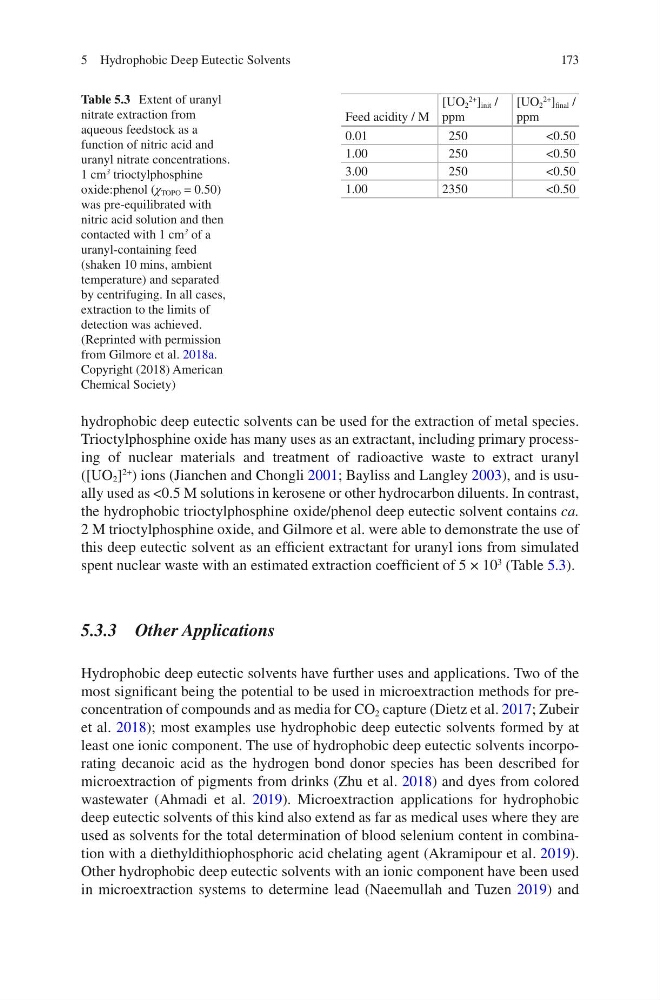
2 M trioctylphosphine oxide, and Gilmore et al. were able to demonstrate the use of
this deep eutectic solvent as an efficient extractant for uranyl ions from simulated
spent nuclear waste with an estimated extraction coefficient of 5 × 10
3
(Table 5.3).
5.3.3 Other Applications
Hydrophobic deep eutectic solvents have further uses and applications. Two of the
most significant being the potential to be used in microextraction methods for preconcentration of compounds and as media for CO 2 capture (Dietz et al. 2017; Zubeir
et al. 2018); most examples use hydrophobic deep eutectic solvents formed by at
least one ionic component. The use of hydrophobic deep eutectic solvents incorporating decanoic acid as the hydrogen bond donor species has been described for
microextraction of pigments from drinks (Zhu et al. 2018) and dyes from colored
wastewater (Ahmadi et al. 2019). Microextraction applications for hydrophobic
deep eutectic solvents of this kind also extend as far as medical uses where they are
used as solvents for the total determination of blood selenium content in combination with a diethyldithiophosphoric acid chelating agent (Akramipour et al. 2019).
Other hydrophobic deep eutectic solvents with an ionic component have been used
in microextraction systems to determine lead (Naeemullah and Tuzen 2019) and
Table 5.3 Extent of uranyl
nitrate extraction from
aqueous feedstock as a
function of nitric acid and
uranyl nitrate concentrations.
1 cm
3 trioctylphosphine
oxide:phenol (χ TOPO = 0.50)
was pre-equilibrated with
nitric acid solution and then
contacted with 1 cm
3 of a
uranyl-containing feed
(shaken 10 mins, ambient
temperature) and separated
by centrifuging. In all cases,
extraction to the limits of
detection was achieved.
(Reprinted with permission
from Gilmore et al. 2018a.
Copyright (2018) American
Chemical Society)
Feed acidity / M
[UO 2
2+ ] init /
ppm
[UO 2
2+ ] final /
ppm
0.01
250
<0.50
1.00
250
<0.50
3.00
250
<0.50
1.00
2350
<0.50
5 Hydrophobic Deep Eutectic Solvents
hydrophobic deep eutectic solvents can be used for the extraction of metal species.
Trioctylphosphine oxide has many uses as an extractant, including primary processing of nuclear materials and treatment of radioactive waste to extract uranyl
([UO 2 ]
2+
) ions (Jianchen and Chongli 2001; Bayliss and Langley 2003), and is usually used as <0.5 M solutions in kerosene or other hydrocarbon diluents. In contrast,
the hydrophobic trioctylphosphine oxide/phenol deep eutectic solvent contains ca.
2 M trioctylphosphine oxide, and Gilmore et al. were able to demonstrate the use of
this deep eutectic solvent as an efficient extractant for uranyl ions from simulated
spent nuclear waste with an estimated extraction coefficient of 5 × 10
3
(Table 5.3).
5.3.3 Other Applications
Hydrophobic deep eutectic solvents have further uses and applications. Two of the
most significant being the potential to be used in microextraction methods for preconcentration of compounds and as media for CO 2 capture (Dietz et al. 2017; Zubeir
et al. 2018); most examples use hydrophobic deep eutectic solvents formed by at
least one ionic component. The use of hydrophobic deep eutectic solvents incorporating decanoic acid as the hydrogen bond donor species has been described for
microextraction of pigments from drinks (Zhu et al. 2018) and dyes from colored
wastewater (Ahmadi et al. 2019). Microextraction applications for hydrophobic
deep eutectic solvents of this kind also extend as far as medical uses where they are
used as solvents for the total determination of blood selenium content in combination with a diethyldithiophosphoric acid chelating agent (Akramipour et al. 2019).
Other hydrophobic deep eutectic solvents with an ionic component have been used
in microextraction systems to determine lead (Naeemullah and Tuzen 2019) and
Table 5.3 Extent of uranyl
nitrate extraction from
aqueous feedstock as a
function of nitric acid and
uranyl nitrate concentrations.
1 cm
3 trioctylphosphine
oxide:phenol (χ TOPO = 0.50)
was pre-equilibrated with
nitric acid solution and then
contacted with 1 cm
3 of a
uranyl-containing feed
(shaken 10 mins, ambient
temperature) and separated
by centrifuging. In all cases,
extraction to the limits of
detection was achieved.
(Reprinted with permission
from Gilmore et al. 2018a.
Copyright (2018) American
Chemical Society)
Feed acidity / M
[UO 2
2+ ] init /
ppm
[UO 2
2+ ] final /
ppm
0.01
250
<0.50
1.00
250
<0.50
3.00
250
<0.50
1.00
2350
<0.50
5 Hydrophobic Deep Eutectic Solvents