

164
formation of a “poor” protic ionic liquid (Yoshizawa et al. 2003; MacFarlane and
Seddon 2007). In the case of hydrophobic deep eutectic solvents, enhancement was
attributed to increased hydrogen bonding ability in the deep eutectic solvent.
Extraction efficiency (Table 5.1) increased with increasing hydrophobicity of the
acids extracted, reaching 38.0, 70.5, and 89.8% for acetic, propionic, and butyric
acids, respectively. However, there was no compelling correlation to the hydrophobicity of the ammonium salt components of the deep eutectic solvents.
Following on from the first studies by Kroon and co-workers (van Osch et al.
2016), and the subsequent identification of different hydrophobic deep eutectic solvent motifs (discussed above), the majority of work has been directed at the use of
hydrophobic deep eutectic solvents as extractants of biomolecules from aqueous
media (Ribeiro et al. 2015; Krízek et al. 2018). The key classes of molecules that
have been explored are listed in Table 5.2.
Hydrophobic deep eutectic solvents based on menthol and natural organic acids
were proposed as solvents to extraction of caffeine, vanillic acid, tetracycline, and
tryptophan, tested as model biomolecules of commercial interest. Unfortunately,
partition coefficients were poorer than the corresponding highest performing
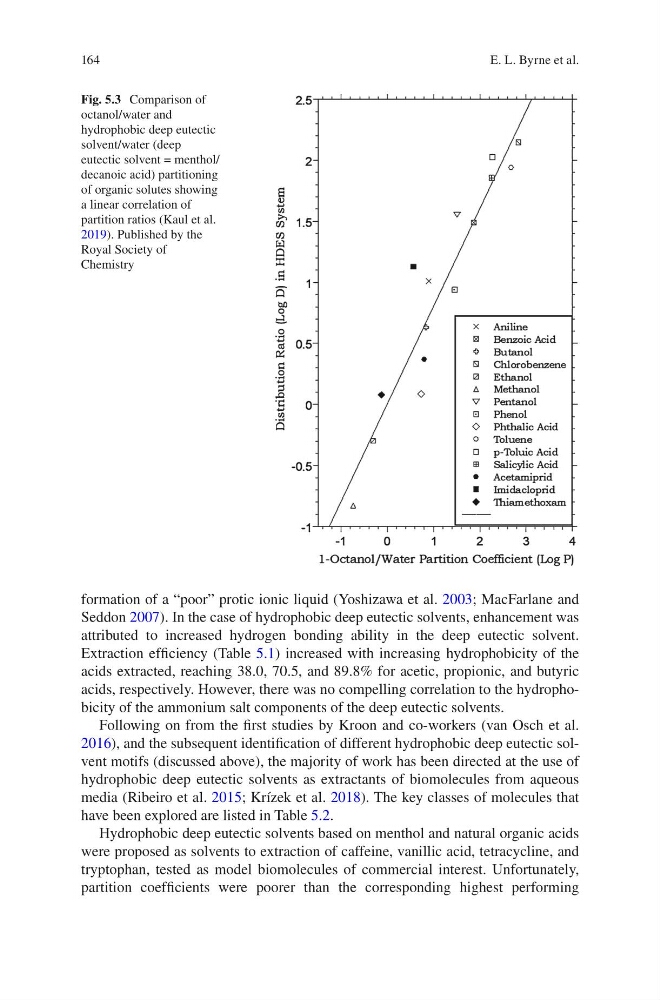
Fig. 5.3 Comparison of
octanol/water and
hydrophobic deep eutectic
solvent/water (deep
eutectic solvent = menthol/
decanoic acid) partitioning
of organic solutes showing
a linear correlation of
partition ratios (Kaul et al.
2019). Published by the
Royal Society of
Chemistry
E. L. Byrne et al.
formation of a “poor” protic ionic liquid (Yoshizawa et al. 2003; MacFarlane and
Seddon 2007). In the case of hydrophobic deep eutectic solvents, enhancement was
attributed to increased hydrogen bonding ability in the deep eutectic solvent.
Extraction efficiency (Table 5.1) increased with increasing hydrophobicity of the
acids extracted, reaching 38.0, 70.5, and 89.8% for acetic, propionic, and butyric
acids, respectively. However, there was no compelling correlation to the hydrophobicity of the ammonium salt components of the deep eutectic solvents.
Following on from the first studies by Kroon and co-workers (van Osch et al.
2016), and the subsequent identification of different hydrophobic deep eutectic solvent motifs (discussed above), the majority of work has been directed at the use of
hydrophobic deep eutectic solvents as extractants of biomolecules from aqueous
media (Ribeiro et al. 2015; Krízek et al. 2018). The key classes of molecules that
have been explored are listed in Table 5.2.
Hydrophobic deep eutectic solvents based on menthol and natural organic acids
were proposed as solvents to extraction of caffeine, vanillic acid, tetracycline, and
tryptophan, tested as model biomolecules of commercial interest. Unfortunately,
partition coefficients were poorer than the corresponding highest performing
Fig. 5.3 Comparison of
octanol/water and
hydrophobic deep eutectic
solvent/water (deep
eutectic solvent = menthol/
decanoic acid) partitioning
of organic solutes showing
a linear correlation of
partition ratios (Kaul et al.
2019). Published by the
Royal Society of
Chemistry
E. L. Byrne et al.