

161
within a similar viscosity range to many ionic liquids such as 1-butyl-3methylimidazolium hexafluorophosphate ([C 4 mim][PF 6 ]) and 1-butyl-3methylimidazolium tetrafluoroborate ([C 4 mim][BF 4 ]) which have viscosities of 371
and 154 mPa s
−1
, respectively, at 20 °C (Seddon et al. 2002).
5.2.3 Losing the Salt, Abandoning the Hydrogen Bond
Acceptor-Hydrogen Bond Donor Strategy
Despite discussions about definitions and nomenclature of what specifically a deep
eutectic solvent is (Francisco et al. 2013; Smith et al. 2014; Silva et al. 2018; Martins
et al. 2019), it can be easily recognized that liquids can be produced by judicious
combination of two components, which leads to melting point depression and formation of a eutectic composition, with a melting point lower than that of either
constituent. Such behavior is entirely normal – in fact, it is typical in two- component
mixtures – and does not require the presence of an organic salt, or explicit hydrogen
bond donor/acceptor pairing. At the same time that Kroon and co-workers were first
describing hydrophobic tetraalkylammonium chloride/decanoic acid deep eutectic
solvents (van Osch et al. 2015), Marrucho and co-workers (Ribeiro et al. 2015)
reported that hydrophobic deep eutectic solvents produced from DL-menthol and
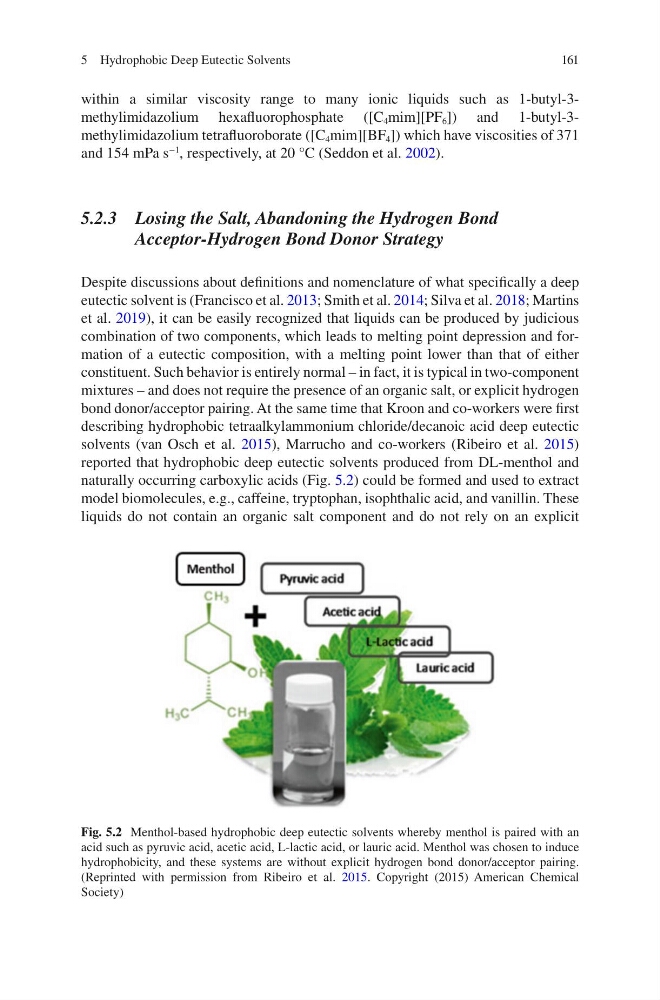
naturally occurring carboxylic acids (Fig. 5.2) could be formed and used to extract
model biomolecules, e.g., caffeine, tryptophan, isophthalic acid, and vanillin. These
liquids do not contain an organic salt component and do not rely on an explicit
Fig. 5.2 Menthol-based hydrophobic deep eutectic solvents whereby menthol is paired with an
acid such as pyruvic acid, acetic acid, L-lactic acid, or lauric acid. Menthol was chosen to induce
hydrophobicity, and these systems are without explicit hydrogen bond donor/acceptor pairing.
(Reprinted with permission from Ribeiro et al. 2015. Copyright (2015) American Chemical
Society)
5 Hydrophobic Deep Eutectic Solvents
within a similar viscosity range to many ionic liquids such as 1-butyl-3methylimidazolium hexafluorophosphate ([C 4 mim][PF 6 ]) and 1-butyl-3methylimidazolium tetrafluoroborate ([C 4 mim][BF 4 ]) which have viscosities of 371
and 154 mPa s
−1
, respectively, at 20 °C (Seddon et al. 2002).
5.2.3 Losing the Salt, Abandoning the Hydrogen Bond
Acceptor-Hydrogen Bond Donor Strategy
Despite discussions about definitions and nomenclature of what specifically a deep
eutectic solvent is (Francisco et al. 2013; Smith et al. 2014; Silva et al. 2018; Martins
et al. 2019), it can be easily recognized that liquids can be produced by judicious
combination of two components, which leads to melting point depression and formation of a eutectic composition, with a melting point lower than that of either
constituent. Such behavior is entirely normal – in fact, it is typical in two- component
mixtures – and does not require the presence of an organic salt, or explicit hydrogen
bond donor/acceptor pairing. At the same time that Kroon and co-workers were first
describing hydrophobic tetraalkylammonium chloride/decanoic acid deep eutectic
solvents (van Osch et al. 2015), Marrucho and co-workers (Ribeiro et al. 2015)
reported that hydrophobic deep eutectic solvents produced from DL-menthol and
naturally occurring carboxylic acids (Fig. 5.2) could be formed and used to extract
model biomolecules, e.g., caffeine, tryptophan, isophthalic acid, and vanillin. These
liquids do not contain an organic salt component and do not rely on an explicit
Fig. 5.2 Menthol-based hydrophobic deep eutectic solvents whereby menthol is paired with an
acid such as pyruvic acid, acetic acid, L-lactic acid, or lauric acid. Menthol was chosen to induce
hydrophobicity, and these systems are without explicit hydrogen bond donor/acceptor pairing.
(Reprinted with permission from Ribeiro et al. 2015. Copyright (2015) American Chemical
Society)
5 Hydrophobic Deep Eutectic Solvents