

160
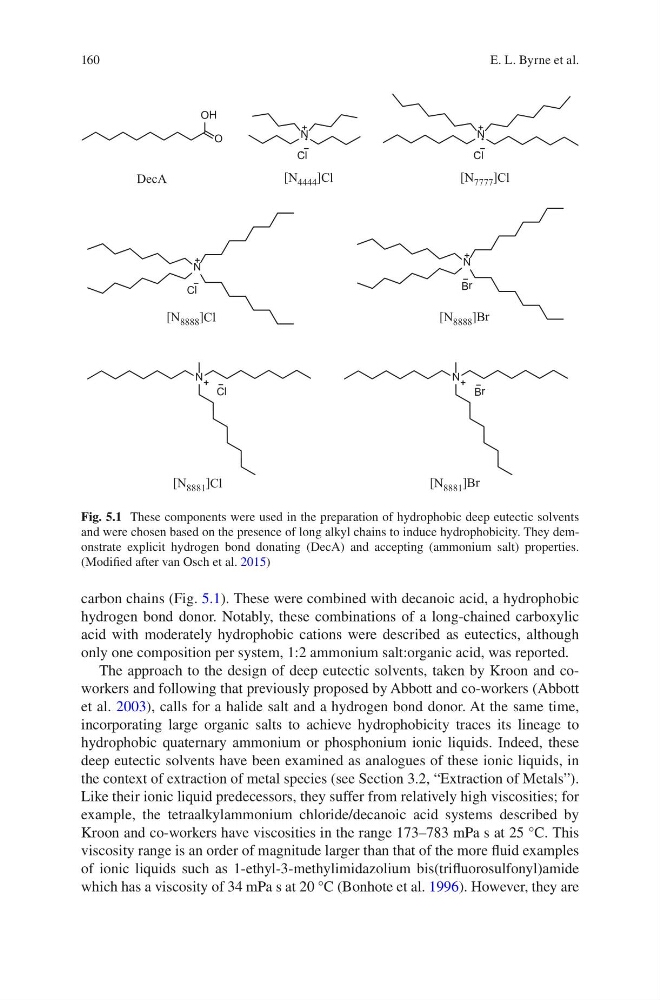
carbon chains (Fig. 5.1). These were combined with decanoic acid, a hydrophobic
hydrogen bond donor. Notably, these combinations of a long-chained carboxylic
acid with moderately hydrophobic cations were described as eutectics, although
only one composition per system, 1:2 ammonium salt:organic acid, was reported.
The approach to the design of deep eutectic solvents, taken by Kroon and coworkers and following that previously proposed by Abbott and co-workers (Abbott
et al. 2003), calls for a halide salt and a hydrogen bond donor. At the same time,
incorporating large organic salts to achieve hydrophobicity traces its lineage to
hydrophobic quaternary ammonium or phosphonium ionic liquids. Indeed, these
deep eutectic solvents have been examined as analogues of these ionic liquids, in
the context of extraction of metal species (see Section 3.2, “Extraction of Metals”).
Like their ionic liquid predecessors, they suffer from relatively high viscosities; for
example, the tetraalkylammonium chloride/decanoic acid systems described by
Kroon and co-workers have viscosities in the range 173–783 mPa s at 25 °C. This
viscosity range is an order of magnitude larger than that of the more fluid examples
of ionic liquids such as 1-ethyl-3-methylimidazolium bis(trifluorosulfonyl)amide
which has a viscosity of 34 mPa s at 20 °C (Bonhote et al. 1996). However, they are
OH
O
N
Cl
N
Cl
DecA
[N 4444 ]Cl
[N 7777 ]Cl
N
Cl
[N 8888 ]Cl
N
[N 8888 ]Br
Br
N
Cl
[N 8881 ]Cl
N
[N 8881 ]Br
Br
Fig. 5.1 These components were used in the preparation of hydrophobic deep eutectic solvents
and were chosen based on the presence of long alkyl chains to induce hydrophobicity. They demonstrate explicit hydrogen bond donating (DecA) and accepting (ammonium salt) properties.
(Modified after van Osch et al. 2015)
E. L. Byrne et al.
carbon chains (Fig. 5.1). These were combined with decanoic acid, a hydrophobic
hydrogen bond donor. Notably, these combinations of a long-chained carboxylic
acid with moderately hydrophobic cations were described as eutectics, although
only one composition per system, 1:2 ammonium salt:organic acid, was reported.
The approach to the design of deep eutectic solvents, taken by Kroon and coworkers and following that previously proposed by Abbott and co-workers (Abbott
et al. 2003), calls for a halide salt and a hydrogen bond donor. At the same time,
incorporating large organic salts to achieve hydrophobicity traces its lineage to
hydrophobic quaternary ammonium or phosphonium ionic liquids. Indeed, these
deep eutectic solvents have been examined as analogues of these ionic liquids, in
the context of extraction of metal species (see Section 3.2, “Extraction of Metals”).
Like their ionic liquid predecessors, they suffer from relatively high viscosities; for
example, the tetraalkylammonium chloride/decanoic acid systems described by
Kroon and co-workers have viscosities in the range 173–783 mPa s at 25 °C. This
viscosity range is an order of magnitude larger than that of the more fluid examples
of ionic liquids such as 1-ethyl-3-methylimidazolium bis(trifluorosulfonyl)amide
which has a viscosity of 34 mPa s at 20 °C (Bonhote et al. 1996). However, they are
OH
O
N
Cl
N
Cl
DecA
[N 4444 ]Cl
[N 7777 ]Cl
N
Cl
[N 8888 ]Cl
N
[N 8888 ]Br
Br
N
Cl
[N 8881 ]Cl
N
[N 8881 ]Br
Br
Fig. 5.1 These components were used in the preparation of hydrophobic deep eutectic solvents
and were chosen based on the presence of long alkyl chains to induce hydrophobicity. They demonstrate explicit hydrogen bond donating (DecA) and accepting (ammonium salt) properties.
(Modified after van Osch et al. 2015)
E. L. Byrne et al.