

122
3.3.3 Future Perspectives
The THEDES could be used as a single mixture, providing higher dissolution rates
of the API and enhancement of solubility, permeability, and absorption through tissues, or they can be incorporated in suitable polymer to potentiate the efficiency of
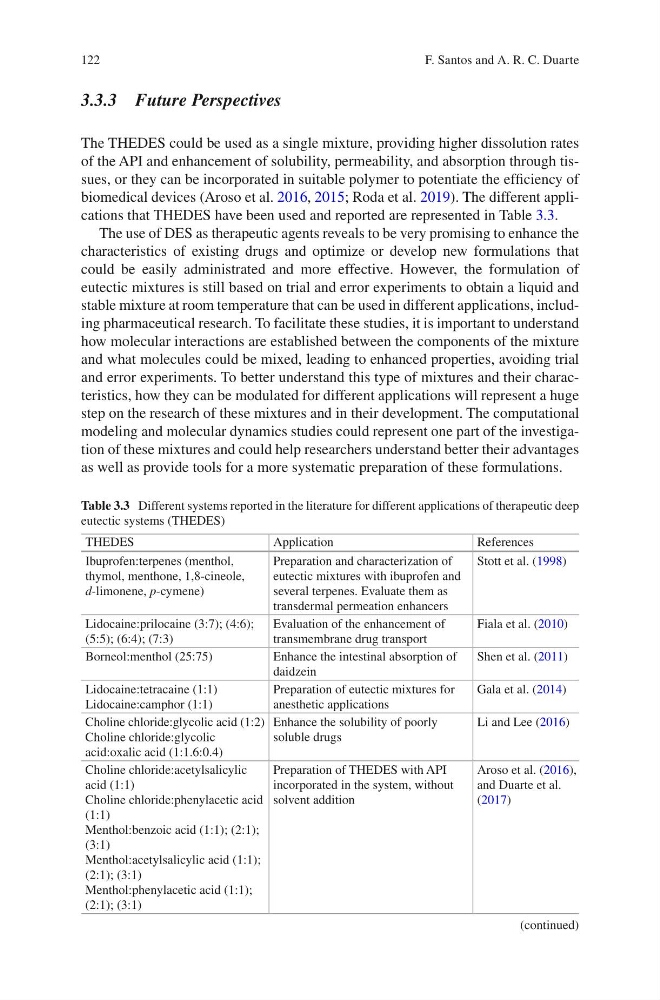
biomedical devices (Aroso et al. 2016, 2015; Roda et al. 2019). The different applications that THEDES have been used and reported are represented in Table 3.3.
The use of DES as therapeutic agents reveals to be very promising to enhance the
characteristics of existing drugs and optimize or develop new formulations that
could be easily administrated and more effective. However, the formulation of
eutectic mixtures is still based on trial and error experiments to obtain a liquid and
stable mixture at room temperature that can be used in different applications, including pharmaceutical research. To facilitate these studies, it is important to understand
how molecular interactions are established between the components of the mixture
and what molecules could be mixed, leading to enhanced properties, avoiding trial
and error experiments. To better understand this type of mixtures and their characteristics, how they can be modulated for different applications will represent a huge
step on the research of these mixtures and in their development. The computational
modeling and molecular dynamics studies could represent one part of the investigation of these mixtures and could help researchers understand better their advantages
as well as provide tools for a more systematic preparation of these formulations.
Table 3.3 Different systems reported in the literature for different applications of therapeutic deep
eutectic systems (THEDES)
THEDES
Application
References
Ibuprofen:terpenes (menthol,
thymol, menthone, 1,8-cineole,
d-limonene, p-cymene)
Preparation and characterization of
eutectic mixtures with ibuprofen and
several terpenes. Evaluate them as
transdermal permeation enhancers
Stott et al. (1998)
Lidocaine:prilocaine (3:7); (4:6);
(5:5); (6:4); (7:3)
Evaluation of the enhancement of
transmembrane drug transport
Fiala et al. (2010)
Borneol:menthol (25:75)
Enhance the intestinal absorption of
daidzein
Shen et al. (2011)
Lidocaine:tetracaine (1:1)
Lidocaine:camphor (1:1)
Preparation of eutectic mixtures for
anesthetic applications
Gala et al. (2014)
Choline chloride:glycolic acid (1:2)
Choline chloride:glycolic
acid:oxalic acid (1:1.6:0.4)
Enhance the solubility of poorly
soluble drugs
Li and Lee (2016)
Choline chloride:acetylsalicylic
acid (1:1)
Choline chloride:phenylacetic acid
(1:1)
Menthol:benzoic acid (1:1); (2:1);
(3:1)
Menthol:acetylsalicylic acid (1:1);
(2:1); (3:1)
Menthol:phenylacetic acid (1:1);
(2:1); (3:1)
Preparation of THEDES with API
incorporated in the system, without
solvent addition
Aroso et al. (2016),
and Duarte et al.
(2017)
(continued)
F. Santos and A. R. C. Duarte
3.3.3 Future Perspectives
The THEDES could be used as a single mixture, providing higher dissolution rates
of the API and enhancement of solubility, permeability, and absorption through tissues, or they can be incorporated in suitable polymer to potentiate the efficiency of
biomedical devices (Aroso et al. 2016, 2015; Roda et al. 2019). The different applications that THEDES have been used and reported are represented in Table 3.3.
The use of DES as therapeutic agents reveals to be very promising to enhance the
characteristics of existing drugs and optimize or develop new formulations that
could be easily administrated and more effective. However, the formulation of
eutectic mixtures is still based on trial and error experiments to obtain a liquid and
stable mixture at room temperature that can be used in different applications, including pharmaceutical research. To facilitate these studies, it is important to understand
how molecular interactions are established between the components of the mixture
and what molecules could be mixed, leading to enhanced properties, avoiding trial
and error experiments. To better understand this type of mixtures and their characteristics, how they can be modulated for different applications will represent a huge
step on the research of these mixtures and in their development. The computational
modeling and molecular dynamics studies could represent one part of the investigation of these mixtures and could help researchers understand better their advantages
as well as provide tools for a more systematic preparation of these formulations.
Table 3.3 Different systems reported in the literature for different applications of therapeutic deep
eutectic systems (THEDES)
THEDES
Application
References
Ibuprofen:terpenes (menthol,
thymol, menthone, 1,8-cineole,
d-limonene, p-cymene)
Preparation and characterization of
eutectic mixtures with ibuprofen and
several terpenes. Evaluate them as
transdermal permeation enhancers
Stott et al. (1998)
Lidocaine:prilocaine (3:7); (4:6);
(5:5); (6:4); (7:3)
Evaluation of the enhancement of
transmembrane drug transport
Fiala et al. (2010)
Borneol:menthol (25:75)
Enhance the intestinal absorption of
daidzein
Shen et al. (2011)
Lidocaine:tetracaine (1:1)
Lidocaine:camphor (1:1)
Preparation of eutectic mixtures for
anesthetic applications
Gala et al. (2014)
Choline chloride:glycolic acid (1:2)
Choline chloride:glycolic
acid:oxalic acid (1:1.6:0.4)
Enhance the solubility of poorly
soluble drugs
Li and Lee (2016)
Choline chloride:acetylsalicylic
acid (1:1)
Choline chloride:phenylacetic acid
(1:1)
Menthol:benzoic acid (1:1); (2:1);
(3:1)
Menthol:acetylsalicylic acid (1:1);
(2:1); (3:1)
Menthol:phenylacetic acid (1:1);
(2:1); (3:1)
Preparation of THEDES with API
incorporated in the system, without
solvent addition
Aroso et al. (2016),
and Duarte et al.
(2017)
(continued)
F. Santos and A. R. C. Duarte