

113
evaporation of water from an aqueous solution. The components are dissolved in an
excess of water and then evaporated at approximately 50 °C in a rotary evaporator;
the obtained liquid is then placed in a desiccator to dry, with silica gel until constant
weight is reached (Dai et al. 2013; Liu et al. 2018a, b; Owczarek et al. 2016; Santana
et al. 2019; Meneses et sal. 2019). Other method used is freeze-drying and consists
in the preparation of an aqueous solution of each component as in evaporation
method, but in this method, the resulting solution is freeze-dried to form a clear
viscous liquid (Gutiérrez et al. 2009; Owczarek et al. 2016; Santana et al. 2019;
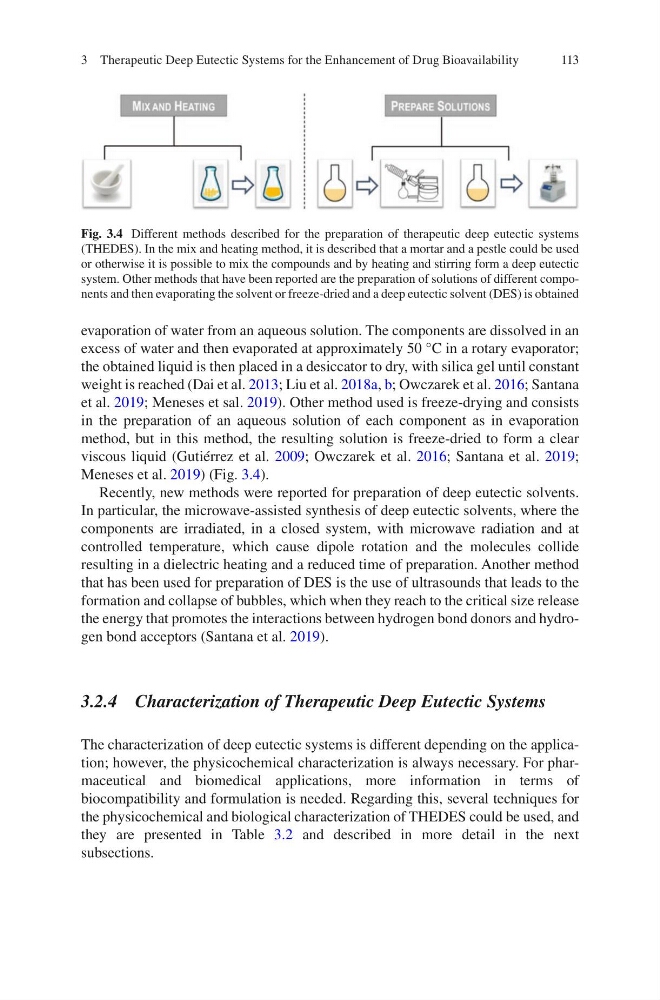
Meneses et al. 2019) (Fig. 3.4).
Recently, new methods were reported for preparation of deep eutectic solvents.
In particular, the microwave-assisted synthesis of deep eutectic solvents, where the
components are irradiated, in a closed system, with microwave radiation and at
controlled temperature, which cause dipole rotation and the molecules collide
resulting in a dielectric heating and a reduced time of preparation. Another method
that has been used for preparation of DES is the use of ultrasounds that leads to the
formation and collapse of bubbles, which when they reach to the critical size release
the energy that promotes the interactions between hydrogen bond donors and hydrogen bond acceptors (Santana et al. 2019).
3.2.4 Characterization of Therapeutic Deep Eutectic Systems
The characterization of deep eutectic systems is different depending on the application; however, the physicochemical characterization is always necessary. For pharmaceutical and biomedical applications, more information in terms of
biocompatibility and formulation is needed. Regarding this, several techniques for
the physicochemical and biological characterization of THEDES could be used, and
they are presented in Table 3.2 and described in more detail in the next
subsections.
Fig. 3.4 Different methods described for the preparation of therapeutic deep eutectic systems
(THEDES). In the mix and heating method, it is described that a mortar and a pestle could be used
or otherwise it is possible to mix the compounds and by heating and stirring form a deep eutectic
system. Other methods that have been reported are the preparation of solutions of different components and then evaporating the solvent or freeze-dried and a deep eutectic solvent (DES) is obtained
3 Therapeutic Deep Eutectic Systems for the Enhancement of Drug Bioavailability
evaporation of water from an aqueous solution. The components are dissolved in an
excess of water and then evaporated at approximately 50 °C in a rotary evaporator;
the obtained liquid is then placed in a desiccator to dry, with silica gel until constant
weight is reached (Dai et al. 2013; Liu et al. 2018a, b; Owczarek et al. 2016; Santana
et al. 2019; Meneses et sal. 2019). Other method used is freeze-drying and consists
in the preparation of an aqueous solution of each component as in evaporation
method, but in this method, the resulting solution is freeze-dried to form a clear
viscous liquid (Gutiérrez et al. 2009; Owczarek et al. 2016; Santana et al. 2019;
Meneses et al. 2019) (Fig. 3.4).
Recently, new methods were reported for preparation of deep eutectic solvents.
In particular, the microwave-assisted synthesis of deep eutectic solvents, where the
components are irradiated, in a closed system, with microwave radiation and at
controlled temperature, which cause dipole rotation and the molecules collide
resulting in a dielectric heating and a reduced time of preparation. Another method
that has been used for preparation of DES is the use of ultrasounds that leads to the
formation and collapse of bubbles, which when they reach to the critical size release
the energy that promotes the interactions between hydrogen bond donors and hydrogen bond acceptors (Santana et al. 2019).
3.2.4 Characterization of Therapeutic Deep Eutectic Systems
The characterization of deep eutectic systems is different depending on the application; however, the physicochemical characterization is always necessary. For pharmaceutical and biomedical applications, more information in terms of
biocompatibility and formulation is needed. Regarding this, several techniques for
the physicochemical and biological characterization of THEDES could be used, and
they are presented in Table 3.2 and described in more detail in the next
subsections.
Fig. 3.4 Different methods described for the preparation of therapeutic deep eutectic systems
(THEDES). In the mix and heating method, it is described that a mortar and a pestle could be used
or otherwise it is possible to mix the compounds and by heating and stirring form a deep eutectic
system. Other methods that have been reported are the preparation of solutions of different components and then evaporating the solvent or freeze-dried and a deep eutectic solvent (DES) is obtained
3 Therapeutic Deep Eutectic Systems for the Enhancement of Drug Bioavailability